📌 As of 3 July 2026 — a point-in-time view. Financials corrected 30 Aug 2026.
✏️ Corrected 30 Aug 2026 — this report’s annual financial table was wrong, and it was wrong in the direction that mattered most: it showed profits rising when they were falling.
| Item | As published | Audited (연결) |
|---|---|---|
| Revenue FY2024 / FY2025 | ₩17.0tn / ₩17.5tn | ₩16.233tn / ₩17.058tn |
| Operating profit FY2024 | ₩1.40tn | ₩1.018tn |
| Operating profit FY2025 | ₩1.60tn (+14.3%) | ₩0.763tn (−25.0%) |
| Net income FY2024 | ₩0.80tn | ₩0.395tn consolidated / ₩0.111tn to owners |
| Net income FY2025 | ₩0.90tn | ₩0.205tn consolidated / ₩0.085tn to owners |
The direction was reversed. The article reported operating profit rising 14.3% and built a narrative on top of it — “margins expand toward 11.5%.” Operating profit actually fell 25.0%, and the operating margin has compressed for three consecutive years: 8.34% → 6.27% → 4.47%. Basic EPS fell from ₩174 to ₩132. Every paragraph that rested on the margin-expansion premise has been rewritten.
Six further factual corrections, all against the Q1 2026 quarterly report: the Czech contract is for Dukovany Units 5 & 6, not 7 & 8. The order backlog is ₩26.768tn consolidated (₩24.660tn for the Doosan Enerbility segment alone), not ₩24.1tn — and the conclusion’s ₩24.5tn contradicted the body’s own figure. Doosan is not yet fabricating NuScale reactor pressure vessels; the filing describes material fabrication followed by sales activity to win equipment-manufacturing orders. X-energy and TerraPower are not named anywhere in the filing — nor is Rolls-Royce SMR — so those names are removed. “KEPO” was a typo for KEPCO. And the forward P/E of 18.5x is only reconstructable from the stale second share price of ₩41,500 that also appeared in the price box (17.7× on the article’s own 2026 estimate), not from the ₩86,200 price it was printed beside (36.8×).
Second pass, 30 Aug 2026 — a re-check of this correction found two more things. First, one of the “capability statements you can verify” was not in the filings at all: the 17,000-tonne forging press at Changwon appears in neither the FY2025 annual report nor the Q1 2026 quarterly report. The figure is real and publicly stated, but it is a company statement carried by trade press rather than a disclosure — it is now labelled as such, and the filing’s own forging capacity and utilisation figures stand in its place. Second, the original price box carried two target prices (₩125,000 and a stale ₩62,000) as well as the two share prices; the first pass disclosed the duplicate price but not the duplicate target. Both are now disclosed in the box below. No financial-statement figure changed in this pass.
What was checked and found correct: the Q1 2026 table’s revenue of ₩4,261,130 million, operating profit of ₩233,514 million, and the +13.67% / +63.90% year-on-year figures all match the filing exactly and are unchanged. Sources: DART rcpNo 20260320001246 (FY2025 annual report) and rcpNo 20260514001269 (Q1 2026 quarterly report). See our corrections policy.
- 📉 The income statement has been going the wrong way. The consolidated operating margin compressed three years running — 8.34% (FY2023) → 6.27% (FY2024) → 4.47% (FY2025) — and FY2025 revenue is still below FY2023. (Source: DART rcpNo 20260320001246)
- 📈 The order book has been going the right way. Remaining performance obligations rose from ₩18.934tn at end-Q1 2025 to ₩26.768tn at end-Q1 2026, up 41.4%. The nuclear renaissance is visible in the backlog, not yet in the profit.
- 🧾 Almost none of the profit reaches the parent’s shareholders. Minority holders of the consolidated subsidiaries took 58.7% of FY2025 net income and 98.7% of Q1 2026’s. Profit attributable to owners was ₩84.8bn for the whole of FY2025 — basic EPS of ₩132.
- 🇨🇿 The Czech award is real and barely started. The Dukovany 5 & 6 NSSS contract is ₩4.983tn running to April 2038, and was 5.33% delivered at 31 March 2026.
📌 Point-in-time record — 3 July 2026. Not a live quote.
Share price at time of writing: ₩86,200 — the KRX settled close on 3 July 2026, the last trading day before this report was published (Source: KRX). Shares in issue: 640,561,146 → market capitalisation of about ₩55.2tn at that price. A second price of ₩41,500 appeared in the original box; it was stale and has been removed.
Target price as originally published: ₩125,000 — retained for the record and withdrawn as a view. It rested on an earnings trajectory that ran in the opposite direction to the audited accounts. We have not issued a replacement, and the original “upside potential” line has been removed because it was arithmetic on a withdrawn number. A second target of ₩62,000 appeared beside it in the original box; like the ₩41,500 price it was stale, and it has been removed.
Original market report: 3 July 2026. Financials corrected 30 August 2026.
Doosan Enerbility Valuation: Nuclear Renaissance and SMR Manufacturing Leadership
Doosan Enerbility (KRX: 034020), formerly Doosan Heavy Industries & Construction, is South Korea’s leading heavy industrial company and the country’s sole manufacturer of nuclear steam supply systems. It has pivoted away from coal-fired power toward large-scale nuclear reactors, Small Modular Reactors (SMRs), gas turbines, and wind.
The investment question is not whether the orders are coming — they demonstrably are. It is when they reach the income statement, and how much of that arrives at the parent company’s shareholders rather than at the minority holders of its listed subsidiaries. On the audited numbers, neither has happened yet.
📊 How Is Doosan Enerbility Actually Performing?
In Q1 2026 the company posted revenue of ₩4,261,130 million (up 13.67% year on year) and operating profit of ₩233,514 million (up 63.90%) — a genuine operating inflection after three years of margin compression, but one that had not yet reached the bottom line: profit attributable to owners was ₩758 million and basic EPS was ₩1.
| Metric (Q1 2026, consolidated) | Value | YoY |
|---|---|---|
| Revenue | ₩4.261tn | +13.67% |
| Operating profit | ₩233.5bn | +63.90% |
| New orders (energy segment) | ₩2.79tn | +61.9% * |
| Remaining performance obligations — consolidated (corrected) | ₩26.768tn | +41.4% |
| — of which Doosan Enerbility segment | ₩24.660tn | +51.5% |
| Net income — consolidated (added) | ₩60.2bn | — |
| — attributable to owners (added) | ₩0.758bn | — |
| Basic EPS (added) | ₩1 | — |
Source: DART Q1 2026 quarterly report, rcpNo 20260514001269, filed 14 May 2026. The revenue and operating-profit rows and their year-on-year percentages are as originally published and were re-verified against the filing without change. The backlog row is corrected: the filing’s remaining-performance-obligation table shows ₩24,660,023 million for the Doosan Enerbility segment, ₩1,869,163 million for Doosan Bobcat and ₩238,392 million for Doosan Fuel Cell, totalling ₩26,767,578 million; the comparable prior-year figures are ₩16,275,610 million and ₩18,933,615 million, which is where the +51.5% and +41.4% come from. Net income and EPS rows are newly added from the same filing. * We could not locate the “new orders ₩2.79tn, +61.9%” line in the quarterly report’s own tables and have not been able to verify it; it is retained as originally published and flagged as company-reported rather than filing-confirmed.
📈 What Do the Annual Financials Show?
Three consecutive years of margin compression on roughly flat revenue — the opposite of what the original version of this article reported.
| Consolidated (연결재무제표) | FY2023 | FY2024 | FY2025 |
|---|---|---|---|
| 매출액 Revenue | ₩17.590tn | ₩16.233tn | ₩17.058tn |
| 영업이익 Operating profit | ₩1.467tn | ₩1.018tn | ₩0.763tn |
| Operating margin (computed) | 8.34% | 6.27% | 4.47% |
| 당기순이익 Net income (total) | ₩0.518tn | ₩0.395tn | ₩0.205tn |
| — 지배기업 소유주지분 attributable to owners | ₩0.056tn | ₩0.111tn | ₩0.085tn |
| — 비지배지분 non-controlling interests | ₩0.462tn | ₩0.283tn | ₩0.120tn |
| 기본주당이익 Basic EPS | ₩87 | ₩174 | ₩132 |
| 자본총계 Total equity | ₩10.842tn | ₩11.661tn | ₩12.009tn |
| — 비지배지분 non-controlling interests | ₩3.724tn | ₩4.165tn | ₩4.224tn |
Source: DART annual report FY2025, rcpNo 20260320001246, filed 20 Mar 2026 — consolidated (연결) statements. Figures are quoted in the filing’s own currency and units. Operating margin computed by us. Equity attributable to owners is total equity less non-controlling interests: ₩7.786tn at FY2025. The original “2026 (Est.)” column has been removed rather than re-estimated: it projected ₩2.20tn of operating profit and an 11.5% margin from a FY2025 base that was itself overstated by more than double, and we do not publish replacement forecasts inside a correction.
Why Margins Have Been Falling, Not Rising
Doosan Enerbility is a project business. Revenue and margin in any given year come from the mix of contracts progressing through their construction schedules — not from the contracts just signed. Three things show up in the numbers above.
First, revenue has not grown. FY2025 revenue of ₩17.058tn is still 3.0% below FY2023’s ₩17.590tn. Whatever is happening in the order book has not yet reached the top line.
Second, the margin has compressed in each of the last two years, from 8.34% to 6.27% to 4.47%. On a standalone (별도) basis the parent entity fared better — ₩496.0bn of operating profit on ₩7.117tn of revenue in FY2025, a 6.97% margin — so a meaningful part of the consolidated compression comes from the subsidiaries rather than from the parent’s own nuclear and turbine business.
Third, and most consequential for a shareholder: the split. Of FY2025’s ₩205.2bn of consolidated net income, ₩120.4bn went to non-controlling interests and ₩84.8bn to Doosan Enerbility’s own shareholders — 58.7% and 41.3%. Non-controlling interests also hold ₩4.224tn of the ₩12.009tn of consolidated equity, or 35.2%. The consolidated income statement describes a group that includes Doosan Bobcat and Doosan Fuel Cell; the per-share figures describe what is left after those companies’ outside shareholders are paid.
⚠️ The original article said Doosan’s capacity utilisation was “approaching optimal” and that fixed-cost dilution would push margins “from historical single digits toward 11.5% in 2026.” Both halves were wrong. Margins were in the single digits and falling, not climbing toward 11.5%; and revenue — the denominator that dilutes fixed cost — was roughly flat across three years. The passage has been removed rather than adjusted, because there was no version of it that the accounts supported.
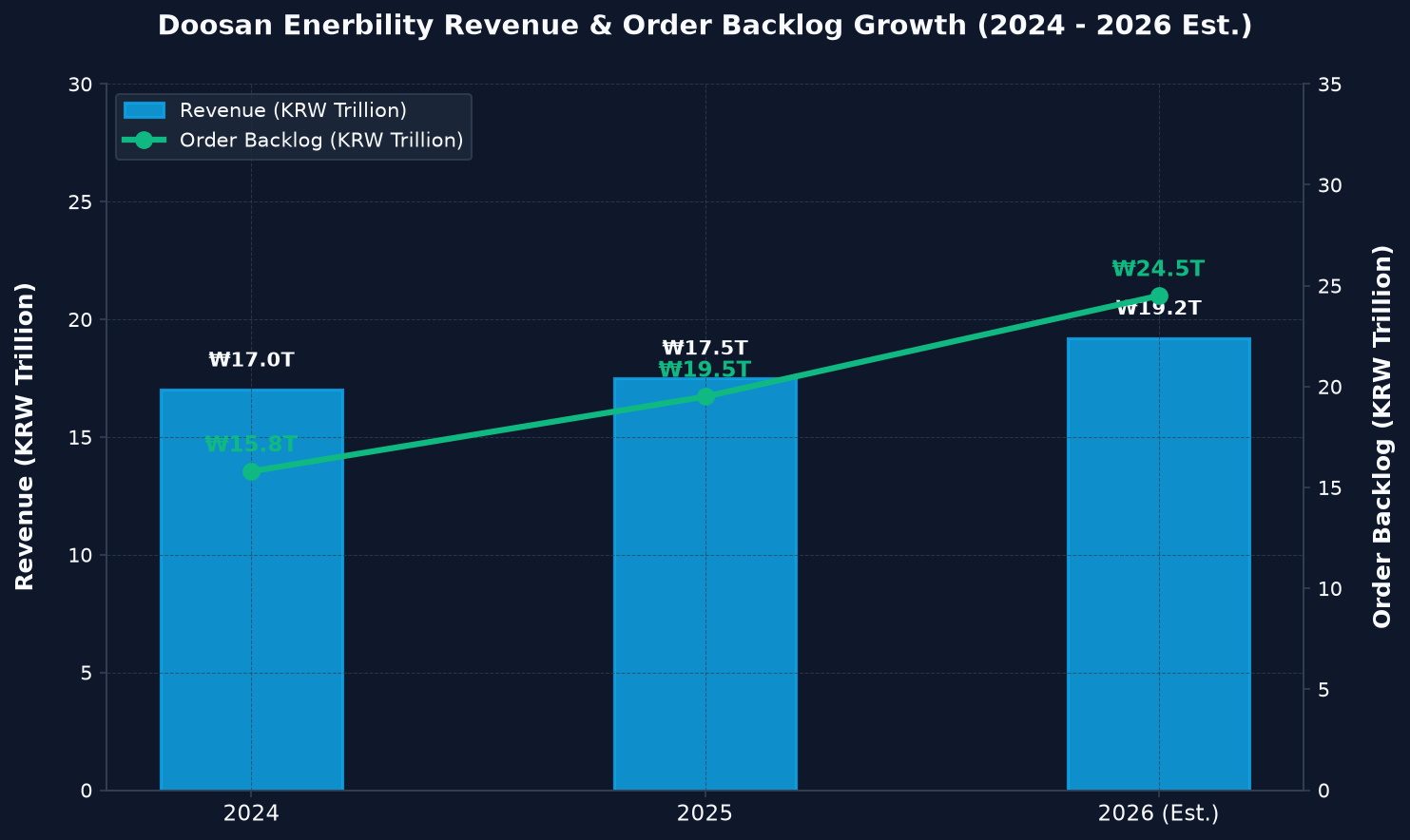
Figure: chart published with the original 3 July 2026 report. It was drawn from the revenue and margin estimates corrected above and is retained only as a record of what was published; read the tables, not the chart.
🧾 If Profits Are Falling, Why Is the Backlog the Bull Case?
Because a project company’s backlog leads its income statement by years, and this backlog grew 41.4% in twelve months while the flagship contract inside it was only 5.33% delivered.
The Q1 2026 filing discloses remaining performance obligations — the contracted revenue not yet recognised — with a full bridge. Reading it is the single most useful thing an investor can do with this company.
| Remaining performance obligations (수행의무), Q1 2026 | Doosan Enerbility | Doosan Bobcat | Doosan Fuel Cell | Consolidated |
|---|---|---|---|---|
| Opening (1 Jan 2026) | ₩22.911tn | ₩1.881tn | ₩0.229tn | ₩25.020tn |
| Additions | ₩3.559tn | ₩0.012tn | ₩0.024tn | ₩3.595tn |
| Recognised as revenue | −₩1.809tn | −₩0.023tn | −₩0.014tn | −₩1.847tn |
| Closing (31 Mar 2026) | ₩24.660tn | ₩1.869tn | ₩0.238tn | ₩26.768tn |
| Same figure, 31 Mar 2025 | ₩16.276tn | ₩1.844tn | ₩0.814tn | ₩18.934tn |
| Year-on-year change | +51.5% | +1.4% | −70.7% | +41.4% |
Source: DART Q1 2026 quarterly report (rcpNo 20260514001269), note on remaining performance obligations, base date 31 Mar 2026 with the prior-year comparative at 31 Mar 2025. The filing’s own bridge reconciles exactly in both periods (22.911 + 3.559 − 1.809 = 24.660; 25.020 + 3.595 − 1.847 = 26.768). Basis note: the original article’s “₩24.1tn consolidated” matched none of these figures — it was between the Doosan Enerbility segment (₩24.660tn) and the standalone entity’s ₩23.780tn. If a figure is labelled “consolidated,” it must be the ₩26.768tn total; we have used that label consistently and removed the conflicting ₩24.5tn from the conclusion.
Two things are worth reading out of that table. The growth is concentrated in the Doosan Enerbility segment itself — up 51.5% — which is the nuclear and gas turbine business rather than the construction-equipment or fuel-cell subsidiaries. And Doosan Fuel Cell’s book fell 70.7%, a detail no summary of “the backlog hit a record” would surface.
The Czech Contract, in the Filing’s Own Numbers
The Dukovany award is the largest single addition, and the quarterly report itemises it twice — in the contract table and in the performance-obligation note.
| Contract, as named in the filing | Period | Contract value | Delivered | Progress |
|---|---|---|---|---|
| Czech Dukovany Units 5 & 6 — NSSS (customer: KHNP) | 2025.12 → 2038.04 | ₩4.983tn | ₩0.266tn | 5.33% |
| Czech Dukovany Units 5 & 6 — turbine generator | 2025.12 → 2038.04 | ₩0.709tn | ₩0.006tn | 0.84% |
| Combined primary equipment scope | — | ₩5.692tn | ₩0.272tn | — |
Source: DART Q1 2026 quarterly report (rcpNo 20260514001269), contract detail table, base date 31 Mar 2026. Exact filing figures: NSSS ₩4,983,255 million with ₩265,649 million delivered; turbine generator ₩708,981 million with ₩5,988 million delivered. The original article’s “about ₩5.6 trillion” for the combined scope was close — ₩5.692tn is the exact sum — but it described the wrong reactor units, and its claim that the scope had been “expanded from an earlier ₩4 trillion estimate” is not something the filing supports; that comparison has been removed.
The delivery horizon is the point. This contract runs to April 2038 and was 5.33% complete a quarter after signing. It is a decade-plus revenue annuity, not a 2026 earnings event — which is precisely why the backlog can grow 41.4% in a year in which the operating margin falls.
🗓️ How Did Doosan Enerbility Get Here, and Who Owns It?
It was founded in 1962, nationalised in 1980, privatised into the Doosan group, and renamed twice — and the Doosan holding company still controls it with a 30.40% stake.
The corporate history is set out in section I of the annual report, and it explains why a private company is Korea’s sole nuclear equipment maker: for two decades it was the state’s heavy-industry champion.
| Date | What happened |
|---|---|
| 20 Sep 1962 | Founded as Hyundai Yanghaeng (현대양행) |
| Oct 1980 | Taken into state ownership under the heavy and chemical industry restructuring; becomes the public enterprise Korea Heavy Industries & Construction (한국중공업) |
| 25 Oct 2000 | Lists on the Korea Exchange |
| 23 Mar 2001 | Privatised into the Doosan group and renamed Doosan Heavy Industries & Construction (두산중공업) |
| 29 Mar 2022 | Renamed Doosan Enerbility by resolution of the annual general meeting |
Source: DART annual report FY2025 (rcpNo 20260320001246), “I. Overview of the Company.” Head office: 22 Doosan Volvo-ro, Seongsan-gu, Changwon, South Gyeongsang province. For an entity anchor and general background see Wikipedia’s Doosan Enerbility page — but the figures in this report come from the filings, not from there.
Governance and Group Structure
Doosan Corporation (주)두산, the group holding company, is the principal shareholder with 30.40% at 31 December 2025. Doosan Enerbility in turn consolidates 62 subsidiaries — 2 listed and 60 unlisted — and the two listed ones, Doosan Bobcat and Doosan Fuel Cell, are the reason 35.2% of consolidated equity and 58.7% of FY2025 net income sit outside the parent’s shareholders.
That is a three-layer chain: you own shares in a company that is controlled by a holding company, and whose reported earnings largely belong to the minority shareholders of its own listed subsidiaries. This structure is central to the Korea Discount, and it is the single most important thing to understand about the per-share figures in this report. The company has not disclosed a Value-Up participation programme in this filing, and we are not aware of a buyback-and-cancellation policy in the period covered; readers should check the current disclosures rather than rely on that absence. (Source: DART annual report FY2025, rcpNo 20260320001246, general-information note and consolidated subsidiary schedule.)
🏆 What Is Doosan’s Actual Market Position?
It is the sole domestic manufacturer of nuclear steam supply systems in South Korea, and one of a small number of companies worldwide able to build large power-generation gas turbines — but the filing publishes no market-share number for its energy business, and neither will we.
We went looking, because a market-share claim is the kind of thing that gets repeated in English coverage until it acquires a false precision. What the FY2025 annual report actually says about the power-equipment business is that the company is working to “maintain its existing market-share advantage” through R&D at its centres in Korea, the Middle East, the United States and Europe. That is a company assertion of position, not a measured share, and the filing attaches no figure or denominator to it. The only numeric market-share tables in the document belong to the Doosan Bobcat segment’s sales strategy discussion, which is a different business.
The defensible positional facts are narrower and still substantial. Doosan Enerbility is the only company in Korea that manufactures nuclear steam supply systems — reactor pressure vessels, steam generators, reactor coolant pumps — which is why it captures a defined share of any reactor contract the Korean consortium wins abroad. It runs the heavy casting-and-forging plant at Changwon that makes reactor-grade forgings, and the filing puts a number on it: FY2025 capacity of 166,300 tonnes against 104,082 tonnes actually produced, a 62.6% utilisation rate. And it has localised 270MW and 380MW gas turbine models that previously had to be imported. Those are capability statements you can check against the filing. “X% of the global market” is not one we can source, so we do not print it.
On the 17,000-tonne press. An earlier version of this paragraph listed “a 17,000-tonne heavy forging press at Changwon” among the facts you can verify from the filing. It is not in the filing. We searched the FY2025 annual report (rcpNo 20260320001246) and the Q1 2026 quarterly report (rcpNo 20260514001269) for the figure and for its Korean forms and found none; the filings describe the forging plant and its 단조프레스 but publish no press tonnage. The number itself is real, and Doosan states it publicly — World Nuclear News (20 August 2026) reports the company saying it “leverages its world-class 17,000-tonne press and ultra-large forging technologies at its Changwon headquarters forging plant.” We have therefore moved it out of the filing-verifiable list and marked it [secondary — company statement, not a disclosure]. A paragraph that promises filings-only evidence has to keep that promise. Capacity and utilisation above: DART rcpNo 20260320001246, “생산능력 및 생산실적” (주조품·단조품·금형공구강), unit: tonnes.
💡 Lingo Check: SMR, NSSS, and Performance Obligations
| Term | What it means |
|---|---|
| Small Modular Reactor (SMR — 소형 모듈 원전) | A nuclear reactor of up to about 300 MW per unit — roughly a third of a conventional plant — built as factory-made modules and shipped to site rather than constructed in place. |
| NSSS (원자로 계통설비) | Nuclear Steam Supply System — the reactor pressure vessel, steam generators, reactor coolant pumps and associated primary-loop equipment. The high-value core of any nuclear island, and the scope Doosan supplies. |
| Heavy forging plant (주단조 공장) | A facility using very large hydraulic presses to compress steel ingots into the dense, seamless components a reactor pressure vessel requires. Doosan’s Changwon plant is disclosed at 166,300 tonnes of annual capacity; its main press is reported at 17,000 tonnes — [secondary: a company statement, not stated in the DART filings]. |
| Remaining performance obligations (수행의무) | Under IFRS 15, contracted revenue a company has committed to deliver but not yet recognised. It is the audited, reconciled version of “order backlog” — and unlike a press-release backlog figure, it comes with a bridge you can check. |
🚀 What Is Doosan’s Real Position in SMR Manufacturing?
It is the manufacturing partner for NuScale and, per the DART Q1 2026 quarterly report (rcpNo 20260514001269), in discussions with several other SMR designers on equipment supply — but the filing describes it as pursuing equipment orders, not as holding them.
The long-term thesis is that SMR developers in the United States and Europe are asset-light: they design reactors and outsource fabrication to a small number of heavy industrial manufacturers with the forging capacity to make reactor-grade components. Doosan is one of those manufacturers.
The NuScale Relationship, Precisely Stated
Doosan Enerbility is a strategic equity investor in NuScale Power, the first company to receive US Nuclear Regulatory Commission design approval for an SMR. On the specifics, the Q1 2026 filing says Doosan has completed material fabrication for the NuScale programme and is conducting sales activity to win the follow-on equipment-manufacturing orders. It also states that it is in discussions with multiple other SMR designers on equipment supply.
⚠️ Three claims removed here, and why. The original article stated that Doosan “is fabricating reactor pressure vessels and steam generator modules for NuScale’s landmark projects.” The filing does not say that; it describes material fabrication followed by sales activity to secure equipment-manufacturing orders — a stage earlier. The completed-action wording has been corrected.
The article also stated that Doosan “has expanded its manufacturing agreements to include X-energy and TerraPower,” and elsewhere referred to Rolls-Royce SMR work. None of those three names appears anywhere in the Q1 2026 report. What the filing says is “discussions with multiple SMR designers for equipment supply,” without naming them. We have removed the names rather than source them to press reporting, because attributing a specific counterparty to a filing that does not name one is how a plausible sentence becomes a false one. Similarly, the article’s “management guides to a further ₩13.3 trillion of new orders by year-end” is not in the quarterly report and has been removed.
🔬 Nuclear Exports and Gas Turbine Localisation
Large-scale nuclear exports and domestic gas turbine localisation drive the near-term cash flows behind the SMR option.
Global Nuclear Export Strategy
South Korea’s nuclear consortium — led by Korea Electric Power Corporation (KEPCO — 한국전력) and Korea Hydro & Nuclear Power (KHNP — 한국수력원자력) — bids for reactor contracts in Europe and the Middle East. As the sole domestic manufacturer of nuclear steam supply systems, Doosan Enerbility captures a substantial share of any contract the consortium wins. The filing’s contract table shows the pattern directly: KHNP is the named customer on the ₩4.983tn Dukovany NSSS award, alongside earlier UAE Barakah NSSS and turbine-generator contracts now essentially complete.
Gas Turbine Localisation and Hydrogen Co-firing
Doosan Enerbility is one of a small handful of companies worldwide able to manufacture large-scale power-generation gas turbines. It has localised 270MW and 380MW models, displacing imported turbines in Korea’s domestic grid, and is developing hydrogen co-firing capability. The filing’s R&D table lists gas-turbine development running in parallel with SMR equipment technology — the two growth lines share the same forging and machining base, which is the real source of operating leverage if volumes arrive.
⚖️ What Does the Stock Actually Cost?
At the 3 July 2026 close of ₩86,200 the shares traded at roughly 651× the FY2025 profit that belongs to Doosan Enerbility’s own shareholders — a number the original article’s 18.5x forward P/E could not have survived.
The original multiples matrix quoted a forward P/E of 18.5x, EV/EBITDA of 9.2x and Net Debt/EBITDA of 1.8x for Doosan, alongside figures for GE, Westinghouse and IHI. None carried a source. The 18.5x is roughly reconstructable only from the stale ₩41,500 price that also appeared in the price box: against the article’s own ₩1.50tn 2026 net income estimate that price gives 17.7×, close to the published figure. The ₩86,200 price gives 36.8× on the same estimate. In other words the price was updated and the multiple was left behind. We have withdrawn the peer figures rather than replace them with numbers we cannot trace to a primary filing.
| Measure (3 July 2026 close, FY2025 accounts) | Value |
|---|---|
| Market capitalisation (₩86,200 × 640,561,146 shares) | ₩55.22tn |
| P/E on FY2025 profit attributable to owners (₩84.8bn) | 651× |
| P/E on FY2025 consolidated net income (₩205.2bn) | 269× |
| Cross-check: price ÷ reported basic EPS of ₩132 | 653× |
| Price / book on total equity (₩12.009tn) — the screener number | 4.60× |
| Price / book on owners’ equity (₩7.786tn) | 7.09× |
| FY2025 ROE on year-end owners’ equity | 1.09% |
| Market cap / consolidated backlog (₩26.768tn) | 2.06× |
| Market cap / FY2025 revenue (₩17.058tn) | 3.24× |
All ratios computed by us. Price: ₩86,200 — the KRX settled close on 3 July 2026, which is the figure the original report used. Every multiple below is struck at that close; re-date it against the live quote before use. Share count 640,561,146 (KRX, 3 July 2026). Earnings, equity and backlog from DART rcpNo 20260320001246 and 20260514001269. The 651× and the 653× cross-check are computed two different ways — market cap over attributable profit, and price over the filing’s own reported EPS — and agree to within 0.3%, which is the small gap between the weighted-average and period-end share counts. The original forward P/E of 18.5x, EV/EBITDA of 9.2x, Net Debt/EBITDA of 1.8x, and all three peer figures are withdrawn as unsourced.
⚠️ The Bear Case: What Would Prove This Wrong?
⚠️ The bull case here is entirely a backlog-conversion case, so the bear case is everything that stops the conversion — or makes it worthless to a minority shareholder.
– The backlog may not convert at an attractive margin. This is the central risk and the accounts already speak to it: over three years the order book grew while the operating margin fell from 8.34% to 4.47%. Growth in contracted revenue is not the same as growth in profit.
– Most of the profit belongs to somebody else. Minority holders took 58.7% of FY2025 net income and 98.7% of Q1 2026’s, and hold 35.2% of consolidated equity. Metrics built on consolidated figures overstate what a Doosan Enerbility shareholder owns.
– The flagship contract is a decade out. Dukovany 5 & 6 runs to April 2038 and was 5.33% delivered at 31 March 2026. Large nuclear projects slip, and a schedule slip defers revenue recognition while financing costs continue.
– SMR revenue is not yet contracted. On the filing’s own wording Doosan is pursuing equipment-manufacturing orders and holding discussions with designers — a pipeline, not a book.
– Geopolitical and IP disputes. Intellectual property disputes between KHNP and foreign reactor designers over export technology can delay contract finalisation.
– Raw material volatility. Sharp increases in nickel, chromium and specialised steel alloys compress margins on fixed-price, long-dated contracts — and these contracts are very long-dated.
🎯 Why It Matters for K-Export Stars
This is the correction that most justifies the way this site works. The original article had the direction of Doosan Enerbility’s profits backwards and wrote a margin-expansion story on top of the error. The audited figures showing a 25.0% fall in operating profit had been filed in Korean on 20 March 2026, and the reactor unit numbers, the exact backlog, and the careful wording about what Doosan has and has not yet won were all sitting in a quarterly report filed on 14 May. Reading the primary source is not an edge you have to be clever to get; it is one you have to bother to take.
🛡️ Conclusion
Conclusion
Doosan Enerbility is a company whose order book and income statement are telling opposite stories, and the honest version of this report says so. Remaining performance obligations rose 41.4% year on year to ₩26.768tn, with the Doosan Enerbility segment alone up 51.5%. Over the same stretch, the consolidated operating margin compressed for a third consecutive year to 4.47%, revenue remained below its FY2023 level, and profit attributable to the parent’s own shareholders came to ₩84.8bn — basic EPS of ₩132, down from ₩174.
Q1 2026 is the first quarter in which the operating line turned: revenue up 13.67% and operating profit up 63.90%. That is a real inflection and it deserves to be recorded as one. It is also a single quarter, it had not yet reached the bottom line — ₩758 million to owners, EPS of ₩1 — and it does not by itself reverse three years of margin compression.
The nuclear renaissance is visible in this company’s filings. It is visible in the backlog and in a Czech contract running to 2038 that was 5.33% delivered. It is not yet visible in the profits, and an investor is being asked to pay ₩55.2tn today for the conversion of ₩26.8tn of contracted revenue at a margin that has been falling.
We are not restating a target price. The original ₩125,000 target was derived from an earnings trajectory that ran in the opposite direction to the audited accounts, and the honest response to that is withdrawal, not replacement.
Not yet set up to trade Seoul? Start with our practical guide on how to buy Korean stocks as a foreign investor — through local brokers, ADRs, or ETFs.
Newer, and built from the filings
This piece dates from an earlier reporting cycle. We have since read the Korean supply chain company by company, straight from DART:
- Doosan Enerbility (034020) — builds the reactor and the turbine island.
- KEPCO E&C (052690) — designs the plant and the reactor system.
- KEPCO KPS (051600) — maintains the fleet once it is running.
- BHI Co. (083650) — supplies the heat-recovery and boiler equipment.
Where this company sits in the chain
Our filing map places all four listed suppliers by how many contractual steps separate them from the utility that signs — and shows why you cannot add their contract values together: Korea’s Nuclear Export Chain: What the Filings Show.
Disclaimer: This report is for informational and educational purposes only and does not constitute investment advice. Figures are point-in-time as noted and go stale; check the live quote and the current filings before acting. Investors should conduct their own research before making financial decisions.
Written by James Ju — a Seoul-based engineer who reads Korean-language DART and KRX filings, the primary sources most English-language coverage skips. About the author.