📌 As of 3 July 2026 — a point-in-time view. Financials corrected 30 August 2026. We do not yet have a current, filings-based reference article on LG Energy Solution; the corrected figures below come straight from the FY2025 annual report.
✏️ Correction — 30 August 2026. This report had the sign of the bottom line wrong. We printed net profit rising from ₩0.40T (FY2024) to ₩0.92T (FY2025), and ROE rising from 1.80% to 3.90%, and described the company as expanding its profits. LG Energy Solution’s audited consolidated accounts report a loss attributable to owners of the parent of −₩1.019T in FY2024 and −₩1.073T in FY2025 — two consecutive years of loss for common shareholders — with basic and diluted EPS of −₩4,354 and −₩4,585. Consolidated net profit including non-controlling interests was ₩0.339T and ₩0.081T. ROE on equity attributable to owners was −4.8% and −5.3%. Operating profit has been restated to the filed figures (₩0.575T and ₩1.346T, versus ₩0.56T and ₩1.30T printed), and the operating margins recomputed. The forward P/E has been recomputed from this report’s own price and share count: 87.6× → 94.3×. We have added a section explaining the non-controlling-interest split, because that is the whole reason the two figures diverge. Revenue was checked against the same filing and was correct — it is unchanged. Source: DART, FY2025 annual report, rcpNo 20260312000217, filed 12 March 2026.
Second pass, 30 August 2026 — a re-check found that the correction above had deleted figures without disclosing them. The original price box printed two share prices (₩362,500 and a stale ₩685,000) and two target prices (₩520,000 and ₩920,000), and the original conclusion quoted a third target of ₩480,000 in its closing paragraph. The stray ₩685,000, ₩920,000 and ₩480,000 were dropped in the first pass and never named; they are now disclosed in the price box below. The same pass also tied the IRA-credit claim to the filing’s own note on 기타영업수익 (other operating income) instead of leaving it as our inference, and stated the counterfactual as a bound rather than a certainty. No financial-statement figure changed. See our corrections policy.
- 🔻 Two straight years of losses for common shareholders: basic and diluted EPS of −₩4,354 (FY2024) and −₩4,585 (FY2025). (Source: DART rcpNo 20260312000217)
- 🧩 The group earns; the shareholder does not: FY2025 consolidated net profit was ₩0.081T, but ₩1.154T of it belonged to non-controlling interests — leaving −₩1.073T for the owners of the parent.
- 🇺🇸 Strip out the US manufacturing credit and both years become operating losses: the filing’s 기타영업수익 (other operating income) line — which its own note describes as the IRA advanced-manufacturing production credit — was ₩1.647T in FY2025 against a ₩1.346T operating profit, and ₩1.480T in FY2024 against ₩0.575T. Remove it and the two years read −₩0.301T and −₩0.905T. (Source: DART rcpNo 20260312000217, consolidated note 21)
💵 Price at writing (3 July 2026, KRX settled close): $235 (₩362,500)
🎯 Target discussed (3 July 2026): $337 (₩520,000)
📈 Implied upside at the time: 43.4%
The original box carried a second, stale share price of ₩685,000 alongside the ₩362,500, and a second target of ₩920,000 alongside the ₩520,000; the original conclusion quoted a third target of ₩480,000. The stale figures have been removed. ₩362,500 is the KRX settled close for 3 July 2026 and ₩520,000 is the target the body of the report actually argued.
Both figures are the point-in-time record of what this report said on 3 July 2026. Neither is a current view, and we do not publish target prices. FX ₩1,542/$ (USD/KRW, 2 Jul 2026, FinanceDataReader).
*Market Report as at 3 July 2026*
LG Energy Solution Valuation: Bridging the EV Chasm with ESS and Next-Gen Battery Dominance
LG Energy Solution (KRX: 373220), South Korea’s leading pure-play lithium-ion battery manufacturer, is navigating a pivotal transition in the global clean energy supply chain. As the automotive industry experiences a temporary cooling in pure electric vehicle (EV) sales—a phenomenon widely described as the “EV Chasm”—LG Energy Solution has pivotally shifted resources toward stationary Energy Storage Systems (ESS) for public utilities and the mass production of next-generation 46-series cylindrical cells.
This strategic adaptability, coupled with massive tax credits under the U.S. Inflation Reduction Act (IRA), is helping the company maintain premium valuations compared to its Chinese and Japanese counterparts. For the contrasting case of Korea’s smaller battery champion — loss-making, but pivoting hard into ESS — see our Samsung SDI stock analysis. This report delivers a detailed valuation analysis of LG Energy Solution, evaluating its three-year financial trajectory, ESS growth contribution, next-gen cell roadmaps, and relative multiples against global peers.
📈 Financial Trajectory and the ESS Pivot
LG Energy Solution’s income statement reflects the impact of the global EV transition. Revenue fell 7.6% in FY2025 to ₩23.67T on high interest rates and battery metal price corrections, while operating profit more than doubled to ₩1.35T. Below that line the picture reverses, and the reversal is the most important thing in this report.
Three-Year Financial Summary
The following table outlines LG Energy Solution’s financial performance from 2024 through 2026 estimates. The 2024 and 2025 columns are the audited consolidated figures as filed with DART; the 2026 column is an estimate published with this report on 3 July 2026, reflecting the strategic shift toward high-margin utility-scale ESS shipments and initial sales of 4680 cylindrical cells.
| Financial Metric | 2024 (Actual) | 2025 (Actual) | 2026 (Est.) | Operating Margin & ROE Trend (Visual) |
|---|---|---|---|---|
| Revenue (KRW Trillion) | ₩25.62T | ₩23.67T | ₩29.60T | 2.24% (2024 OP Margin) |
| Operating Profit (KRW Trillion) | ₩0.575T | ₩1.346T | ₩1.27T | 5.69% (2025 OP Margin) |
| Net Profit — 당기순이익(손실) (KRW Trillion) | ₩0.339T owners’ share: −₩1.019T |
₩0.081T owners’ share: −₩1.073T |
₩0.90T | 4.29% (2026 OP Margin Est.) |
| Basic & diluted EPS (KRW) | −₩4,354 | −₩4,585 | — | As filed. Basic and diluted are identical in both years. |
| Return on Equity (ROE %) — owners | −4.8% | −5.3% | — | −5.3% (2025 ROE, owners) |
Basis. 2024 and 2025 are consolidated (연결) figures from the FY2025 annual report, DART rcpNo 20260312000217. “Net Profit” is the 당기순이익(손실) line; “owners’ share” is 지배기업의 소유주지분. EPS is the filed 보통주 기본 및 희석주당이익(손실) line. ROE = result attributable to owners ÷ closing equity attributable to owners (₩21.12T in 2024, ₩20.22T in 2025) — a closing-equity calculation. On the consolidated total instead, ROE would be 1.1% and 0.3%; on neither basis does it reach the 1.80% and 3.90% this report originally printed. The 2026 column is an estimate published with this report on 3 July 2026, not a filing, and it does not distinguish between the consolidated and owners’ bases; we have not restated it, and we have left the 2026 EPS and ROE blank rather than derive shareholder figures from an estimate that does not specify which line it refers to.
Why the Group Makes Money and the Shareholder Does Not
Most of LG Energy Solution’s consolidated profit belongs to somebody other than its shareholders. In FY2025 the group reported consolidated net profit of ₩0.081T. Of that, ₩1.154T was attributable to non-controlling interests and −₩1.073T to the owners of the parent. FY2024 splits the same way: ₩0.339T consolidated, ₩1.357T to non-controlling interests, −₩1.019T to owners (Source: DART rcpNo 20260312000217).
The same split runs through the balance sheet. Of ₩29.32T of total equity at the end of FY2025, ₩9.11T is non-controlling interest and ₩20.22T belongs to the parent’s shareholders. Non-controlling shareholders also paid in a further ₩1.83T of fresh capital during the year (cash-flow statement, 비지배지분의 출자), after ₩3.38T the year before. That is the accounting signature of a group whose recent capacity has been built inside consolidated subsidiaries in which outside partners hold large minority stakes: the group consolidates the full revenue and the full cost of those plants, then hands the partners’ share of the resulting profit back out on the non-controlling line.
We did not confirm from the FY2025 filing which specific subsidiaries account for the non-controlling line, so we are not attributing it to named ventures here. The mechanical point stands without that: for two consecutive years the consolidated bottom line was positive while the figure that belongs to someone buying the stock was negative. Any valuation of LGES that starts from consolidated net profit — as the original version of this report did — is valuing a number the shareholder does not receive.
Profitability Drivers and CapEx Maturation
The main driver behind the recovery of operating profit in 2025 and 2026 is the expansion of utility-scale energy storage products in North America. These products utilize LFP (Lithium Iron Phosphate) chemistries manufactured locally, qualifying them for robust federal incentives. Additionally, the company’s capital expenditure (CapEx) cycle is beginning to mature.
Having completed the initial construction of massive joint-venture plants with General Motors, Honda, and Stellantis, the company is shifting from heavy investment to optimizing capacity utilization, structurally reducing depreciation drag on margins.
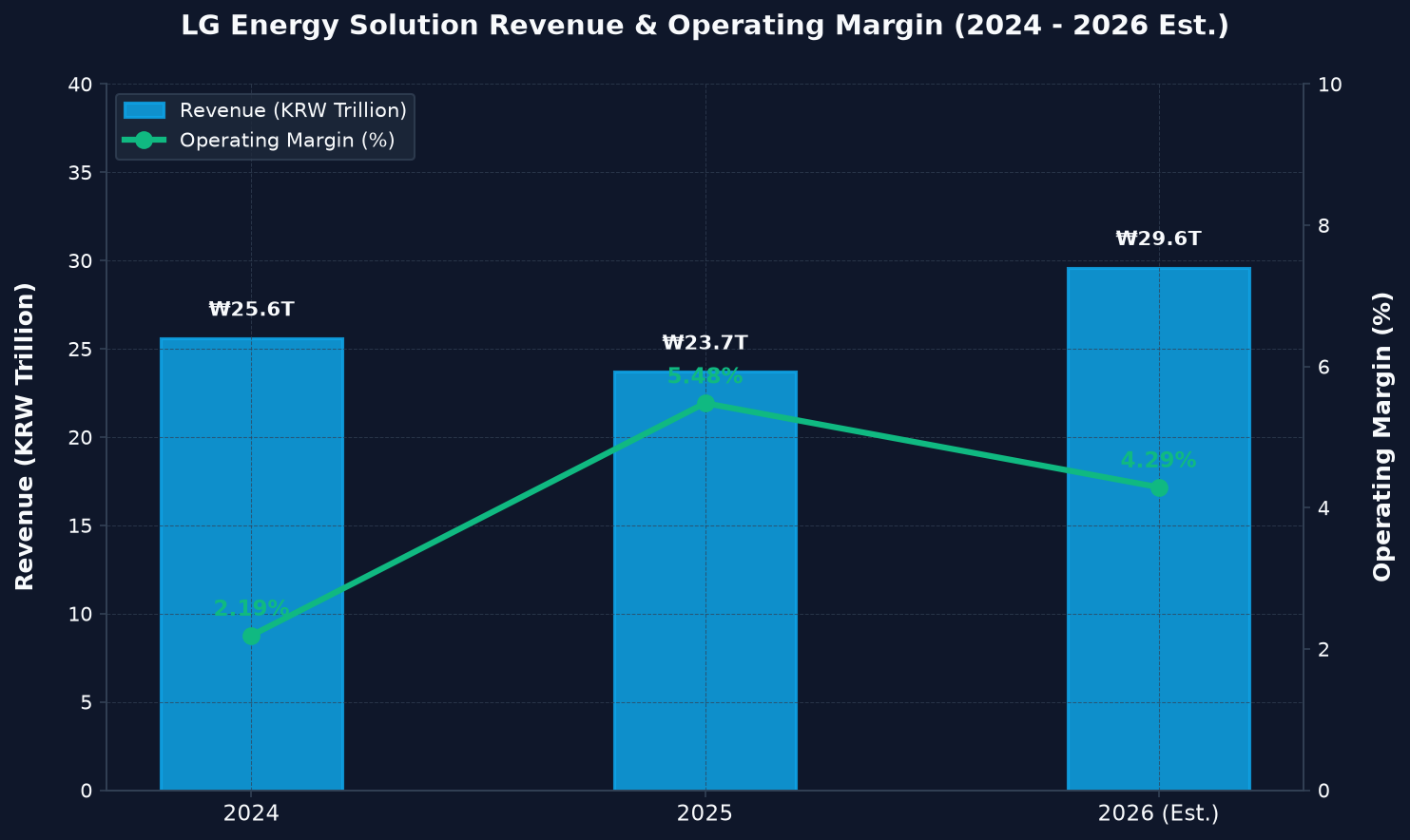
Figure: Revenue Recovery and Operating Margin Trend (2024 – 2026 Est.)
💡 Lingo Check: Battery Policy and Disclosure Bodies
To understand LG Energy Solution’s operational framework, it is helpful to outline key regulatory and accounting terms:
– IRA AMPC (첨단 제조 생산 세액공제): Advanced Manufacturing Production Credit under the U.S. Inflation Reduction Act, which awards battery manufacturers $35 per kilowatt-hour (kWh) for battery cells and $10 per kWh for modules produced in the United States.
– ESS (에너지 저장 시스템): Energy Storage Systems designed to store electrical power on a utility scale, commonly integrated with renewable energy sources like wind and solar to stabilize grid systems.
– Non-controlling interest (비지배지분): The share of a consolidated subsidiary’s equity and profit that belongs to shareholders other than the parent. A group that consolidates joint ventures reports 100% of their revenue but only keeps its own slice of the profit — the rest is stripped out on this line.
– Profit attributable to owners of the parent (지배기업의 소유주지분): What is left of consolidated net profit after the non-controlling share is removed. This, not consolidated net profit, is the number that earnings per share is built from.
– Financial Supervisory Service (금융감독원 – FSS): The primary government body in South Korea overseeing corporate transparency and market disclosures.
– DART (전자공시시스템): The electronic disclosure system operated by the FSS, where Korean corporations file official financial statements.
🔋 Technology Roadmap: 46-Series Cylindrical Batteries and LFP Pivot
LG Energy Solution is deploying two key technological strategies to navigate the changing battery market.
Cylindrical 46-Series Dominance
LG Energy Solution has established an early lead in mass-producing the 46-series cylindrical cells (specifically 4680 cells), which are becoming the standard format for major EV manufacturers including Tesla. By starting production at its dedicated Ochang plant in South Korea in late 2024 and expanding to North American sites in 2026, LGES is securing long-term high-margin supply agreements. These cylindrical cells offer five times the energy capacity and six times the power of standard 2170 cells, providing a substantial advantage over competitors who are still struggling with early-stage yield rates.
The LFP Battery Transition for ESS
To compete with low-cost Chinese cell makers in the stationary energy storage market, LG Energy Solution has developed its own Lithium Iron Phosphate (LFP) pouch cells. By producing these cells at its Arizona plant in the United States, the company avoids tariffs applied to Chinese battery imports while capturing the IRA AMPC benefits. This allows LGES to offer competitive pricing to North American utility clients while maintaining positive margin spreads.
🔄 EV Chasm Mitigation Strategy: Deploying Grid Infrastructure
The core of LG Energy Solution’s near-term recovery is its strategic focus on stationary utility-scale energy storage.
The AI Data Center Demand Trigger
The rapid global build-out of artificial intelligence data centers has created an unprecedented demand for continuous electricity. Since grids cannot rely solely on intermittent solar and wind power, utility-scale battery systems are essential to prevent grid instability.
– Portfolio Shift: LG Energy Solution has stated its goal to increase the revenue share of its ESS business to mid-30% by the end of 2026, up from low single digits in 2023.
– High Backlog Visibility: Over 70% of the company’s Arizona plant capacity for ESS is pre-sold through long-term supply agreements with major U.S. power developers, providing highly predictable cash flows.
– High-margin Upgrades: The company integrates advanced liquid cooling systems and energy management software into its containerized ESS products, capturing software-like premium margins.
⚖️ Valuation & Global Peer Comparison
Despite navigating the EV transition and possessing a strong manufacturing presence in the United States, LG Energy Solution traded at a significant premium to global peers on 3 July 2026. The LGES line below has been recomputed; see the correction note at the top of this page.
Valuation Multiples Matrix (3 July 2026)
– LG Energy Solution (KRX: 373220): Forward P/E 94.3× | trailing P/E not meaningful | ROE −5.3% (FY2025 actual, owners’ basis) | EV/EBITDA 28.2x (as published, not re-verified). Arithmetic: ₩362,500 × 234,000,000 issued shares = ₩84.83T ($55.0bn) of market value; divided by this report’s own ₩0.90T estimate for 2026 net profit = 94.3×. The report previously printed 87.6×. There is no trailing P/E to quote, because FY2024 and FY2025 EPS were −₩4,354 and −₩4,585. Share count and financials from DART rcpNo 20260312000217.
– CATL (SZSE: 300750): Forward P/E 31.9x | EV/EBITDA 16.5x | ROE 22.0%
– BYD Co. (SZSE: 002594): Forward P/E 27.5x | EV/EBITDA 27.1x | ROE 20.0%
– Panasonic (TSE: 6752): Forward P/E 15.5x | EV/EBITDA 14.3x | ROE 7.0%
The CATL, BYD and Panasonic figures are reproduced as published with this report on 3 July 2026. We have not re-verified them against those companies’ own filings, and they should not be treated as sourced.
Valuation Analysis and the Multiples Premium
LG Energy Solution’s forward P/E of 94.3x and EV/EBITDA of 28.2x compared to CATL (31.9x P/E) reflects, in part, its geopolitical position. Unlike Chinese battery makers who face steep tariffs (up to 25% under U.S. Section 301 tariffs), LGES enjoys tariff-free access to the North American market. But the premium is also arithmetic: a multiple gets large when the denominator is small, and LGES’s denominator is not merely small — on the line that belongs to shareholders it is negative.
The company’s operating profit is also highly dependent on the IRA AMPC, and the filing quantifies that dependence itself rather than leaving it to inference. The consolidated income statement carries a separate line, 기타영업수익 (other operating income), of ₩1.647T in FY2025 and ₩1.480T in FY2024, and the note attached to that line describes it as the credit (our translation from the Korean): “Under the U.S. Inflation Reduction Act’s advanced manufacturing production credit, in force from 1 January 2023, the group may receive tax credits of a set amount on battery cells and modules produced and sold in the United States; this amount is the income the consolidated group expects to receive as at the end of the current period.”
The income statement is built as gross profit plus other operating income less SG&A, so the counterfactual is arithmetic on the filing’s own lines: ₩4.232T − ₩4.533T = −₩0.301T in FY2025, and ₩3.406T − ₩4.311T = −₩0.905T in FY2024, against reported operating profits of ₩1.346T and ₩0.575T. One caveat belongs with that. The filing does not itemise an AMPC amount separately, and we did not find one elsewhere in the report; the arithmetic above therefore treats the whole 기타영업수익 line as the credit, which is what the note describes but is not something the filing states as an exhaustive breakdown. Read ₩1.647T as the upper bound of the credit and the two loss figures as the matching lower bound. (Source: DART FY2025 annual report, rcpNo 20260312000217, consolidated note 21, 영업이익.)
The original version of this section argued that rapid EPS growth would “naturally compress the P/E multiple toward historical averages.” That framing assumed a positive starting point that does not exist. Earnings per share attributable to LGES shareholders was −₩4,585 in FY2025; before any P/E means anything, that number has to cross zero. The premium therefore rests on the protected US supply-chain position and on the ESS scale-up delivering profit that reaches the parent’s shareholders rather than its joint-venture partners — two conditions, not one.
⚠️ Potential Risk Factors
Investors should monitor the following risk factors that could impact LG Energy Solution’s performance:
– IRA Policy Volatility: Any legislative attempt to scale back or repeal the IRA AMPC subsidies in the United States would significantly impact the company’s operating profits. The scale is quantified above: on the filing’s own income-statement arithmetic, removing the credit line turns both years into operating losses (−₩0.301T in FY2025, −₩0.905T in FY2024).
– Non-controlling Leakage: Profit generated inside consolidated joint ventures accrues to partners as well as to LGES. In FY2025, ₩1.154T of consolidated profit went to non-controlling interests while owners of the parent booked a loss.
– LFP Cost Competition: Continued price cuts on LFP chemistries by Chinese competitors could force LGES to lower its prices, impacting margins despite domestic subsidies.
– Execution Risks in Advanced Cylindrical Cells: Any yield or ramp-up delays in 4680 cell production at North American sites could slow shipment volumes and impact contract relationships.
🛡️ Conclusion
LG Energy Solution’s strategic position in the U.S. market is real, and the 3 July 2026 operational case — utility-scale ESS scaling while the EV Chasm suppresses volume growth, with 4680 cells behind it — still reads. The financial case as originally written does not. This report described a company whose profits were expanding; the filed accounts show a loss attributable to shareholders in both FY2024 (−₩1.019T) and FY2025 (−₩1.073T), and a forward multiple of 94.3× rather than 87.6× on its own estimate. The ₩520,000 target discussed at the time is recorded in the box above as history and is not carried forward. The fact this report originally missed is the one that matters most for anyone valuing the stock: the group’s consolidated profit and its shareholders’ profit are not the same number, and for two years they had opposite signs.
*Disclaimer: This report is for informational purposes only and does not constitute investment advice. Investors should conduct their own research before making financial decisions.*