
For decades, “K-beauty” meant sheet masks and snail cream — cheap, trendy, and easy to knock off. Then a company called APR quietly did something no Korean cosmetics brand had managed: it built a skincare label that tops Amazon’s US beauty charts and a home-device business with recurring, gadget-like economics. In 2025 the two engines together more than doubled revenue past KRW 1.5 trillion, with 80% of it earned overseas. This is the K-beauty story that is really a tech-and-export story.
🔑 Key Takeaways
- Explosive, export-led growth. FY2025 revenue hit KRW 1.53 trillion, up 111% year-on-year, with operating profit up ~198% to KRW 365 billion. Overseas sales jumped 207% and now make up roughly 80% of the top line.
- Two engines, not one. APR pairs the Medicube skincare brand with Age-R home beauty devices — an unusually high device mix that gives it a razor-and-blades flywheel most K-beauty peers lack.
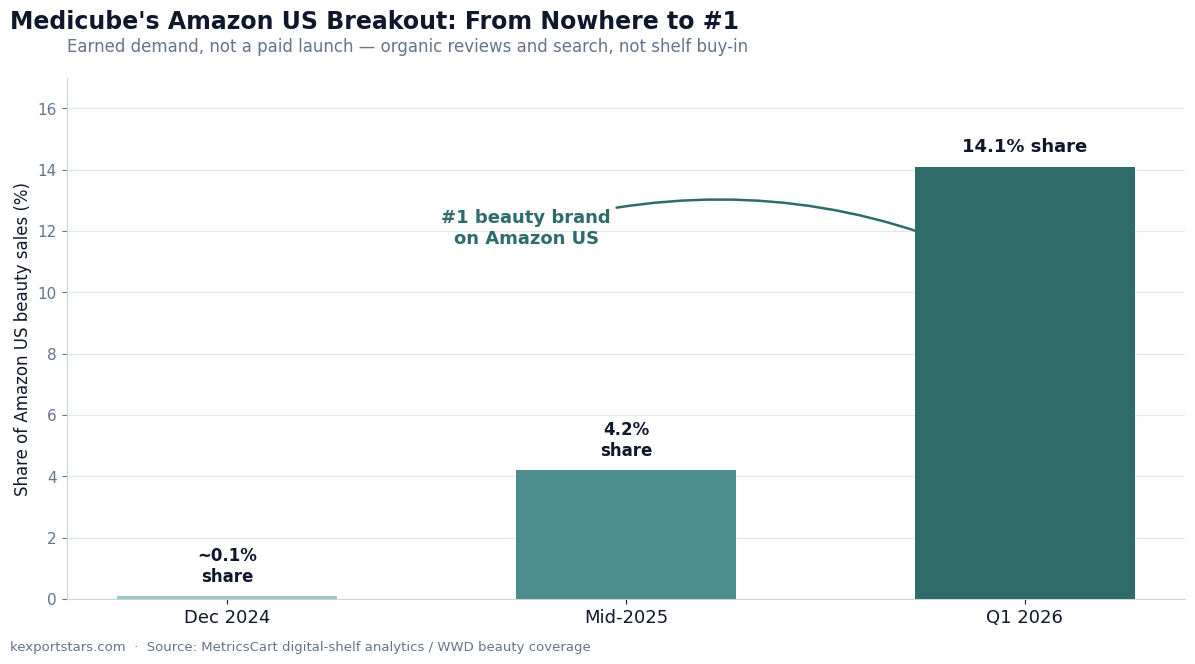
- An Amazon phenomenon. Medicube went from ~0.1% of Amazon US beauty sales in late 2024 to become the platform’s single largest beauty brand by sales share by early 2026 — a genuine US breakout, not just a Korea story.
- Priced for growth. At ~KRW 393,000 (mid-July 2026) the stock trades near 41x trailing (TTM) earnings on a ~KRW 14.7 trillion market cap. Analysts are overwhelmingly bullish (consensus “Strong Buy”, ~KRW 490,000 average target) — but the multiple leaves little room for a stumble.
💄 What Is APR Corporation?
APR Corporation (KRX: 278470) is a Korean “beauty-tech” company that sells both cosmetics and home beauty devices — a combination that makes it structurally different from a pure skincare brand. Founded in 2014 and listed on the KOSPI in February 2024, APR runs two core businesses:
- Medicube (메디큐브) — a dermocosmetic (derma-cosmetic) skincare brand built around problem-solving “clinical” positioning: pores, texture, elasticity, and barrier repair. It is the group’s growth engine and its cosmetics division alone passed KRW 1 trillion in annual sales in 2025.
- Age-R (에이지알) — home beauty devices (microcurrent, booster, and radio-frequency style gadgets), led by the multi-mode Age-R Booster Pro. Cumulative global device sales passed 6 million units in early 2026, with more than 60% now sold outside Korea.
APR also owns supporting brands such as April Skin and Forment, but Medicube and Age-R are the story. For global investors already tracking Korea’s consumer-export champions, APR slots naturally alongside our profile of Samyang Foods and its Buldak global empire — another Korean brand that turned a domestic hit into a worldwide export franchise.
🚀 How Did a K-Beauty Brand Grow Revenue 111% in One Year?
APR’s revenue more than doubled in 2025 because Medicube broke out in the United States — largely through Amazon and social media — while Age-R devices scaled globally at the same time, turning a Korea-centric brand into an export machine almost overnight. The growth is not one lucky viral moment; it is the result of a deliberate playbook.
Start with the product, not the ad. Medicube launched as a dermocosmetic brand — skincare framed as targeted, results-driven solutions rather than lifestyle fluff. That gave it credible “hero” SKUs to build around: the dual-textured Zero Pore Pad toner pads, the PDRN Pink Collagen line (its salmon-DNA “PDRN” ranges surpassed 15 million cumulative units sold globally), and the Collagen Jelly Cream. Clear before-and-after claims travel well on video.
Then let the internet do the selling. Rather than buy its way onto US shelves first, Medicube seeded demand online — on TikTok, YouTube, and Amazon — where authentic “it actually works” reviews and creator content compound for free. The results are striking: Medicube’s share of Amazon US beauty sales rocketed from roughly 0.1% in December 2024 to become the platform’s single largest beauty brand by sales share in early 2026, and during Amazon Prime Day 2025 it was among the most-searched beauty brands on the site. Celebrity mentions (Kylie Jenner, Hailey Bieber) added fuel, but the base was earned demand, not a paid launch.
Only then, go to the shelf. With online demand proven, APR moved into physical US retail from a position of strength — launching at Ulta Beauty across 1,400+ stores in 2025, with management publicly in talks to widen distribution into mass channels. That sequencing — prove it online, then negotiate shelf space — is why the US ramp has been fast and profitable rather than a margin-destroying land grab.
🔁 The Device + Skincare Flywheel
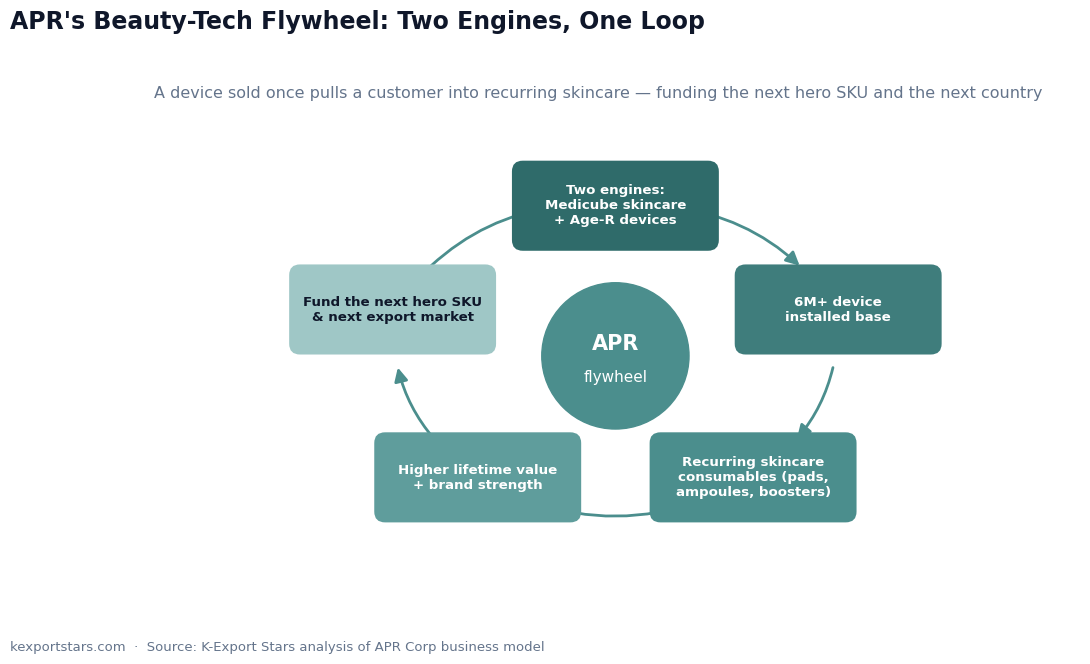
APR’s real moat is the “device plus consumable” ecosystem: an Age-R gadget is a one-time purchase that pulls the customer into a recurring stream of Medicube skincare — a razor-and-blades model that raises lifetime value and blends into unusually high margins for a beauty company.
Most K-beauty rivals sell only cosmetics, a category with low barriers to entry and fickle, trend-driven demand. APR’s twist is hardware. An Age-R Booster Pro owner is encouraged to use branded ampoules, pads, and boosters with the device — so the gadget doesn’t just sell once, it anchors a customer to the Medicube consumables that follow. Historically the device business has represented roughly 40% of APR’s revenue — one of the highest device mixes in the industry — and although that share has compressed toward a third as the cosmetics division surged past KRW 1 trillion, devices still carry a different, stickier economic profile than a jar of cream.
The financial fingerprint of that model is visible in the numbers: APR runs a gross margin near 77% and delivered a ~24% operating margin in 2025 — figures that look more like a consumer-tech company than a commodity cosmetics maker. With over 6 million devices now in customers’ bathrooms worldwide, the installed base itself becomes a growing, semi-captive market for the next skincare launch.
🌏 The Export Engine: America First, Then the World
APR is, above all, an export story — and that is exactly why it fits the K-Export Stars thesis. Overseas revenue surged 207% in 2025 to roughly KRW 1.23 trillion, and the overseas share of sales leapt from 55% to about 80% in a single year. The United States is the spearhead, but management is deliberately replicating the playbook across markets.
| Metric (FY2025) | Figure | Change / Note |
|---|---|---|
| Revenue | KRW 1.53 trillion | +111% YoY |
| Operating profit | KRW 365 billion | +198% YoY (~24% margin) |
| Net profit | KRW 290 billion | +170% YoY |
| Overseas revenue | ~KRW 1.23 trillion | +207% YoY; ~80% of total |
| Cosmetics division | > KRW 1 trillion | First time above KRW 1tn |
| Age-R devices (cumulative) | > 6 million units | >60% sold overseas |
Beyond the US, Age-R and Medicube have been pushing into Japan, Greater China, Southeast Asia, and Europe — after entering the UK, APR has signaled Amazon-led expansion into France, Germany, Italy, and Spain. Each new market is the same funnel run again: organic social demand first, marketplace scale second, retail shelves third. For readers newer to how foreign money reacts to stories like this, our primer on how foreign and institutional flows move Korean stocks is a useful companion.
💰 Is APR Stock Expensive?
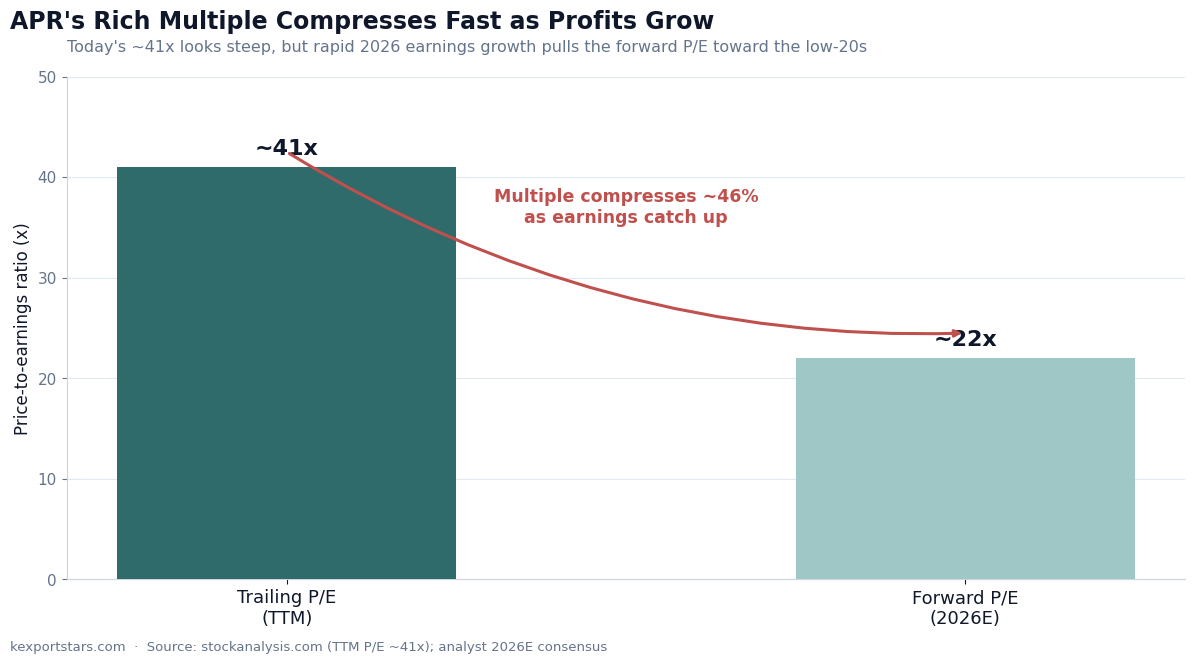
Yes — APR trades at a clear growth premium: roughly 41x trailing earnings and a ~KRW 14.7 trillion market cap, well above a typical cosmetics multiple, so the price already embeds years of rapid expansion. One reconciliation note for readers doing the math: that ~41x is measured on trailing-twelve-month net income of about KRW 357 billion — already ahead of the FY2025 figure of KRW 290 billion, because profits kept climbing through the first half of 2026 — so dividing the KRW 14.7 trillion market cap by TTM earnings (not the FY2025 number) is what gives ~41x. The bull case is that earnings are growing so fast the multiple compresses quickly — the forward P/E falls toward the low-20s on 2026 estimates, and analysts model revenue pushing toward KRW 2 trillion or more next year.
| Valuation snapshot | Value (mid-July 2026) |
|---|---|
| Share price | ~KRW 393,000 |
| Market cap | ~KRW 14.7 trillion |
| Trailing P/E | ~41x (TTM, on ~KRW 357bn net income) |
| Forward P/E (2026E) | ~22x |
| Analyst consensus | “Strong Buy” (27 buy / 0 sell) |
| Average target price | ~KRW 490,000 (range 330k–560k) |
In other words, APR is priced like a high-growth consumer-tech name, not a legacy cosmetics stock — a notable exception to the usual Korea Discount that weighs on so many KOSPI shares. When a Korean company earns a global-growth multiple, it means the market is treating it as a global company. That is the opportunity — and the risk.
- Valuation leaves no cushion. At ~40x trailing earnings, APR is priced for continued hypergrowth. A single soft quarter — beauty is seasonal and hit-SKU driven — could trigger a sharp de-rating.
- K-beauty is brutally competitive. Cosmetics has low barriers to entry, and today’s viral hero product can be tomorrow’s discount-bin item. Sustaining a steady pipeline of new hits is harder than launching one.
- US and Amazon concentration. A huge share of the growth runs through a single country and, in large part, a single platform. Changes to Amazon’s algorithm, fee structure, or a shift in social-media momentum could hit sales fast.
- Tariff and trade risk. With US demand central to the thesis, any escalation in US–Korea trade friction or new tariffs on imported cosmetics/devices would pressure margins or pricing.
- Growth-rate math. After +111%, simply lapping 2025 is a tall order. Even excellent absolute growth can disappoint a market that has extrapolated the recent curve.
📚 Lingo Check
| Term | What it means |
|---|---|
| Dermocosmetic | Skincare positioned as clinical / problem-solving (“derma-cosmetic”), sitting between mass cosmetics and pharmacy skincare. |
| Beauty device | A home gadget (microcurrent, RF, booster) that delivers skincare treatments — Age-R’s category. |
| Razor-and-blades | Sell the hardware once, then earn recurring revenue on consumables it requires — here, devices pulling repeat skincare sales. |
| PDRN | Polydeoxyribonucleotide — a salmon-DNA derived ingredient marketed for skin repair and elasticity; a hero Medicube range. |
| Operating margin | Operating profit ÷ revenue. APR’s ~24% is high for a cosmetics firm, reflecting the device/brand mix. |
| Forward P/E | Share price ÷ next year’s expected earnings — lower than trailing P/E when profits are growing fast. |
🎯 Why It Matters for K-Export Stars
APR is a textbook K-Export Star: a Korean company earning the vast majority of its money abroad by exporting a differentiated, high-margin product the world actually wants. It extends the same consumer-soft-power thesis we track in K-food (Samyang’s Buldak) into K-beauty — but with a tech twist that lifts margins and stickiness above a typical snack or cosmetics brand. Alongside d’Alba Global — the other K-beauty growth story, the vegan-skincare IPO star that just opened Korea’s first shareholder-only store — APR anchors the K-beauty basket global investors keep screening for — the very basket where it recently dethroned the legacy incumbent, Amorepacific — see the full lineup in our complete guide to Korean beauty stocks.
It also matters because the market is paying for it. Where the Korea Discount usually caps how much investors will pay for KOSPI earnings, APR commands a global-growth multiple. That is a data point in a bigger story: when Korean companies build genuine global brands and export engines, the discount can invert into a premium. APR is one of the clearest current examples of that shift.
Conclusion
APR has done something rare: turned a Korean skincare brand into a genuine global export franchise, and wrapped it in a device-plus-consumable model that gives it consumer-tech economics. The growth is real, the margins are excellent, and the US breakout is verifiable — not hype. The catch is that the market already knows all of this. At ~40x earnings, APR is a bet that the flywheel keeps spinning across new products and new countries. If it does, today’s premium looks cheap in hindsight; if growth merely normalizes, the stock has a long way to fall. For investors, the question is not “is APR a great company?” — it clearly is — but “how much of the next three years is already in the price?”
Disclaimer: This article is for informational and educational purposes only and does not constitute investment advice, a recommendation, or an offer to buy or sell any security. Figures are drawn from company disclosures and third-party sources believed to be reliable as of mid-July 2026 but may contain errors or become outdated. Investing in equities — especially high-growth, high-multiple stocks — involves substantial risk, including loss of principal. Always do your own research and consult a licensed financial professional before making any investment decision.
Written by James Ju — a Seoul-based engineer who reads Korean-language DART and KRX filings, the primary sources most English-language coverage skips. About the author.