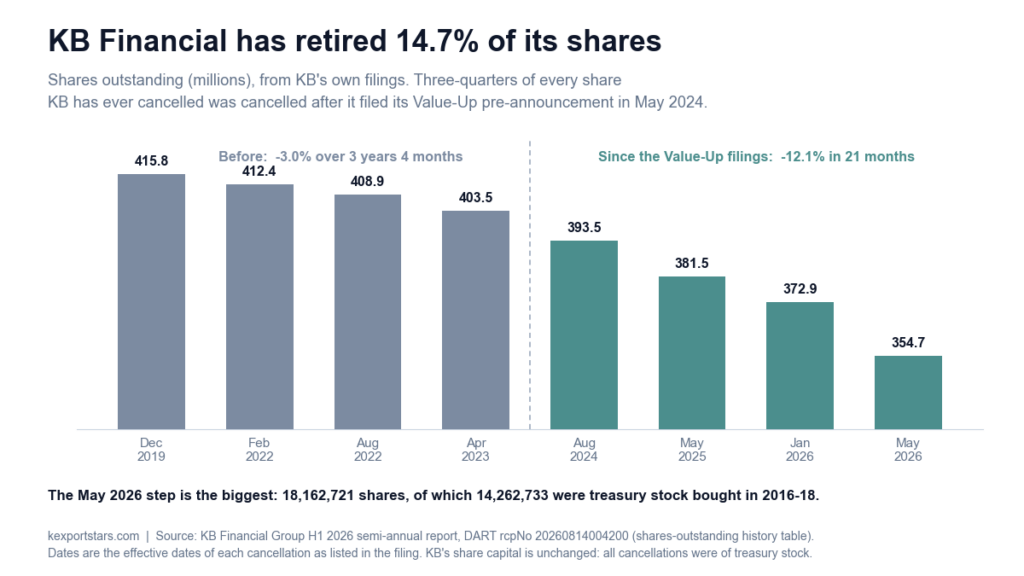
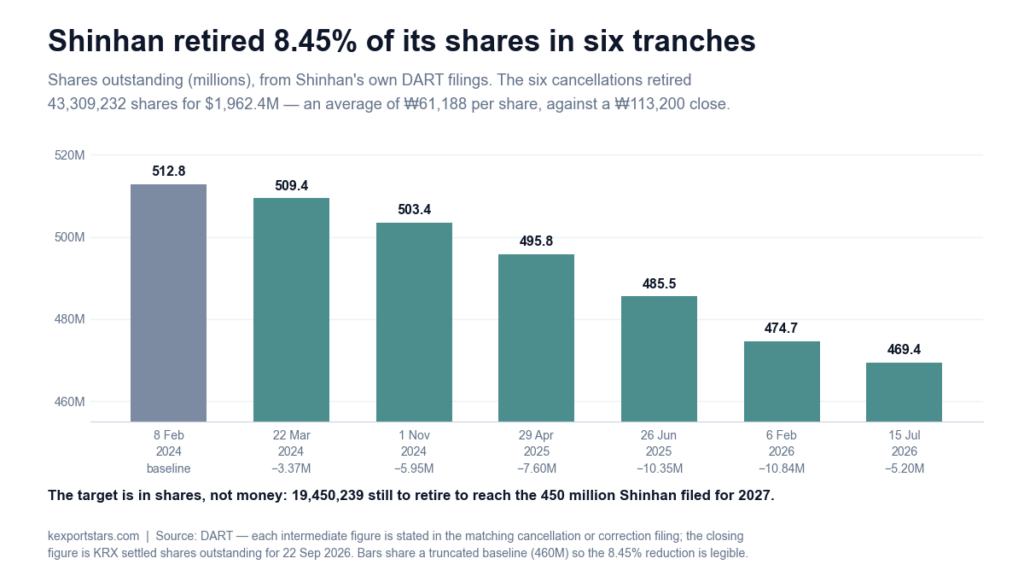
Every big Korean bank is telling foreign investors the same story right now: we are buying back stock, we are raising our capital ratio, please re-rate us. Woori Financial Group is the cheapest of the four, at 0.68 times book on its September 22, 2026 close. It is also the one whose own filings show the buyback being more than undone — by a deal the same company describes as the moment its franchise was finally complete.
🔑 Key Takeaways
- Woori is the cheapest of Korea’s big four banks — 8.8× trailing earnings and 0.68× controlling-interest book value at $26.47 (₩35,750) as of Sep 22, 2026 (KRX settled close), against KB at 11.4× / 1.02× and Shinhan at 11.5× / 0.88×. (Source: KRX settled close Sep 22, 2026; DART FY2025 annual reports — see valuation table footnote for each rcpNo.)
- The old knock on Woori — thinnest capital of the four — is no longer true. Its group CET1 ratio was 13.74% at Jun 30, 2026, exactly level with KB and ahead of Shinhan (13.43%) and Hana (13.27%), all read from the same regulatory table in each group’s own half-year report. ⚠️ But 71 of the 85 basis points Woori added this half landed in the first quarter alone, and the ₩1.80tn ($1.33bn) land revaluation dated to March 31, 2026 is worth roughly 74bp on its own. The capital came from marking up land, not from earning money. (Source: DART 반기보고서, rcpNo 20260814003410 / 20260814004200 / 20260814003306 / 20260814003800; provisional.)
- Woori cancelled 5,986,638 shares in June and issued 8,696,875 in August. The share count is higher than it was on January 1 — 1.45 shares issued for every one retired. (Source: DART 20260610800817 and 20260811000475.)
- Headline loan-loss coverage fell to 112.9%, but that ratio leaves out Korea’s statutory 대손준비금, whose balance was ₩3.19tn ($2.36bn) at Jun 30, 2026. Add it and the real buffer is 219% — a number no English-language source prints. ⚠️ ₩2.96tn ($2.19bn) of that balance is already appropriated inside retained earnings; the remaining ₩229bn ($169.9M) is a charge against first-half profit still to be appropriated. (Source: DART 반기보고서 20260814003410, note 22-B.)
- Woori has no controlling family and no chaebol parent. Its largest shareholder is its own employees’ stock ownership association at 8.51%, ahead of BlackRock (7.18%) and the National Pension Service (6.43%). It was state-controlled until December 2021.
🏢 What Is Woori Financial Group, and What Does It Actually Sell?
Woori Financial Group is a Korean bank holding company that owns Woori Bank — Korea’s oldest bank, founded in 1899 — plus 15 other financial subsidiaries spanning insurance, cards, consumer finance, securities and asset management, with total assets of ₩635.2tn ($470.4bn) as of June 30, 2026.
The holding company itself does almost nothing. Woori Financial Group Inc. was incorporated on January 11, 2019 and listed on the KOSPI on February 13, 2019; its stated purpose is to control, manage and fund its subsidiaries. It is run from 51 Sogong-ro in central Seoul by chairman Lim Jong-yong, who took the job in March 2023. Everything you are buying sits one level below.
The operating engine is Woori Bank, which traces directly to Daehan Cheonil Bank, founded January 30, 1899 with purely Korean capital — the country’s first modern bank. Through a century of mergers it became Hanil Bank and Korea Commercial Bank, then Hanvit Bank in 1999, then Woori Bank in 2002. Woori Bank runs 24 countries of network, including subsidiaries in Indonesia (150 branches), Cambodia (133), Vietnam (29) and the United States (24 offices across nine states) — the widest emerging-market branch footprint of any Korean bank.
Around the bank sit the rest: Dongyang Life and ABL Life (life insurance, acquired July 2025), Woori Card, Woori Financial Capital (auto and corporate lending), Woori Investment & Securities, Woori Asset Trust, Woori Savings Bank, Woori Asset Management, Woori Venture Partners, Woori Private Equity, Woori F&I (a distressed-debt investor), plus service units in credit information, fund administration, IT and research. At June 30, 2026 the group consolidated 215 entities, up from 203 six months earlier at December 31, 2025, and 188 at December 31, 2024. (Source: DART 반기보고서 2026.06, rcpNo 20260814003410.) For background on the company as a neutral entity, see Wikipedia’s Woori Financial Group page.
Who pays Woori? Overwhelmingly, Korean borrowers. Average interest-earning loans ran ₩383.7tn ($284.1bn) in the first half of 2026 at a 4.26% yield, funded by ₩361.4tn ($267.6bn) of average deposits costing 2.20%. That roughly 2.06-point gap between loan yield and deposit cost, applied across a third of a trillion dollars, is the business. ⚠️ It is not the net interest margin: it compares one asset yield with one funding cost, ignoring wholesale funding and non-loan assets. Read it as where the money comes from, not as a margin you can multiply out.
📊 Where Does Woori’s Revenue Actually Come From?
Lending still produced 82.4% of Woori’s operating revenue in FY2025, but the non-interest share has grown from 11.1% in FY2023 to 17.6% — the clearest evidence that the diversification strategy is doing something.
A bank has no “sales” line in the sense a manufacturer does. The equivalent revenue mix is net interest income — what it earns lending, minus what it pays depositors — against everything else: fees, trading, FX, and now insurance.
| Revenue mix (full year) | FY2023 | FY2024 | FY2025 |
|---|---|---|---|
| Net interest income | $6,475M | $6,580M | $6,688M |
| — share of operating revenue | 88.9% | 85.1% | 82.4% |
| Non-interest income | $810M | $1,151M | $1,426M |
| — share of operating revenue | 11.1% | 14.9% | 17.6% |
| Total operating revenue | $7,285M | $7,731M | $8,114M |
Consolidated, on the company’s own 순이자이익 / 비이자이익 presentation; shares are our calculation of each line over their sum. ⚠️ Do not mix this “non-interest income” with the separately disclosed gross fee line — they are different definitions. Converted at ₩1,350.36/$1. Source: DART 사업보고서 2025.12, rcpNo 20260313001235, “주요 경영지표”.
Translated into profit, the same shift looks like this. The bank produced 77.6% of subsidiary-level net income in the first half of 2026 — down from 90.3% in 2025 and 91.6% in 2024, but still far more bank-dependent than any of Woori’s three rivals.
| Segment | H1 2026 net income | Share | FY2025 net income | Share |
|---|---|---|---|---|
| Bank | $1,011M | 77.60% | $1,912M | 90.25% |
| Insurance | $85M | 6.53% | $74M | 3.48% |
| Credit card | $70M | 5.41% | $112M | 5.28% |
| Consumer finance (Capital) | $57M | 4.37% | $110M | 5.20% |
| Securities | $19M | 1.41% | $20M | 0.96% |
| All other subsidiaries | $61M | 4.68% | −$110M | −5.17% |
| Group (after consolidation adj.) | $1,234M | — | $2,390M | — |
Segment figures are total net income (including non-controlling interests), per the company’s own segment table; shares are of the simple sum of subsidiaries before consolidation adjustments, which is how Woori presents them. Group totals include a consolidation adjustment of −$69M (H1 2026) and +$271M (FY2025). Converted at ₩1,350.36/$1 (FDR close, Sep 22, 2026). Source: DART 반기보고서 2026.06, rcpNo 20260814003410.
The jump in non-bank share — 8.4% in FY2024, 9.8% in FY2025, 22.4% in H1 2026 — is the number Woori’s management leads with, and it is real. But two things drove it, and only one is the insurance deal. The insurers contributed $85M. The rest of the move came from the “all other” bucket swinging from −$110M for full-year 2025 to +$61M in six months. Half the re-balancing is smaller units ceasing to lose money.
And here is the check that matters. The two life insurers were consolidated from July 1, 2025, so the first half of 2026 is the first half-year that carries them and the first half of 2025 carries none. The insurance segment earned ₩114.8bn ($85.0M) of net income in H1 2026. Group net income attributable to shareholders rose from ₩1,552.0bn ($1.15bn) to ₩1,608.9bn ($1.19bn) — just ₩56.9bn ($42.1M), or +3.7%.
Subtracting one from the other is the obvious move and it is wrong, in a way that nearly doubles the gap. The ₩114.8bn is total segment net income including non-controlling interests; the ₩56.9bn is the increase in profit attributable to Woori’s own shareholders. Woori held only 75.34% of Dongyang Life through the period, and the filing says precisely how much of Dongyang’s profit went to its minorities: ₩21.7bn ($16.1M). So about ₩93bn ($68.9M) was ever available to Woori shareholders in the first place, and against a ₩56.9bn increase that implies the pre-existing businesses went backwards by something like ₩36bn ($26.7M) — not the ₩58bn ($42.9M) a straight subtraction gives. ⚠️ Even ₩36bn is approximate, because segment net income is struck before consolidation adjustments and the attributable figure after them; treat it as an order of magnitude, not a line item. Either way the portfolio got broader before it got bigger. (Source: DART 반기보고서 2026.06, rcpNo 20260814003410 — segment note and the note on non-controlling interests in significant subsidiaries, which prints Dongyang Life’s ₩21,712m allocation against a nil comparative.)
🗓️ How Woori Got Here: From Ward of the State to Private Holdco
Woori is the only one of Korea’s four major financial groups that spent the 2000s and 2010s under government control, and it completed privatisation only in December 2021 — which is why it entered this decade with the thinnest non-bank franchise and the weakest capital position of the four.
No Korean financial group has a stranger recent history. Woori’s predecessor was nationalised after the 1997 Asian financial crisis; the Korea Deposit Insurance Corporation — the government’s deposit insurer — remained its largest shareholder for the next two decades. Full privatisation only completed at the end of 2021.
| Date | What happened |
|---|---|
| Jan 1899 | Daehan Cheonil Bank founded — Korea’s first modern bank, later Woori Bank |
| Jan 2019 | Woori Financial Group Inc. established as a holding company; KOSPI listing Feb 13, 2019 |
| Dec 2021 | Privatisation completed — KDIC stake cut from 15.1% to 5.8%; the employee stock ownership association becomes largest shareholder |
| Mar 2023 | Lim Jong-yong appointed chairman; first buy-and-cancel resolution since holdco conversion follows in April |
| Jul 2024 | First Value-Up disclosure — the first by any Korean bank holding company |
| Aug 2024 | Woori Investment & Securities launched (Korea Pos Securities + Woori Investment Bank merger); SPA signed to buy Dongyang Life and ABL Life |
| Jul 2025 | Dongyang Life (75.34%) and ABL Life (100%) consolidated — the non-bank portfolio is “complete” |
| Aug 2026 | Dongyang Life taken to 100% via comprehensive share exchange, paid for in new Woori stock |
Source: DART 사업보고서 2025.12, rcpNo 20260313001235, sections “회사의 연혁” and “주요 자회사의 연혁”; 반기보고서 2026.06, rcpNo 20260814003410.
That history explains the two facts that define Woori today. Because it spent twenty years as a state-managed asset, it entered the 2020s with the thinnest non-bank franchise of the big four and a capital ratio the market treated as its defining weakness. Everything management has done since 2023 — the securities merger, the insurance purchase, the buybacks — is an attempt to close both gaps at once. The rest of this piece is about whether the filings show it working.
🌍 Is Woori Actually a Leader in Anything?
No — Woori has the smallest market share of the four major Korean commercial banks, at 22.6% of won-denominated lending as of March 2026, and that share has been shrinking while its rivals hold theirs.
Woori Bank discloses its own market share against its three rivals, sourced to Korea’s official financial statistics system. It is not flattering:
| Won-loan market share | Mar 2026 | 2025 | 2024 |
|---|---|---|---|
| Kookmin Bank (KB) | 28.3% | 28.4% | 28.3% |
| Shinhan Bank | 25.3% | 25.1% | 24.9% |
| Hana Bank | 23.9% | 23.9% | 23.5% |
| Woori Bank | 22.6% | 22.6% | 23.3% |
Share of won-denominated loans among the four major commercial banks only, period-end balances, as disclosed by Woori Bank and reproduced as filed rather than recalculated. All three columns come from a single table in the half-year report, so the periods are directly comparable. ⚠️ The same filing carries a separate deposit-share table with different numbers — do not read across the two. The filing names its own source in two footnotes: 주1) share among the four major commercial banks, on a March 2026 basis; 주2) period-end balances per 금융통계정보시스템. Source: the Financial Supervisory Service’s Financial Statistics Information System (FISIS), as reproduced in DART 반기보고서 2026.06, rcpNo 20260814003410, “[시장점유율 추이]”. FISIS is the free public database behind these numbers, run by the Financial Supervisory Service — anyone can re-pull the series.
Woori is last of the four and it is the only one of the four that lost share: down 0.7 points since 2024, while Shinhan gained 0.4 and Hana gained 0.4 and KB held flat. Deposits tell the same story — Woori’s share of won deposits fell from 23.1% to 22.6% over the same period. At $19.51bn of market capitalisation on Sep 22, 2026 it is worth 42% of KB and 50% of Shinhan, and it earned ₩3.12tn ($2.31bn) attributable to shareholders in 2025 against KB’s ₩5.83tn ($4.32bn) and Shinhan’s ₩4.97tn ($3.68bn). There is no product line in which Woori is the domestic number one.
One unit is genuinely gaining: Woori Asset Management’s share of Korean fund and discretionary assets rose from 2.51% to 3.25% in six months as assets under management grew 64.3% to ₩90.1tn ($66.7bn). (Source: Korea Financial Investment Association via DART rcpNo 20260814003410.)
What Woori does have: the oldest banking licence in Korea, and the broadest retail footprint in Southeast Asia of any Korean bank — 150 outlets in Indonesia, 133 in Cambodia, 29 in Vietnam, all consolidated subsidiaries rather than representative offices. If you want Korean-bank exposure with a genuine frontier-market lending book attached, Woori is the one that has it. That is a real differentiator and it is also, at present, a small one relative to the ₩531.3tn ($393.5bn) Korean bank balance sheet it sits beside.
📈 Is the Business Getting Better or Worse?
Revenue is growing and the revenue mix is improving, but costs are growing faster and return on equity has fallen in each of the last two years — from 9.34% in 2024 to 9.01% in 2025 to 8.55% annualised in the first half of 2026.
| Full year (consolidated) | FY2023 | FY2024 | FY2025 |
|---|---|---|---|
| Net interest income | $6,475M | $6,580M | $6,688M |
| Non-interest income | $810M | $1,151M | $1,426M |
| Operating expenses (SG&A) | $3,290M | $3,309M | $3,836M |
| Cost-to-income ratio | 45.2% | 42.8% | 47.3% |
| Credit provisions charged | $1,403M | $1,271M | $1,557M |
| Return on equity (ex-minorities) | 8.25% | 9.34% | 9.01% |
All figures full-year consolidated, converted at ₩1,350.36/$1. The cost-to-income ratio is our calculation — operating expenses divided by net interest income plus non-interest income — not a company-disclosed figure. ⚠️ FY2025 is not strictly like-for-like: the two life insurers were consolidated from July 1, 2025, adding six months of both revenue and cost. Source: DART 사업보고서 2025.12, rcpNo 20260313001235, “이사의 경영진단 및 분석의견 — 주요 경영지표”.
Non-interest income has grown 76% in two years and now supplies 17.6% of operating revenue, up from 11.1%. That is the diversification thesis working. But operating expenses jumped 15.9% in 2025, pushing the cost-to-income ratio to 47.3% — its worst level in the three years shown — and credit provisions rose 22.6%.
Which brings us to a claim worth flagging. Woori’s half-year report states that the non-bank build-out is “improving group ROE.” The company’s own return-on-equity table, three sections later in the same filing, reads 9.60% → 9.31% → 8.85% including minorities, and 9.34% → 9.01% → 8.55% excluding them. Group ROE has fallen in every period since the strategy began. The ambition may well be right; the disclosed trend to date is the opposite of the sentence.
🔍 Did Woori Really Shrink Its Share Count in 2026?
No. Woori cancelled 5,986,638 shares in June 2026 and issued 8,696,875 new ones in August — leaving 2,710,237 more shares outstanding than at the start of the year, or 1.45 issued for every one retired.
This is the part of the story that exists only in Korean-language filings, in three separate documents that no English wire has put side by side. Here is the chain, and it reconciles exactly to the share count behind today’s market capitalisation.
| Date | Event | Shares | Running total |
|---|---|---|---|
| Dec 31, 2025 | Shares issued | — | 734,076,320 |
| Jun 18, 2026 | Cancelled — ₩200.0bn ($148.1M) buyback | −5,986,638 | 728,089,682 |
| Aug 11, 2026 | Issued — Dongyang Life share exchange | +8,696,875 | 736,786,557 |
| Sep 22, 2026 | Net change year to date | +2,710,237 | 736,786,557 |
The June 30 figure is confirmed independently in the half-year report’s lock-up table (총발행주식수 728,089,682) and the September figure matches the KRX listed-share count used for market capitalisation. Sources: DART rcpNo 20260313001235 (annual report), rcpNo 20260610800817 (amended cancellation decision), rcpNo 20260811000475 (securities issuance report), rcpNo 20260814003410 (half-year report).
The August issue paid for the last 24.66% of Dongyang Life, at an exchange ratio of 0.2521056 Woori shares per Dongyang share, with the new stock listed on August 31. Dissenting Dongyang holders — 2,043 of them, covering 21,865,634 shares — exercised appraisal rights at $6.93 (₩9,356) per share.
It is worth being precise about what that deal bought. Woori already controlled and already consolidated Dongyang Life. The exchange did not add a business; it converted non-controlling interests in a subsidiary Woori already ran into wholly-owned equity, and it paid for that conversion with 1.19% dilution of every existing Woori shareholder. At the September 22 close the new shares are worth $230.2M — against the $148.1M of cash the company spent retiring stock two months earlier.
There is a second, smaller finding buried in the same filings, and it changes how you should read every Korean buyback announcement. A Korean 주식소각결정 states a won amount and an estimated share count, and the share count is derived from the prior day’s closing price. It is an estimate, not a commitment — and Woori has missed it twice running, in the same direction:
- 2025 programme: announced 9,596,928 shares for ₩150bn ($111.1M), priced off a ₩15,630 close. Executed: 8,515,181 shares — 11.3% fewer — at an average ₩17,616 ($13.05), cancelled Sep 19, 2025.
- 2026 programme: announced 6,269,592 shares for ₩200bn ($148.1M), priced off a ₩31,900 close. Executed: 5,986,638 shares — 4.5% fewer — at an average ₩33,409 ($24.74), cancelled Jun 18, 2026.
The won is the promise; the share count is a guess that shrinks whenever the stock rallies during the buying window. A reader who anchors on the announced share count will overestimate the retirement every time the programme works.
Woori has a third programme live: a ₩150bn ($111.1M) trust resolved on July 24, 2026, with a buying window running to January 22, 2027 and an estimated 4,854,368 shares. We covered that resolution the week it was filed, in Foreign Flow Watch for the week of July 24, 2026. Two months on, the update is the important part: it has been announced, not executed — no shares have been acquired or cancelled under it as of this writing. Even if it completes in full, it would retire fewer shares than August issued.
🔍 Is Woori Dangerously Under-Reserved?
On the headline ratio Woori’s loan-loss coverage has collapsed from 153.0% at December 2024 to 112.9% at June 2026 — but that ratio excludes Korea’s statutory loan-loss reserve, whose balance stood at ₩3.19tn ($2.36bn) on June 30, 2026, and once you add it the combined buffer is 219%.
This is the single most misread number in Korean bank analysis, and it is misread because of a distinction that exists in Korean regulation and has no clean English equivalent. Two different things are both called “loan loss reserves” in English coverage:
- 대손충당금 — the IFRS 9 allowance. A contra-asset, charged through the income statement, sized by expected credit loss models. This is what the published coverage ratio measures.
- 대손준비금 — the regulatory loan-loss reserve. An appropriation of retained earnings, required of Korean financial institutions precisely because supervisors judged IFRS 9 provisioning to be thinner than the old Korean rules. Once appropriated it sits in equity, inside retained earnings. It is not in the coverage ratio.
| As of | Non-performing loans | IFRS allowance | Headline coverage | Regulatory reserve | Combined buffer |
|---|---|---|---|---|---|
| Dec 31, 2024 | $1,637M | $2,504M | 153.0% | not disclosed here | — |
| Dec 31, 2025 | $1,864M | $2,420M | 129.9% | $2,192M | 247.4% |
| Jun 30, 2026 | $2,227M | $2,515M | 112.9% | $2,362M | 219.0% |
Group consolidated, FSS financial-holding-company reporting basis; June 30, 2026 figures are provisional per the filing. Non-performing loans = 고정이하여신 (substandard-and-below). The regulatory reserve is the closing balance of 대손준비금 (₩2,959,506m at Dec 2025; ₩3,188,953m at Jun 2026), taken from the consolidated equity note, which computes it under Articles 26–28 of the Financial Holding Company Supervision Regulation — i.e. on the same group basis as the loan figures. ⚠️ The balance is not all money already set aside. The note builds it from three separate lines; at June 30, 2026 those were ₩2,959,506m already appropriated within retained earnings (적립액), ₩0 from business combinations, and ₩229,447m ($169.9M) still to be appropriated out of first-half earnings (전입 예정액). Those are different measures, not one measure at two dates — the appropriated figure at June 30 equals the December 31 balance only because December’s pending amount was duly appropriated in between. We use the balance because it is the buffer the regulation requires, and read the ₩229,447m as a committed charge against profit already earned rather than as capital already standing in the accounts. The 2024 comparative is not given in this filing, so we leave it blank rather than estimate. Combined buffer is our calculation: (allowance + reserve) ÷ NPLs. Converted at ₩1,350.36/$1. Source: DART 반기보고서 2026.06, rcpNo 20260814003410, sections “라. 건전성 지표” and note 20 (자본).
Both readings contain truth, and an honest analyst has to hold them together. The reserve balance rose ₩229bn ($169.9M, +7.8%) in six months — and that entire increase is the ₩229,447m the group has yet to appropriate out of first-half profit, so Woori is topping the buffer up rather than running it down. But non-performing loans grew 19.5% in the same six months while the IFRS allowance grew only 3.9%, and the combined buffer still fell from 247% to 219%. Asset quality is deteriorating faster than either cushion is being topped up.
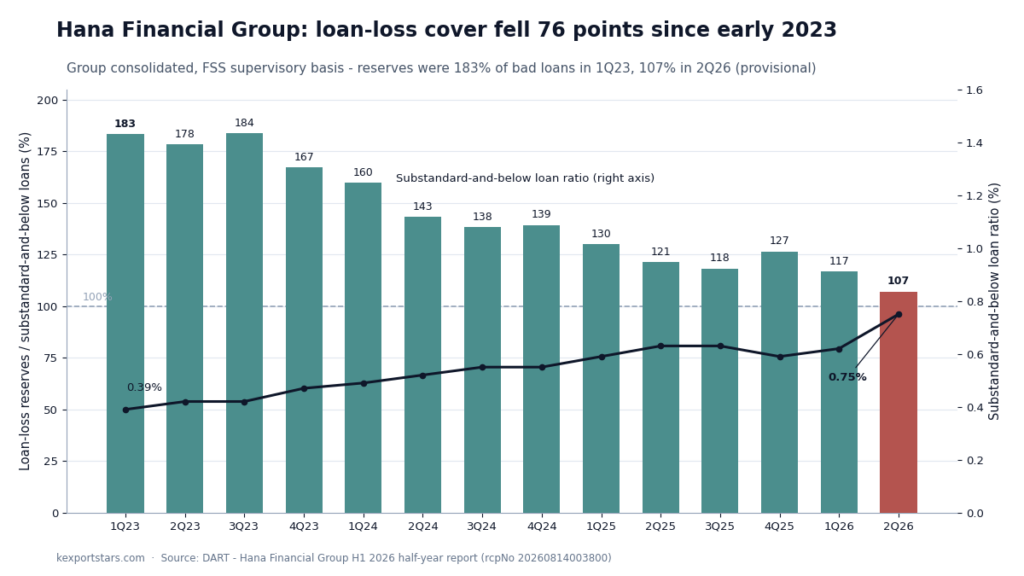
The other half of the context is the cross-section. At June 2026 the four sit in a narrow band — Shinhan 117.0%, Woori 112.9%, KB 112.2%, Hana 107.0% — so Woori ends in the middle of the pack. But they did not all travel the same distance to get there, and we are not going to assert a sector-wide trajectory we have not measured bank by bank. What we have measured is Woori’s own: 153.0% to 129.9% to 112.9%. It started from the highest cushion of the four and it fell the furthest. Whether the others fell with it is a separate question, and the answer is not the same for all three.
🏛️ Has Woori Fixed the Capital Problem It Was Famous For?
Yes — Woori’s group CET1 ratio reached 13.74% at June 30, 2026, exactly level with KB and above both Shinhan and Hana, ending a decade in which thin capital was the standard argument against the stock.
Woori’s own half-year report says its CET1 ratio “recorded an industry-best level.” That is a management assertion, and the kind of sentence that should never be copied without checking. So we checked it — by reading the identical regulatory table (capital headroom under Article 43 of the Financial Holding Company Supervision Regulation) in all four groups’ own half-year reports, filed on the same day.
| Group (ticker) | CET1 ratio | NPL ratio | Headline coverage |
|---|---|---|---|
| Woori (316140) | 13.74% | 0.73% | 112.9% |
| KB Financial (105560) | 13.74% | 1.01% | 112.2% |
| Shinhan Financial (055550) | 13.43% | 0.79% | 117.0% |
| Hana Financial (086790) | 13.27% | 0.75% | 107.0% |
All figures group consolidated as of June 30, 2026, all provisional, all taken from each company’s own 반기보고서 filed August 14, 2026 — Woori 20260814003410, KB 20260814004200, Shinhan 20260814003306, Hana 20260814003800. ⚠️ Where to find this number: the section headed “capital adequacy” (자본적정성 현황) in these filings shows only the total BIS ratio — Woori’s reads 16.59% — and contains no CET1 line at all. The group CET1 is in a different table, the capital-headroom disclosure under Article 43 of the Financial Holding Company Supervision Regulation. Both tables print the same total ratio (16.59%) and the same risk-weighted assets (₩244.3tn: the Article 43 table’s CET1 headroom of ₩27,945.1bn ÷ 11.44% = ₩244,275bn, matching exactly), which is how we confirmed the two refer to the same consolidated entity. NPL and coverage are on the FSS financial-holding-company reporting basis, which is not the same as the definitions some of these groups use in their English IR decks — the IR numbers are generally worse. Do not mix the two.
So the claim survives, with one correction: Woori is joint best, not sole best. The trajectory is the striking part — CET1 of 11.57% at end-2022, 11.99% (2023), 12.13% (2024), 12.89% (2025), 13.60% at March 31, 2026 and 13.74% at June 30. That is 217 basis points in three and a half years, against risk-weighted assets that grew to ₩244.3tn ($180.9bn).
Read the quarterly column rather than the half-year one and the 85-basis-point jump stops being a mystery. Seventy-one of those 85 basis points landed in the first quarter alone (12.89% → 13.60%); the second quarter added 14. Something happened in Q1, and the filing names it three notes later.
Woori changed its accounting policy for land — land only, not buildings — from the historical cost model to the revaluation model, effective this period and not applied retrospectively. The valuation date is March 31, 2026: the first quarter, exactly where 71 of the 85 basis points appeared. The revaluation produced a gross gain of ₩2,474,043m ($1.83bn) before a ₩678,021m ($502.1M) deferred-tax charge, and the first-half statement of comprehensive income records the resulting revaluation surplus of ₩1,796,434m — ₩1.80tn, or $1.33bn, of which ₩1,795,284m is attributable to parent shareholders. The same filing shows the bank’s ratio of business premises to capital jumping from 9.42% to 15.05%, noted as being “after asset revaluation.” Nothing else of that size hit equity in the period.
Set that surplus against risk-weighted assets and it is worth roughly 74 basis points — against a total CET1 increase of 85 basis points for the half, of which 71 fell in the quarter the revaluation is dated to. Note that 74 is larger than 71: on these figures the revaluation more than accounts for its own quarter, and other moves in Q1 — risk-weighted assets growing ₩6.5tn chief among them — pushed the other way. On the disclosed figures, in other words, most of this half’s capital improvement came from marking up land, not from earning money. That is a legitimate and entirely legal source of regulatory capital, and every Korean bank has the same option. It is simply not repeatable in that form, and it is not what “the group’s capital management capability” implies to a reader. (The 74bp is our calculation — ₩1.80tn over ₩244.3tn of risk-weighted assets — and we cannot see from public disclosure exactly how the surplus is treated after regulatory deductions, so read it as the scale of the effect rather than a precise attribution. Risk-weighted assets also grew ₩6.5tn ($4.81bn) in Q1, which works the other way.)
Two further caveats. First, capital ratios and provisioning share a lever: lower credit charges raise retained earnings, which raise CET1. We cannot separate the two from public disclosure, and we are not asserting that Woori under-provisioned to flatter capital — only that the two trends moved in the directions that would be consistent with it, and that the reserve table above is where you would look. Second, ratios described as 잠정 (provisional) in a Korean filing are routinely restated by a few basis points in the subsequent quarterly disclosure.
💰 What Do You Actually Pay for Woori Today?
At $26.47 a share (₩35,750, Sep 22, 2026 close) you pay 8.8 times trailing earnings and 0.68 times controlling-interest book value — the cheapest of the four on both measures, and roughly a third below KB despite an identical capital ratio.
| Group | Market cap | P/E | P/B | P/B ex-hybrid | CET1 |
|---|---|---|---|---|---|
| Woori (316140) | $19.51bn | 8.82 | 0.68 | 0.75 | 13.74% |
| KB Financial (105560) | $46.15bn | 11.40 | 1.02 | 1.10 | 13.74% |
| Shinhan Financial (055550) | $39.35bn | 11.54 | 0.88 | 0.95 | 13.43% |
| Hana Financial (086790) | $27.29bn | 9.75 | 0.79 | 0.87 | 13.27% |
Method, applied identically to all four. Market cap = KRX settled close of Sep 22, 2026 × listed shares (Woori ₩35,750 × 736,786,557; KB ₩175,700 × 354,687,734; Shinhan ₩113,200 × 469,450,239; Hana ₩136,000 × 270,969,910), converted at ₩1,350.36/$1. P/E = that close ÷ company-disclosed FY2025 basic EPS on a controlling-interest basis, after hybrid-security distributions: Woori ₩4,052 (rcpNo 20260313001235), KB ₩15,410 (20260619000667), Shinhan ₩9,812 (20260318000826), Hana ₩13,954 (20260814004019). P/B = market cap ÷ equity attributable to owners of the parent at Jun 30, 2026; P/B ex-hybrid deducts hybrid capital securities from that equity. ⚠️ Numerator and denominator carry different dates: the equity figure predates Woori’s August share issue, so Woori’s P/B here is very slightly overstated. We take each of the other three apart the same way, from its own filings: KB Financial Group (105560), Shinhan Financial Group (055550) and Hana Financial Group (086790).
Two details behind the Woori column matter more than the headline.
First, that ₩4,052 ($3.00) EPS is a 2025 number struck on 2025’s share count. Re-cut FY2025 earnings over today’s 736,786,557 shares and EPS becomes ₩4,029 ($2.98) rather than ₩4,052 ($3.00) — a P/E of 8.87 rather than 8.82. Small, but it is the direction the August issue pushes every per-share metric, and it will show up properly in the second-half accounts. The first half already shows the mechanism running the other way: basic EPS rose 4.8%, from ₩2,006 ($1.49) to ₩2,103 ($1.56) while profit attributable to ordinary shareholders rose only 3.7%, because the weighted share count had fallen 1.1%. The buyback was worth about a point of EPS growth in H1. The August issue hands it back.
Second, the “equity” in P/B is not all common equity. At June 30, 2026, hybrid capital securities were ₩3.51tn ($2.60bn) of the ₩38.88tn ($28.79bn) attributable to parent shareholders, and a further ₩1.41tn ($1.04bn) of hybrids issued by Woori Bank sit inside the ₩2.00tn ($1.48bn) of non-controlling interests. Group-wide, ₩4.92tn ($3.64bn) — 12.0% of total equity — is perpetual hybrid paper, not shareholders’ money. What looks like ₩2.00tn ($1.48bn) of minority interests is really ₩0.59tn ($436.9M) of third-party equity and ₩1.41tn ($1.04bn) of bonds. The ex-hybrid column above is the fairer comparison, and Woori is still the cheapest on it.
🏷️ Which Woori Ticker Are You Actually Buying?
There is one listed Woori entity — Woori Financial Group Inc., KRX ticker 316140, with no preferred share class — but you can buy it in dollars: it trades in New York as a sponsored ADR under NYSE: WF, where one ADS represents three Seoul ordinary shares.
| Entity | Listing | What it is |
|---|---|---|
| Woori Financial Group Inc. | KRX 316140 | The holding company — the only way to own the group |
| Woori Financial Group ADR | NYSE: WF | Sponsored ADR, depositary Citibank N.A.; 1 ADS = 3 ordinary shares, so the ADR tracks three times the Seoul price in dollars |
| Woori Bank | Not listed | Wholly owned; was separately listed until the 2019 holdco reorganisation |
| Dongyang Life | Delisting after Aug 2026 | Taken to 100% by share exchange; no longer a separate way in |
| Woori Investment & Securities | Not listed | Wholly owned since March 2026 |
| “Woori” preferred shares | None exist | Share register shows ordinary shares only — 734,076,320 of 734,076,320 at FY2025 |
Source: DART 사업보고서 2025.12 “주식의 총수 등” and 반기보고서 2026.06 “회사의 연혁”, rcpNo 20260313001235 / 20260814003410. ADR ratio from the depositary contract itself, not from the price: Woori’s SEC Form F-6EF (11 Jan 2019) registers 100,000,000 ADSs, “each ADS representing three (3) Shares of Common Stock.”
Practical note: you have two routes. Buying 316140 in Seoul means opening Korean market access and dealing in won; buying WF in New York means dealing in dollars at three Seoul shares per ADS, with the depositary’s fees and the FX embedded in the price rather than paid by you directly. Woori is one of the handful of Korean groups that maintains a US line at all — our reference list of Korean stocks you can buy as US-listed ADRs sets out who else does and what the ratios are. Our guide to how to buy Korean stocks as a foreign investor covers the mechanics, and the dividend you receive will be taxed at source — see Korean dividend withholding tax: what foreign investors actually pay, which works through the arithmetic on a Korean bank dividend in detail. Index-based exposure is also possible: several of the products in our Korea Value-Up ETF comparison hold the bank holdcos as core positions.
🌏 Is Foreign Money Buying or Selling Woori?
Foreigners have been net sellers of Woori in most sessions up to September 22, 2026 — the apparently large 20-session net buy (Aug 26–Sep 22) is 91.6% one single day, September 3, and stripping that day out leaves near-zero.
This is the kind of number that produces false narratives, so here are three windows side by side rather than the one that tells the nicest story.
| Woori (316140) — window | Foreign net buy | Foreign net-buy days | Institution net buy |
|---|---|---|---|
| 5 sessions (Sep 16–Sep 22) | −$25.8M | 0 of 5 | +$25.5M |
| 20 sessions (Aug 26–Sep 22) | +$365.8M | 8 of 20 | +$89.2M |
| 10 sessions (Sep 9–Sep 22) | +$59.6M | 4 of 10 | +$6.5M |
| 67 sessions (Jun 18–Sep 22) | +$404.5M | 32 of 67 | +$181.1M |
Method: net shares each day multiplied by that day’s KRX settled close, then summed — an approximation, not execution prices — and converted at ₩1,350.36/$1. September 23 is excluded because KRX had not settled that session at the time of writing. The 67-session window is the full history in our database for this ticker, not a chosen period. Source: KRX/KIS investor flow data, cross-checked against settled closes.
On September 3 alone, foreigners bought a net 13,051,580 shares, worth $334.9M at that day’s close of $25.66 (₩34,650). The next four largest sessions in the entire 67-day history are each under $33M — the second largest, on September 14, was $32.5M. One print is 10.3 times the second largest.
Take that single day out and the picture inverts. September 3 accounts for 91.6% of the entire 20-session foreign net-buy figure and 83% of the 67-session figure; strip it out and foreigners were net buyers on just 7 of the remaining 19 sessions, and 31 of the remaining 66. Institutions are barely affected by the same adjustment — their buying is spread over 42 separate sessions rather than concentrated in one — which is why the two investor groups tell opposite stories about the same stock. (Ratios are our own calculation from the same daily session data as the table above; the exclusion is an analytical choice, not a data artifact.)
So the honest sentence is not “foreigners are accumulating Woori.” It is: foreigners sold Woori in most sessions this quarter, and one September 3 print is doing all the work in the headline number.
Why is there no filing? Because 13,051,580 shares is 1.77% of Woori’s 736,786,557 shares outstanding, and Korea’s disclosure regime only bites above its threshold: a holder already at 5% or more must report any change of 1% or more, but a seller who was already below 5% files nothing, however large the single trade. We checked rather than assumed — there is no 대량보유상황보고서 for Woori between August 25 and September 27, 2026, and the identical query does return BlackRock’s February 10, 2026 report, so the absence is real and not a failed search. (Source: DART filing list for 우리금융지주, Aug 25–Sep 27, 2026; settled exchange volume from the KRX daily per-stock file.)
What we can say is that the selling side sat in the residual bucket — neither foreign, institutional nor retail, which in Korean flow data means a corporate entity — and that a 14.0 million-share residual equal to 77% of the day’s volume is the signature of a block cross, not of accumulation. Who sold, we cannot say. One obvious candidate is ruled out by the filings: the Korea Deposit Insurance Corporation has held no Woori shares since March 22, 2024, when its final 1.2% residual stake of 9,357,960 shares was bought in as treasury and cancelled. It was not the seller. Beyond that we are not guessing, because when the decision-maker sits outside the company it leaves no filing at all. The print did land three sessions after the Dongyang exchange shares listed on August 31, which is suggestive of index funds rebalancing to a larger free float — suggestive, not established. (Source: DART 반기보고서 2026.06, rcpNo 20260814003410, “회사의 연혁” and 자기주식 note.)
The cross-check that matters: over the same 20 sessions to Sep 22, foreigners were net sellers of all three peers — KB (105560) −$150.5M, Shinhan (055550) −$177.3M and Hana (086790) −$79.3M, each computed by the same method. Woori is the only positive sign in the sector, and it is one day. The persistent buyer across all four is domestic institutions.
🏛️ Who Controls Woori, and What Do Minority Shareholders Get?
Nobody controls Woori — it has no controlling family, no chaebol parent and no cross-shareholdings, and its largest single holder is its own employees’ stock ownership association with 8.51%.
| Holder (as of Jun 30, 2026) | Shares | Stake |
|---|---|---|
| Employee stock ownership associations (group + bank) | 61,936,163 | 8.51% |
| BlackRock Fund Advisors | 52,302,167 | 7.18% |
| National Pension Service | 46,827,446 | 6.43% |
Stakes calculated on the 728,089,682 shares issued at Jun 30, 2026 and therefore diluted slightly by the August issue. BlackRock’s holding is per its 대량보유상황보고서 filed Feb 10, 2026. The employee associations’ combined holding rose from 7.76% at the start of the period. Source: DART 반기보고서 2026.06, rcpNo 20260814003410, “VII. 주주에 관한 사항”.
For a reader approaching Korea through the lens of the Korea Discount, this is unusual and worth sitting with. The standard governance complaint about Korean equities — a founding family extracting value from minorities through opaque holding structures — simply does not apply here. The largest-shareholder register has changed exactly once since listing: on December 9, 2021, when the Korea Deposit Insurance Corporation sold down and the employee association took the top spot.
The flip side is that there is no anchor either. A bank with no controlling shareholder and a dispersed register is a bank whose management answers to the share price, which is a plausible explanation for why Woori was the first Korean bank holding company to file a Value-Up plan, in July 2024.
On shareholder returns. For FY2025 Woori paid a dividend of $1.01 (₩1,360) per share, totalling ₩998.5bn ($739.4M), a consolidated payout ratio of 31.96%. The company states a total shareholder return ratio of 36.8% for 2025, combining that dividend with the ₩150bn ($111.1M) of stock cancelled in September 2025. At the September 22, 2026 close of $26.47 (₩35,750) the trailing dividend yield is 3.80% — lower than the 4.40% stated in the filing, because the shares have risen since the dividend was set.
Woori also pays quarterly, which is still unusual in Korea and easy to miss if you only read the annual figure. It declared $0.16 (₩220) per share in each of the first two quarters of 2026. The second-quarter dividend, resolved by the board on July 24, 2026 with an August 10 record date and paid on August 31, came to ₩159,937m ($118.4M). Note the ordering: the same July 24 board meeting resolved both that dividend and the ₩150bn buyback trust discussed above — roughly $230M of announced returns in one sitting, of which the dividend has been paid and the buyback has not begun. (Source: DART 반기보고서 2026.06, rcpNo 20260814003410, dividend note; Woori’s own shareholder-return page.)
Woori’s Value-Up plan was most recently refiled on February 6, 2026 and again on March 23, 2026. A word of caution that applies to every Korean Value-Up disclosure, and that Woori’s own filing puts in its first line: “This information may include future plans and forward-looking information, and actual results may differ from the forward-looking information.” Value-Up targets are company ambitions, not commitments, and should never be reported as though they were achieved figures. Our guide to Korea’s Value-Up programme explains what the scheme does and does not require, and the Financial Services Commission publishes its own English guidelines for the plans on its Capital Market Reform page. Woori posts its filed plans in English on its Corporate Value Enhancement Plan page, which is the fastest way to check a target against what was actually delivered. For the broader picture of how Korean financial holdcos are being pushed on payouts, our piece on Samsung Life’s dividend structure covers the insurance side of the same reform.
⚠️ The Bear Case — what would make this thesis wrong
- The discount may be correctly pricing the returns, not the capital. Woori earns 8.55% on equity and trades at 0.68× book; KB earns more and trades at 1.02×. A bank that cannot out-earn its cost of equity should trade below book, and Woori’s ROE has fallen two years running.
- The share count is going the wrong way. 2,710,237 more shares than on January 1, 1.45 issued for every one retired, and 1.19% dilution from August alone. If management keeps paying for acquisitions in stock, the buyback is a rounding error.
- Asset quality is deteriorating faster than reserves are being built. NPLs +19.5% in six months against an IFRS allowance +3.9%; the combined buffer including the regulatory reserve still fell from 247% to 219%.
- Costs are running ahead of revenue. The cost-to-income ratio worsened from 42.8% to 47.3% in 2025 as operating expenses rose 15.9%.
- The bank is still 77.6% of the profit. “Completing the portfolio” cost 1.19% dilution, and of the insurance segment’s ₩114.8bn ($85.0M) of H1 net income, ₩21.7bn ($16.1M) went to Dongyang Life’s minorities rather than to Woori’s shareholders. Group net income attributable to shareholders rose only 3.7%.
- Most of this half’s capital gain was a revaluation, not earnings. A ₩1.80tn ($1.33bn) land revaluation surplus is worth about 74bp of risk-weighted assets against an 85bp CET1 increase. And the surplus cannot be paid out: the filing states that revaluation surplus recognised in other comprehensive income is not included in distributable income under the Commercial Act. ⚠️ What is one-off here is the switch from the cost model, not revaluation itself — the same note says revaluations are performed periodically so that carrying amounts do not differ materially from fair value at each reporting date, which also means the line can go down.
- The capital ratio is provisional and the lever is shared. A CET1 described as 잠정 gets restated, and lower credit charges lift both earnings and capital. We cannot disentangle the two from public filings — and neither can anyone else.
- There is no controlling shareholder to defend the stock. The flip side of clean governance is a dispersed register with 8.51% at the top; in a crisis there is no anchor buyer.
📚 Lingo Check
| Term | What it means | Korean |
|---|---|---|
| CET1 ratio | Common Equity Tier 1 capital divided by risk-weighted assets — the strictest measure of a bank’s loss-absorbing capital. Korean financial holdcos disclose it in a standard regulatory table; the Article 43 threshold is 2.30%. | 보통주자본비율 |
| loan-loss allowance | The IFRS 9 expected-credit-loss provision, charged through profit and netted against loans. This is the numerator of the published coverage ratio. | 대손충당금 |
| regulatory loan-loss reserve | ⚠️ Not the same thing. A required appropriation within retained earnings, imposed because Korean supervisors judged IFRS 9 provisioning too thin. It sits in equity and is excluded from the coverage ratio — so Korean bank coverage looks worse than it is to anyone reading only the headline figure. | 대손준비금 |
| NPL coverage ratio | Loan-loss allowance divided by substandard-and-below loans. Note that the FSS holding-company reporting basis and a group’s own English IR deck can give materially different numbers for the same quarter. | 대손충당금적립률 |
| substandard-and-below loans | Korea’s regulatory non-performing category — the bottom three of five asset-classification grades. | 고정이하여신 |
| hybrid capital securities | Perpetual subordinated instruments counted as equity under IFRS and as Additional Tier 1 under Basel. They inflate reported book value: strip them out before comparing P/B across banks. A subsidiary’s hybrids appear inside “non-controlling interests.” | 신종자본증권 |
| comprehensive share exchange | A statutory procedure making one company the wholly-owned subsidiary of another, with minority holders paid in the acquirer’s newly issued shares rather than cash. It dilutes the acquirer’s existing shareholders without any cash leaving the group. | 포괄적 주식교환 |
| appraisal rights | The right of a shareholder who opposes a merger or share exchange to have the company buy their shares at a statutory price. Dongyang Life holders exercised over 21.8M shares at $6.93 (₩9,356). | 주식매수청구권 |
| employee stock ownership association | A statutory body under the Framework Act on Labor Welfare holding shares for employees, voting one-member-one-vote. At Woori it is the largest shareholder — and the filing states no individual member qualifies as a major shareholder. | 우리사주조합 |
| share cancellation decision | The DART filing announcing a buy-and-cancel. ⚠️ Its share count is an estimate derived from the prior day’s close; the won amount is the real commitment. Woori’s last two programmes retired 11.3% and 4.5% fewer shares than announced. | 주식소각결정 |
🎯 Why It Matters for K-Export Stars
Woori matters to this site because it is the cleanest test of whether Korea’s Value-Up reform actually changes what a shareholder receives — a bank with no controlling family, no chaebol parent, the widest discount to book among its peers, and every lever of the reform already pulled.
Woori is not an export champion, and that is exactly why it belongs here. Korean banks are the domestic counterweight to the exporters — the part of the index that does not move on tariffs, memory prices or shipbuilding orders, and the part where the Value-Up reform is being tested hardest because governance, not growth, is the whole argument.
It is also the clearest case we have found of why reading the Korean filing matters. Three facts in this piece are not available in English anywhere we could find: that the 2026 buyback was more than reversed by an August share issue; that the alarming coverage ratio excludes a statutory reserve whose balance was ₩3.19tn ($2.36bn); and that Woori’s CET1 has quietly drawn level with KB’s — while most of the latest half’s gain came from revaluing land rather than earning it. None of those required a model. They required opening four half-year reports and a securities issuance report, and reading the Korean.
Conclusion
On its September 22, 2026 close Woori Financial Group trades at 8.8× earnings and 0.68× book — the widest discount among Korea’s big four — and the historical reason for that discount has stopped being true. Its CET1 ratio of 13.74% is level with KB’s — though most of this half’s gain came from a land revaluation rather than earnings — its non-bank profit share has risen from 8% to 22% in two years, and it is the one large Korean bank with no controlling family to worry about.
Against that: return on equity has fallen two years running, costs are outpacing revenue, non-performing loans are growing five times faster than the IFRS allowance, and the share count is higher than it was in January because the company paid for the deal that completed its franchise in its own stock. The buyback is real. So is the dilution, and it is larger.
The bull case is that a bank with joint-best capital and the worst multiple should converge. The bear case is that the market is pricing returns rather than capital, and returns are still going the wrong way. Both cases are built from the same filings — which is more than can be said for most of what is written about Korean banks in English.
Related reading: What Is Korea’s Value-Up Program? · Understanding the Korea Discount · Taxes, FX and Regulations for Foreign Investors
Disclaimer: This article is for informational and educational purposes only and does not constitute investment advice, a recommendation, or an offer to buy or sell any security. All figures are drawn from public regulatory filings and exchange data as of the dates stated and may be revised — figures described as provisional (잠정) in Korean filings are routinely restated. Prices, valuations and flow data are point-in-time as of September 22, 2026 and will be stale by the time you read this. Disclosure of interest: the author holds no position in Woori Financial Group (316140), and none in KB (105560) or Shinhan (055550). The author does hold a small long position in Hana Financial Group (086790), which is named in this article, and holds KODEX 200, a KOSPI 200 index ETF that gives indirect exposure to all four bank holding companies discussed. Do your own research and consult a licensed financial adviser before making any investment decision.