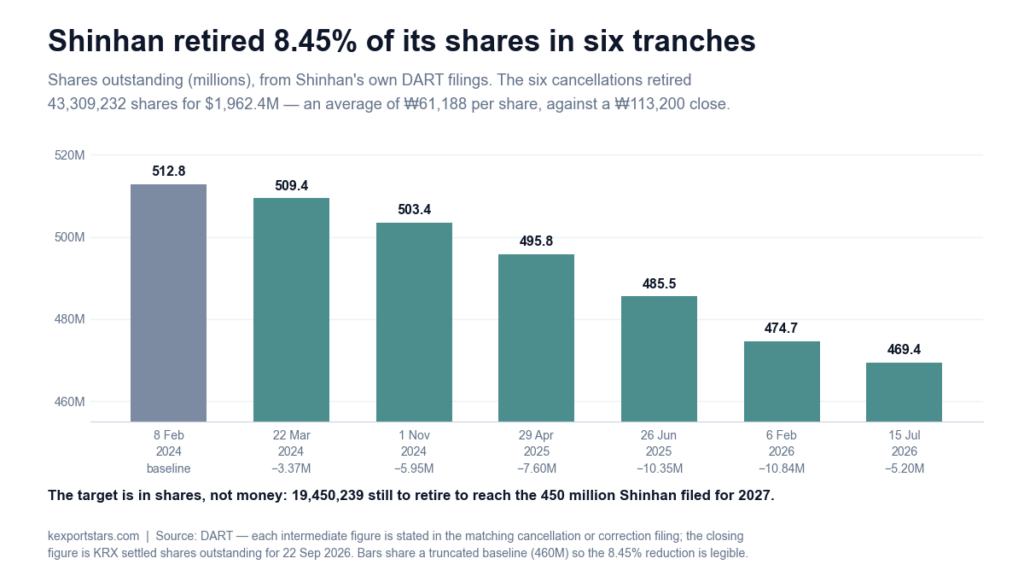
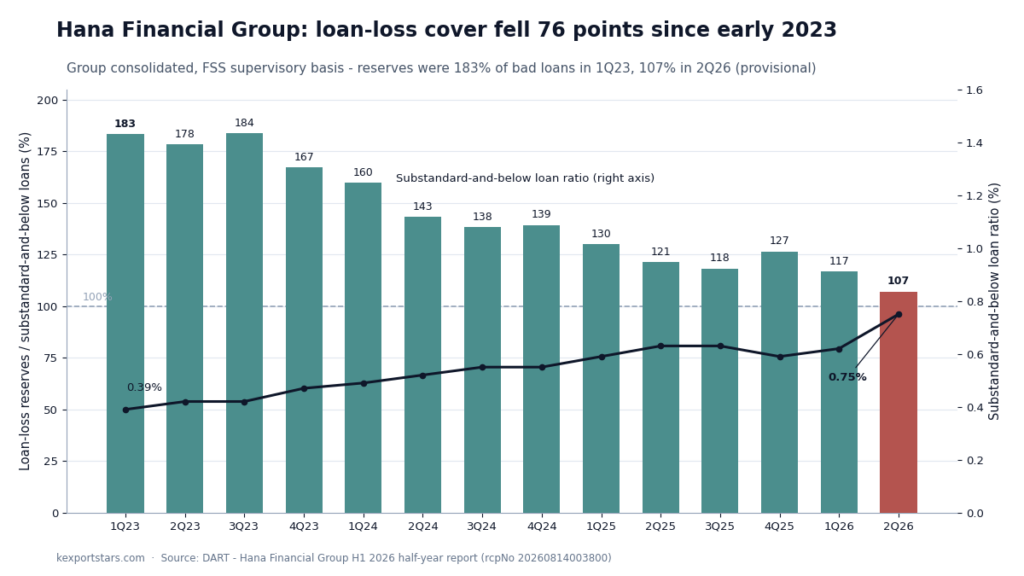
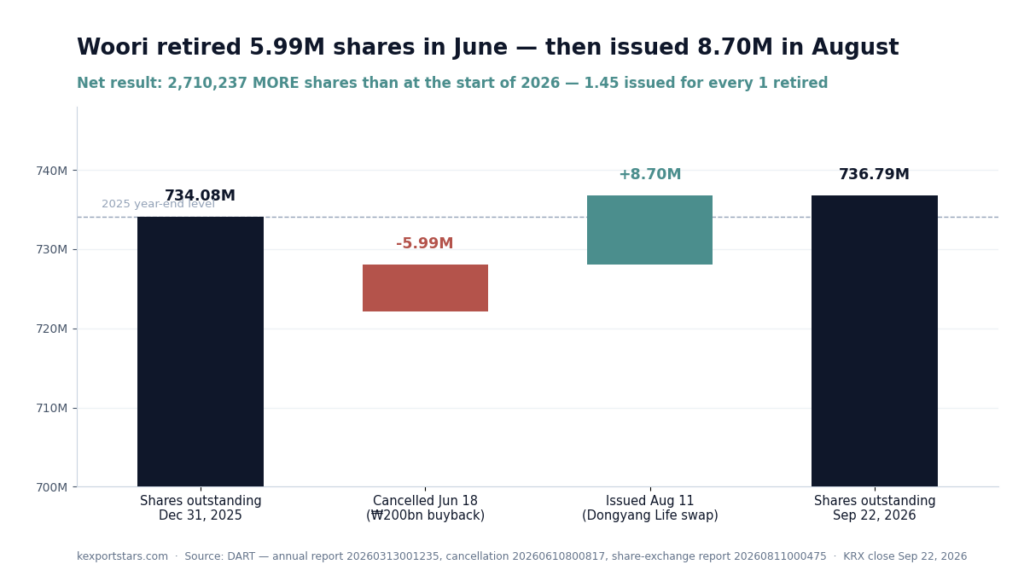
Korea’s eighth-largest company is not a chip maker, a shipbuilder or a defence contractor. It is a bank holding company with no controlling family, no chaebol parent, and a largest shareholder — the national pension fund — that owns just 9.23%. Since August 2024 KB Financial Group has quietly retired 12.1% of its own shares. What almost nobody outside Korea has read is the sentence in its own filings that says how much further it is legally allowed to go.
🔑 Key Takeaways
- KB is Korea’s largest financial group and its ninth-largest listing. Market cap $46.15bn at the settled close of Sep 22, 2026 (Source: KRX; the share price itself is in the valuation table below). Total assets were $642.0bn at Jun 30, 2026 (Source: DART rcpNo 20260814004200).
- The share count is shrinking fast — and it is verifiable to the share. 381,462,103 shares at the end of 2025, 354,687,734 today: −7.0% in six months, and −14.7% since December 2019. KB has retired 15.2% of every share it has ever issued.
- The earnings jump is not coming from banking. Group net profit rose 13.1% in H1 2026, but the banking arm contributed just +1.7%. The securities arm’s profit more than doubled (+135.0%). That is a market cycle, not a franchise re-rating.
- KB is the only one of Korea’s big four banks trading above book — 1.02× versus Woori’s 0.68×. The “Korean banks trade at half book” cliché no longer describes KB.
- The KB-specific discovery: KB’s buyback capacity is capped not by its capital ratio but by a legal ceiling calculated on the holding company’s separate balance sheet. On July 23, 2026 that ceiling was $847M — and the buyback announced the same day used 61.2% of it, leaving roughly $329M. This is the constraint that actually binds, and it is company-specific: no peer’s ceiling looks like KB’s.
- The thing that lifted the ceiling, however, was a sector move — not a KB idea. Three of Korea’s big four converted capital reserve into distributable earnings in H1 2026: Shinhan ₩9.87tn ($7.31bn), KB ₩7.50tn ($5.55bn), Hana ₩7.40tn ($5.48bn). Woori had already done it a year earlier, at its March 2025 meeting, creating ₩3.0tn ($2.22bn) of distributable income — so all four have now used the same provision, and Woori used it first. (Source: Woori’s AGM-result filing, DART rcpNo 20250326802725, agenda item 3, “Reduction of capital reserve”) Korea’s banks rebuilt their payout headroom together, so read KB’s March vote as sector behaviour and the $847M ceiling as the KB story.
🏢 What Is KB Financial Group, and What Does It Actually Sell?
KB Financial Group is a pure holding company — 137 employees in a single Seoul office — that owns Korea’s largest bank, a securities arm with the biggest brokerage-commission share among the peers it benchmarks against, a top-tier non-life insurer, a credit-card issuer and a life insurer, and reports them as one $642.0bn balance sheet. It sells nothing itself. Its only business, as its own charter puts it, is “control and management of companies engaged in the financial business.”
KB Financial Group Inc. (KRX: 105560) was created on September 29, 2008 by a comprehensive share transfer that put KB Kookmin Bank and seven affiliates under one roof. It listed on the New York Stock Exchange the same day and on the Korea Exchange eleven days later, on October 10, 2008. Head office: 26 Gukjegeumyung-ro 8-gil, Yeouido, Seoul. Chairman and CEO: Yang Jong-hee, in post since November 2023. (Source: DART half-year report, rcpNo 20260814004200, “Company overview” and “Corporate history”)
The holding company itself employed 137 people at June 30, 2026 (101 men, 36 women). Everything a customer touches sits in a subsidiary:
- KB Kookmin Bank — $464.2bn of assets, $285.1bn of won loans and $306.6bn of won deposits. Korea’s largest commercial bank. Also owns KB PRASAC Bank in Cambodia (100%) and PT Bank KB Indonesia (66.88%).
- KB Securities — $76.1bn of assets; brokerage, IPO underwriting, principal investment.
- KB Insurance (non-life) — $5.67bn of direct premiums written in H1 2026, on a standalone non-life basis.
- KB Kookmin Card — 21.4 million credit and debit cardholders, roughly 3 million merchants.
- KB Life Insurance — the former Prudential Life Korea, merged with KB Life in January 2023.
- Plus KB Asset Management, KB Capital, KB Real Estate Trust, KB Savings Bank, KB Investment and KB Data Systems — eleven principal subsidiaries in all.
Moody’s rates the group A1 and S&P rates it A, unchanged across 2024, 2025 and mid-2026. (Source: DART rcpNo 20260814004200, credit-rating section)
📊 Where Does KB’s Revenue Actually Come From?
The bank generates 85.1% of group net interest income but only 26.4% of fee income — and in the first half of 2026 it produced just 57.3% of group profit, down from 66.0% for full-year 2025. KB is a bank holding company whose profit mix is drifting away from banking, and the speed of that drift is the single most important thing in its recent results.
| Segment (H1 2026, 6 months) | Net interest income | Net fee income | Insurance result | Net profit | % of group profit |
|---|---|---|---|---|---|
| Banking | $4,082M | $578M | — | $1,648M | 57.29% |
| Securities | $231M | $852M | — | $590M | 20.50% |
| Non-life insurance | −$27M | −$12M | $370M | $355M | 12.33% |
| Credit card | $565M | $276M | $2M | $162M | 5.64% |
| Life insurance | −$49M | $13M | $171M | $105M | 3.64% |
| Other | $145M | $505M | — | $373M | 12.96% |
| Consolidation adjustment | −$149M | −$19M | $17M | −$355M | −12.36% |
| Group total | $4,797M | $2,193M | $560M | $2,877M | 100.00% |
Consolidated (IFRS), six months to Jun 30, 2026. “Net profit” is the controlling-interest share, as the filing labels it. Percentages are the filing’s own. FX: ₩1,350.36/$1, the FDR close of Sep 22, 2026, applied to every won figure in this article. (Source: DART rcpNo 20260814004200, “Group results by business segment”)
Two things jump out of that table. First, the securities arm earned $852M of net fee income against the bank’s $578M — for a company whose name is synonymous with retail banking, the brokerage is now the bigger fee engine. Second, the insurance arms are structurally negative on net interest income; they earn through the insurance service result instead. Reading “net interest income” as a proxy for group revenue would mislead you on two of six segments.
On assets, the picture is the opposite and far more concentrated: the bank holds $464.2bn of the group’s $642.0bn, or 72.3%. KB earns an increasing share of its profit outside banking while keeping almost three-quarters of its risk inside it.
🗓️ How KB Got Here: A Short History
KB was assembled by acquisition in four moves — card (2011), capital (2014), non-life insurance (2015), securities (2016) and life insurance (2020) — each one bolted onto a retail bank that was itself a merger. Nothing about the group is organic; the question for an investor is whether the pieces have been integrated or merely collected.
| Date | What happened |
|---|---|
| Nov 2001 | Kookmin Bank and Housing & Commercial Bank merge to form today’s KB Kookmin Bank. |
| Sep 29, 2008 | KB Financial Group established by comprehensive share transfer of the bank and seven affiliates; ADSs list on the NYSE the same day. KRX listing follows Oct 10. |
| 2008–2011 | Largest shareholder flips four times between the National Pension Service and ING Bank N.V. — an early signal of how dispersed the register is. |
| Mar 2011 | KB Kookmin Card spun out of the bank’s card division as a direct subsidiary. |
| 2014–2015 | KB Capital acquired (Mar 2014); KB Insurance (formerly LIG) acquired (Jun 2015), taken to 100% by share exchange in Jul 2017. |
| 2016 | Hyundai Securities acquired (May) and merged with KB Investment & Securities (Dec) to create KB Securities. |
| 2020 | Prudential Life Korea acquired (Aug); PRASAC in Cambodia (Apr) and Bank Bukopin in Indonesia (Sep) added. Renamed KB Life in Dec 2022, merged with KB Life Insurance Jan 2023. |
| Oct 24, 2024 | Value-Up plan filed: ROE target ≥10%, CET1 target ≥13%, and a formula tying shareholder returns to capital above those thresholds. |
| Mar 26, 2026 | AGM approves a reduction of capital reserve into retained earnings — the item this article decodes below. |
(Source: DART rcpNo 20260814004200, “Corporate history” and AGM minutes; Value-Up plan rcpNo 20241024800258)
🌍 Is KB Actually Korea’s Number One Bank?
Yes, and by a wider margin than the market caps suggest: KB Kookmin Bank held 21.2% of won deposits and 19.3% of won loans at the end of Q1 2026, roughly 2 percentage points ahead of second-placed Shinhan on both. These are not company marketing claims — KB reproduces the table in its half-year report from Korea’s Financial Statistics Information System, and flags that the FSS banking statistics are the official source.
| Bank (end-Q1 2026) | Won deposit share | Won loan share |
|---|---|---|
| KB Kookmin Bank | 21.2% | 19.3% |
| Shinhan Bank | 19.2% | 17.2% |
| NongHyup Bank | 17.7% | 15.7% |
| Hana Bank | 17.6% | 16.3% |
| Woori Bank | 16.9% | 15.4% |
| Industrial Bank of Korea | 7.4% | 16.1% |
Shares are within this six-bank universe only, not the whole Korean banking system. (Source: DART rcpNo 20260814004200, KB Kookmin Bank market-share tables, citing the Financial Statistics Information System; official series at the Financial Supervisory Service)
The number that changed most, though, is one level down. KB Securities’ share of Korean stock brokerage commissions rose to 11.82% in Q1 2026, from 10.29% for full-year 2025 and 9.79% in 2024 — the highest in the peer set KB benchmarks itself against, ahead of Mirae Asset (10.00%), NH Investment (9.45%), Samsung Securities (7.47%) and Korea Investment & Securities (6.64%). That share gain, landing in a hot Korean equity market, is most of the reason group profit grew 13.1% while the bank grew 1.7%.
📈 Is the Business Getting Better or Worse?
Better on every reported line — but the improvement is concentrated in fee income, which rose 50.6% year on year, while net interest income grew 1.7%. Strip out the brokerage cycle and KB’s core lending franchise is close to flat.
| Group consolidated (IFRS) | H1 2026 (6m) | H1 2025 (6m) | FY2025 (12m) | FY2024 (12m) |
|---|---|---|---|---|
| Net interest income | $4,797M | $4,716M | $9,681M | $9,499M |
| Net fee income | $2,193M | $1,456M | $3,035M | $2,851M |
| Insurance service result | $560M | $629M | $965M | $1,222M |
| Total operating income | $7,485M | $6,733M | $13,289M | $12,610M |
| General & administrative expense | $2,706M | $2,485M | $5,232M | $5,138M |
| Credit-loss provisions | $750M | $971M | $1,750M | $1,514M |
| Operating profit | $4,029M | $3,278M | $6,308M | $5,958M |
| Net profit, controlling interest | $2,877M | $2,544M | $4,320M | $3,761M |
Six-month and twelve-month columns are deliberately labelled: they are not comparable to each other, only down the column. “Total operating income” is the sum of the filing’s six revenue lines (net interest, net fee, insurance service result, fair-value gains, other insurance finance result, other operating result) and reconciles to the filing’s pre-provision operating profit. FX ₩1,350.36/$1. (Source: DART rcpNo 20260814004200, consolidated income statement and segment note)
Now the same period in ratios. These are point-in-time or annualised, so they get their own table — mixing them into the one above is how a reader ends up comparing a six-month flow to a year-end stock.
| Ratio | H1 2026 | FY2025 | FY2024 | Basis — read this column |
|---|---|---|---|---|
| ROE (period label matters — see note) | 13.11% half-year, annualised |
9.93% full year |
8.87% full year |
Group, consolidated — as reported |
| ROA | 0.95% | 0.75% | 0.68% | Group, consolidated, annualised — as reported |
| Cost-to-income ratio | 36.2% | 39.4% | 40.8% | Our calculation: G&A ÷ total operating income |
| CET1 ratio | 13.74% | 13.82% | 13.53% | Group, Basel III; H1 2026 is provisional |
| Non-performing loan ratio | 1.01% | 0.99% | 1.07% | Group; substandard-and-below ÷ total credit |
| Net interest margin | 1.76% | 1.74% | 1.78% | KB Kookmin Bank only, not the group |
⚠️ The NIM line is the bank subsidiary’s, on the FSS supervisory basis. KB does not publish a group NIM in this filing, and a group figure would not be meaningful — two of its six segments run negative net interest income.
⚠️ Do not compare 13.11% with a peer’s full-year ROE. All three ROE figures are printed values, lifted verbatim from one row of the half-year report — section 5, [지배회사에 관한 사항][KB금융지주] → (2) 수익성비율, the row 자기자본순이익률(ROE) reading 13.11 / 9.93 / 8.87 under the column heads 2026년 반기 / 2025년 / 2024년. They are DART print, not an investor-relations figure and not a calculation of ours. Two labels on them are ours: the basis and the annualisation. The filing states neither here — it attaches 연환산기준 (annualised) only to KB Kookmin Bank’s separate profitability table, not to this one. We read this table as consolidated because the ROA immediately above it, 0.95%, can only be consolidated: the holding company’s separate assets are about ₩25tn, on which a separate ROA would be an order of magnitude larger. The same section’s common equity tier 1 capital, ₩50,801bn, is likewise the consolidated group figure. The first column is a half-year figure annualised; the other two are full years. Our own arithmetic confirms the basis rather than the exact figure: taking H1 2026 controlling-interest net profit of ₩3,884,590m, doubling it, and dividing by the mean of controlling equity at the two dates printed in the filing (₩59,048,211m at Dec 31, 2025 and ₩60,890,838m at Jun 30, 2026) gives 12.96% — within 0.15 points of the reported number, which is what you would expect if KB uses an average-balance denominator rather than a two-point average. Consolidated and annualised is therefore the right reading; a separate-basis or non-annualised reading is not close. For a like-for-like comparison with peers, use the FY2025 column. (Source: DART rcpNo 20260814004200, holding-company soundness and profitability indicators, and KB Kookmin Bank profitability indicators)
Three observations a headline will not give you.
One: the Value-Up ROE target was missed, twice, and then cleared by the brokerage. KB’s October 2024 plan set a target of “ROE of 10% or more (double digit).” FY2024 came in at 8.87%. FY2025 came in at 9.93% — short by 0.07 percentage points. H1 2026 annualises to 13.11%. The target has now been beaten, but by a segment whose profit more than doubled in six months.
Two: the CET1 ratio fell even though capital rose. Common equity tier 1 capital went from $36.55bn at end-2025 to $37.62bn at end-June 2026, up 2.93%. Risk-weighted assets went from $264.4bn to $273.8bn, up 3.57%. Denominator beat numerator, and the ratio slipped from 13.82% to 13.74%. Management attributes the pressure to a sharp move in USD/KRW and to “large-scale shareholder returns,” and says RoRWA-centred capital management held the ratio firm — that is the company’s own explanation, not a conclusion we have tested independently. What we can verify is the arithmetic: RWA grew faster than capital.
Three: credit is fine, but not improving. Provisions fell 22.7% year on year to $750M, which flatters the profit line. The NPL ratio nonetheless ticked up from 0.99% to 1.01% on a $389.5bn loan book. On our arithmetic, the six-month credit cost of 0.19% of loans annualises to about 0.39% — low, and a tailwind that cannot repeat indefinitely.
🔍 KB Retired 7% of Itself in Six Months — So Why Did It Need a Shareholder Vote?
Because a Korean company’s buybacks and dividends are capped not by its capital ratio but by “distributable profit” calculated on the holding company’s separate, non-consolidated balance sheet — and on July 23, 2026 KB had only $847M of that headroom left. The buyback it announced that same day consumed 61.2% of it. This constraint is disclosed, in a standard table, in Korean, in a filing that has no English counterpart.
Start with what actually happened to the share count, because it is unusually clean. KB’s half-year report gives every figure needed to reconcile it to the share.
| Effective date | Shares cancelled | Shares outstanding after | Change | Where the stock came from |
|---|---|---|---|---|
| Aug 14, 2024 | 9,982,649 | 393,528,423 | −2.47% | Board resolutions of Jul 2023 and Feb 2024 |
| May 15, 2025 | 12,066,320 | 381,462,103 | −3.07% | Board resolutions of Jul 2024, Oct 2024, Feb 2025 |
| Jan 15, 2026 | 8,611,648 | 372,850,455 | −2.26% | Board resolutions of Apr 2025 and Jul 2025 |
| May 15, 2026 | 18,162,721 | 354,687,734 | −4.87% | 3,899,988 bought in 2026 + 14,262,733 held since 2016–18 |
| Not yet set | ≈3,997,715 (estimate) | — | ≈−1.13% | Announced Jul 23, 2026, not executed. $518M; buying window to Dec 16, 2026 |
The final row is a board resolution, not a completed cancellation: the share count in it is KB’s own estimate, derived by dividing the ₩700bn ($518M) cancellation amount by the ₩175,100 close of Jul 22, 2026, and the filing states the final number will be corrected before cancellation. (Sources: DART rcpNo 20260814004200 — treasury-share and cancellation tables; cancellation decision rcpNo 20260723800512)
Add the four completed rows together and you get 48,823,338 shares — that addition is ours, but both of the numbers it should be measured against are printed in the same filing: KB has issued 418,111,537 shares in its history and retired 63,423,803 of them. So 77.0% of every share KB has ever cancelled was cancelled in the four rounds from August 2024 to May 2026, and cumulative cancellations now equal 15.2% of everything ever issued. (The window is the one the filing’s own rows define — Aug 14, 2024 to May 15, 2026 — not a rolling period from today. Counting only the three rounds since December 2024 the figure would be 9.87%, so the August 2024 round is doing real work in that number and we date it rather than describing it as “recent.”)
The May 2026 cancellation is smaller than it looks
The biggest single step, 18,162,721 shares on May 15, 2026, is reported in the filing at a cancellation amount of $1,483M. Only $444M of that was stock KB bought in 2026. The other 14,262,733 shares were treasury stock KB had been sitting on since a series of trust contracts in 2016, 2017 and 2018 — the cancellation filing lists those contracts as related disclosures. Their cost works out to about ₩98,300 per share, against a ₩175,700 market price on Sep 22, 2026. ⚠️ Basis, because this one number carries two: the ₩98,300 is on the cancellation table’s 소각금액 basis, which is built from board-resolution acquisition amounts. The subtraction is ours and both inputs are printed — ₩2,002,230m of cancellation amount for the May round, less the ₩600,000m the filing’s own note attributes to the 3,899,988 shares bought on the February 5, 2026 board resolution, leaves ₩1,402,230m across 14,262,733 shares. It is not the statement-of-changes-in-equity basis this article prefers for cash and equity effects. On the equity basis the 2026 cancellations pool to roughly ₩94,500 per share across all 26,774,369 shares retired in January and May, and that pooled figure cannot be split cleanly onto the 2016–18 tranche. Either way the point holds: the stock was bought far below today’s price.
That matters for how you read the headline. Retiring shares you already own costs no cash today and leaves total equity and CET1 untouched; it only shrinks the denominator. The capital was returned to shareholders — in 2016 to 2018, when KB bought the stock. What happened in May 2026 was the bookkeeping catching up, eight to ten years late.
Note also, and we flag it rather than smooth it over, that the filing itself carries two different won amounts for the same two 2026 cancellations: ₩2,962,230m on the cancellation-history table’s basis and ₩2,529,818m in the statement of changes in equity. To be exact about which figure is whose: ₩2,529,818m is printed as one number in the statement of changes in equity, while ₩2,962,230m is our addition of that table’s two 2026 rows — ₩960,000m against the January cancellation and ₩2,002,230m against May, both printed in the 소각금액 column. The share counts reconcile exactly; the won amounts do not, because the first is on a board-resolution acquisition-cost basis and the second is the pooled carrying amount of treasury stock removed from equity. We use the statement of changes in equity wherever cash or equity effects are at stake.
What KB actually paid out in H1 2026
From the statement of changes in equity, and therefore audited rather than inferred: dividends of $725M (the FY2025 final plus one quarterly) and treasury purchases of $596M, for $1.32bn returned to common shareholders in six months. That is 45.9% of half-year net profit and 2.86% of the Sep 22 market capitalisation — a total shareholder yield of roughly 5.7% annualised, if the second half matches the first. Hybrid-security distributions of $64M are excluded: they go to AT1 holders, not common shareholders.
The ceiling, in the filing’s own template
Every Korean treasury-purchase filing carries a standard table showing how much the company is legally allowed to spend. KB’s, filed July 23, 2026 alongside a ₩700bn ($518M) trust contract with Samsung Securities, reads as follows.
| Line, as the filing labels it | Amount |
|---|---|
| (a) Net assets at the prior fiscal year end — 가. 순자산액 † | $18,466M |
| (b) less paid-in capital | −$1,548M |
| (c) less capital reserve and earnings reserve accumulated to date | −$14,085M |
| (d) less unrealised gains prescribed by decree | −$72M |
| = Distributable profit under the Commercial Act | $2,761M |
| less treasury purchases since that year end | −$889M |
| less the AGM-approved annual dividend | −$425M |
| less board-approved quarterly dividends | −$600M |
| = Buyback headroom, Jul 23, 2026 | $847M |
Won amounts converted once at ₩1,350.36/$1. The filing states that line (c) includes hybrid capital securities and the loan-loss reserve.
† The “separate” basis is our determination, not the filing’s label. The filing’s verbatim wording for line (a) is just 가. 순자산액 — “net assets”. The words 별도 (separate), 연결 (consolidated) and 개별 (individual) appear nowhere in it; its only qualifier is a period note saying the limit was “prepared on the 2025 settlement basis.” Line (b), ₩2,090,558m, is paid-in capital, which is identical on both bases and so settles nothing. (Source for the limit table: rcpNo 20260723000345, “자기주식 취득금액 한도”.)
We identify the basis by matching the figure against KB’s FY2025 balance sheets, which are a different filing: separate total equity of ₩24,935,236m against consolidated ₩60,829,989m. The limit table’s ₩24,935,237m differs from the separate figure by ₩1m of rounding and from the consolidated figure by ₩35.9tn, so it can only be the separate balance sheet. (Source: KB’s FY2025 annual report as amended, rcpNo 20260619000667, separate and consolidated statements of financial position, retrieved via the DART fnlttSinglAcntAll endpoint.)
Read line (a) again. $18,466M is the holding company’s separate net assets at Dec 31, 2025 — against $43.7bn of consolidated controlling-interest equity on that same date (₩59,048,211m). Take care with the date: the equity behind the 1.02× P/B in the valuation table above is the later Jun 30, 2026 figure, ₩60,890,838m or $45.09bn, and setting a Dec 2025 line (a) against a Jun 2026 equity figure would overstate the gap. KB Financial Group the legal entity owns shares in subsidiaries; the bank’s retained earnings sit in the bank. Only what the holding company can legally recognise counts toward its dividend and buyback capacity. That single distinction — 지배회사 별도 versus 연결 — is where most cross-border analysis of Korean bank payouts goes wrong.
The ₩700bn ($518M) programme announced on July 23 therefore used 61.2% of the $847M remaining, leaving roughly $329M. Against a company earning $2.88bn in six months and carrying a CET1 ratio 0.24 points above its own second-tranche trigger, that is a strikingly tight number — and it is the constraint that actually binds.
So shareholders voted to move $5.55bn — and so did two of KB’s three rivals
At the annual general meeting on March 26, 2026, agenda item 3 was “Reduction of capital reserve.” It passed with 300,474,017 votes in favour of the 304,308,986 shares represented. The statement of changes in equity shows exactly what it did:
$5.55bn moved from one equity line to another. No cash. No effect on total equity. No effect on CET1 — both lines are common equity tier 1. What it changes is line (c) of the table above: the deduction for accumulated reserves falls, and the distributable-profit base rises by the same amount.
₩7,500,000m is the AGM-resolved amount, the 이익잉여금 이입 line in the H1 2026 statement of changes in equity — the figure shareholders actually voted on, and the one we use throughout this article. KB’s consolidated capital-surplus balance fell slightly more over the same half, by ₩7,505,997m ($5.56bn), because ₩5,997m of unrelated movement runs through the same line. Either figure is defensible; we name the basis so the two cannot be read as a contradiction.
On the formula KB itself prints, removing $5.55bn from the reserve deduction lifts the distributable-profit base from $2,761M to roughly $8,315M, all else equal — our arithmetic applied to KB’s disclosed template, not a company forecast, and subject to whatever the FY2026 separate accounts actually show. But the direction is not in doubt. KB did not raise the ceiling for fun. It raised it because it was close to hitting the old one.
And KB was not alone — which is the part a single-company read gets wrong. Pull the same balance-sheet line for all four Korean bank holding companies and the same manoeuvre appears three times in one half-year, under the same Article 461-2 of the Commercial Act:
| Capital reserve moved into retained earnings, H1 2026 | Amount (₩) | Amount ($) |
|---|---|---|
| Shinhan Financial (055550) | ₩9,865,923m | $7.31bn |
| KB Financial (105560) | ₩7,500,000m | $5.55bn |
| Hana Financial (086790) | ₩7,400,000m | $5.48bn |
| Woori Financial (316140) | none | none |
All four on one rule: the capital-reserve transfer line in each company’s H1 2026 consolidated statement of changes in equity (DART fnlttSinglAcntAll, report code 11012, consolidated). Won shown alongside dollars here because the comparison is the point. ⚠️ Read Woori’s “none” as none in this window, not never: its capital surplus moved by just ₩282m over the half — subsidiary and other adjustments, no reserve reduction — because Woori had run the same manoeuvre a year earlier, at its March 26, 2025 AGM, adding ₩3.0tn ($2.22bn) of distributable income (rcpNo 20250326802725). A one-half window would have told you Woori never did this, and that would be wrong. Converted at ₩1,350.36/$1. Totals $18.34bn across the three in this window.
That reframes KB’s vote. It is not a KB discovery, and we would be overselling it to present it as one: Korea’s banking sector collectively rebuilt its legal distribution headroom in the first half of 2026, and Shinhan’s transfer was the largest of the three. What is genuinely KB-specific is the number on the other side of the ledger — the $847M ceiling and the 61.2% of it spent in a single July resolution. No peer’s headroom was that tight relative to what it was about to commit. Read the reserve reduction as the sector-wide enabler; read the ceiling as the KB story.
And one small thing that explains a misleading headline
KB pays what its Value-Up plan calls an “equal quarterly dividend on a total-amount basis.” Here is what that does in practice, from two filings three months apart:
- Q1 2026: ₩405,408,079,962 across 354,687,734 shares = ₩1,143 per share (rcpNo 20260423800554)
- Q2 2026: ₩405,527,558,205 across 351,106,111 shares = ₩1,155 per share (rcpNo 20260723800477)
⚠️ Two labels, read them before you use these numbers
The dividend totals above are provisional, and the filings say so. Both carry the same sentence: the stated total “was prepared on a basis of [the share count shown above], and the actual dividend total may change according to the number of shares in circulation (유통주식수) on the record date — May 8 and Aug 7, 2026 respectively — as a result of the treasury-share acquisition disclosed today” (rcpNo 20260423800554 and 20260723800477). So treat the won totals, and the per-share figures derived from them, as the arithmetic at the date of the resolution rather than a settled payment.
The share counts are settled figures, and they measure shares in circulation rather than shares issued. 354,687,734 is the same figure we use in the valuation and shareholder tables above, and it reconciles exactly: 372,850,455 shares issued after the January 2026 cancellation, less 18,162,721 held in treasury, equals 354,687,734 (rcpNo 20260814004200, share and treasury schedules). Korean dividend filings are always struck on the circulating count, so the convention is the same in both quarters — but the label is worth knowing, because “issued” and “circulating” diverge by exactly the treasury balance.
The total cash rose 0.03%. The base fell 1.01%. Dividend per share rose 1.05%. KB did not raise its dividend; a smaller base divided the same cheque.
But be precise about which action shrank the base, because it is not the one this article has spent a section on. The Q1-to-Q2 fall is 354,687,734 − 351,106,111 = 3,581,623 shares — exactly the treasury stock KB bought in the programme it completed on July 16, 2026, and both filings name that acquisition as the cause. The 18,162,721-share cancellation of May 15 contributed nothing to it, because those shares were already sitting in treasury and already excluded from the circulating count when the Q1 dividend was struck. Cancellation retires shares that had stopped counting; it is the purchase that removes them from circulation. Anyone reading “KB lifts quarterly DPS” without opening the filing has the mechanism backwards — and anyone crediting it to the headline cancellation has the right conclusion for the wrong reason.
💰 What Do You Actually Pay for KB Today?
About 11.4× last year’s earnings and 1.02× book — which makes KB the only one of Korea’s big four financial groups trading above its own book value. The discount that defines Korean bank valuations has, for this one name, closed.
| KB Financial Group (105560) | As of Sep 22, 2026 |
|---|---|
| Share price | ₩175,700 (~$130) |
| Shares outstanding | 354,687,734 |
| Market capitalisation | $46.15bn — 9th largest KOSPI listing by market cap; 8th largest company, since Samsung Electronics’ preferred line ranks 3rd separately |
| P/E (FY2025 reported EPS ₩15,410) | 11.40× |
| P/B (controlling equity, Jun 30, 2026) | 1.02× |
| FY2025 dividend per share | ₩4,367 — a 2.49% yield at this price |
| FY2025 payout ratio | 27.0%, cash dividends only |
Price and share count from the KRX settled session of Sep 22, 2026. ⚠️ We deliberately do not use Sep 23. KRX does return figures for that date, but the dataset was still incomplete when this was written, and our own two price tables disagree on the Sep 23 close for 79.6% of listed issues while agreeing on Sep 22 for all but one — so Sep 22 is the last fully settled session. EPS is the company-reported consolidated figure on a controlling-interest basis, taken from the dividend section (배당에 관한 사항) of KB’s FY2025 annual report as amended — [기재정정]사업보고서 (2025.12), rcpNo 20260619000667, filed Jun 19, 2026. That is an annual report, not a dividend-decision filing. Cross-check: FY2025 controlling-interest net profit of ₩5,833,162m ÷ ₩15,410 implies a weighted-average count of about 378.5 million shares, which is consistent. Equity is 지배기업 주주지분 of ₩60,890,838m at Jun 30, 2026, rcpNo 20260814004200.
| Korea’s big four, same rule for all | Share price | Market cap | P/E | P/B | Dividend yield |
|---|---|---|---|---|---|
| KB Financial (105560) | ₩175,700 | $46.15bn | 11.40× | 1.02× | 2.49% |
| Shinhan Financial (055550) | ₩113,200 | $39.35bn | 11.54× | 0.88× | 2.29% |
| Hana Financial (086790) | ₩136,000 | $27.29bn | 9.75× | 0.79× | 3.02% |
| Woori Financial (316140) | ₩35,750 | $19.51bn | 8.82× | 0.68× | 3.80% |
All four on one rule: price = KRX settled close Sep 22, 2026; P/E = price ÷ FY2025 company-reported consolidated EPS on a controlling-interest basis; P/B = market cap ÷ controlling-interest equity at Jun 30, 2026; yield = FY2025 DPS ÷ price. EPS sources: KB rcpNo 20260619000667 (₩15,410) · Shinhan rcpNo 20260318000826 (₩9,812) · Hana rcpNo 20260814004019 (₩13,954) · Woori rcpNo 20260313001235 (₩4,052). ⚠️ Controlling-interest equity in Korea includes hybrid capital securities. Excluding them, the four read 1.10× / 0.95× / 0.87× / 0.75× — the ranking is unchanged, the levels are all higher. We take each of the other three apart the same way, from its own filings: Shinhan Financial Group (055550), Hana Financial Group (086790) and Woori Financial Group (316140).
Three caveats before anyone treats 11.40× as cheap or dear.
First, the P/E is backward-looking and mechanically overstated. Reported EPS uses a weighted-average share count of roughly 378 million; today’s count is 354.7 million, 6.2% lower. Hold earnings flat and the same profit on today’s share base implies a lower multiple.
Second, KB’s premium to Shinhan is not in the P/E — those are nearly identical at 11.40× and 11.54×. It is entirely in the P/B, which is another way of saying the market is paying for KB’s higher ROE. But size that gap on a matched basis, because 13.11% is an annualised half-year figure and there is no comparable half-year number for the peers. On the two companies’ own reported full-year figures the gap is 0.82 percentage points, not four: KB 9.93% against Shinhan 9.11% for FY2025 (KB: half-year report soundness indicators, rcpNo 20260814004200; Shinhan: its April 2026 Value-Up filing, rcpNo 20260423800235, which reports FY2025 ROE of 9.11%, up 67bp). Recomputed ourselves on return on average controlling equity, KB is 9.98%. So KB does out-earn Shinhan, consistently — just by under a point of full-year ROE, which is a thinner foundation for a 16% P/B premium than 13.11% makes it look. If the brokerage cycle turns, that is the leg that moves.
Third, the yields above are cash dividends only. KB’s buyback adds roughly 2.9 percentage points of annualised yield on top — which is the honest way to compare a 2.49% dividend payer that retires 7% of its stock in six months against a 3.80% dividend payer that does not.
🏷️ Which KB Ticker Are You Actually Buying?
There is exactly one listed KB equity in Seoul — 105560, the holding company — and one in New York, an American Depositary Share listed on the NYSE since September 29, 2008. KB Kookmin Bank is not separately listed, and the “KB” you may see in an ETF name is a fund brand, not this company.
| What you might see | Where | What it actually is |
|---|---|---|
| 105560 | KOSPI | The holding company. The only Korean-listed KB equity. No preference share class. |
| KB | NYSE | American Depositary Shares over the same company, listed since Sep 29, 2008. JPMorgan Chase Bank is the depositary and holds 21,896,527 underlying shares — 6.17% of the company. Voting rights sit with individual DR holders. |
| KB Kookmin Bank | Not listed | Wholly owned subsidiary. Its bonds trade; its equity does not. |
| “KB RISE” ETFs | KOSPI | Funds managed by KB Asset Management. Buying one is not buying the group. See our Value-Up ETF comparison. |
(Sources: DART rcpNo 20260814004200 — ADS listing note in the consolidated financial statements, and the 5%-shareholder table; our own Korean ADR list for the ticker.)
One genuine advantage KB has over most Korean large caps: it is an SEC registrant and files an annual report on Form 20-F in English. The filing states KB submitted its FY2025 Form 20-F to the NYSE on April 28, 2026 and reported it to DART the next day (rcpNo 20260429801135). So the annual story is available in English. What is not available in English is everything in this article’s discovery section: the half-year report, the treasury-purchase limit table, the cancellation decisions and the AGM item. Those are Korean-only, filed quarterly, and they are where the mechanics live. If you want the practical mechanics of buying either line, our guide to buying Korean stocks as a foreign investor covers both routes.
🌏 Is Foreign Money Buying or Selling KB?
Selling — but it is concentrated in early July, and widening the window makes the sale smaller, not bigger. Foreigners were net sellers of KB over the last 5, 20 and 60 trading sessions while domestic institutions bought. Push the window out to the full 83 sessions our data covers and the net sale shrinks, from $484.2M to $380.4M — because the 23 sessions before the 60-day window opens were a net purchase. The sign flips at the edge of our own headline window, so we print both.
| Group | Foreign net buy, 5 sessions to Sep 22 | Foreign net buy, 20 sessions to Sep 22 | Foreign net buy, 60 sessions to Sep 22 | Institution net buy, 60 sessions to Sep 22 | Retail net buy, 60 sessions to Sep 22 |
|---|---|---|---|---|---|
| KB Financial (105560) | −$72.7M | −$150.5M | −$484.2M | +$669.5M | −$159.5M |
| Shinhan Financial (055550) | −$32.6M | −$177.3M | −$249.5M | +$487.6M | −$173.9M |
| Hana Financial (086790) | −$44.7M | −$79.3M | −$169.1M | +$311.2M | −$134.1M |
| Woori Financial (316140) | −$25.8M | +$365.8M | +$370.5M | +$231.3M | −$247.4M |
Windows end at the settled session of Sep 22, 2026: 5 sessions = Sep 16–22, 20 = Aug 26–Sep 22, 60 = Jun 29–Sep 22. Method: each day’s net share count multiplied by that day’s close, then summed, then converted at ₩1,350.36/$1 — an approximation, not execution prices. Source: our own investor-flow database, built from KIS Open API daily settled data. Coverage limit, stated plainly: our per-stock series begins May 26, 2026 for KB and Jun 18, 2026 for Woori, so 83 and 67 sessions respectively are the widest windows that exist for us — we cannot test a one-year view and do not claim to. Not a full decomposition: foreign + institution + retail do not sum to zero here (KB: −484.2 + 669.5 − 159.5 = +$25.8M) because “other corporates” and “other foreigners” are separate KRX investor categories we have not printed as columns.
| Window | KB Financial (105560) foreign net buy |
|---|---|
| 60 sessions, Jun 29 to Sep 22, 2026 — our headline | KB Financial (105560): −$484.2M |
| 83 sessions, May 26 to Sep 22, 2026 — the widest we have | KB Financial (105560): −$380.4M |
| The 23 sessions before that, May 26 to Jun 26, 2026 | KB Financial (105560): +$103.8M (+824,490 shares) |
| Jun 29 to Jul 27, 2026 alone | KB Financial (105560): −$305.1M |
| 10 sessions, Sep 9 to Sep 22, 2026 | KB Financial (105560): −$77.5M |
The Jun 29 to Jul 27 window alone is 63% of the 60-session total. So the accurate sentence is “selling concentrated in early July and continuing at a slower pace since” — not “selling in every window.” Two-thirds of a quarter’s outflow happened in one month, and the 60-session window’s left edge sits close to a local turning point, which flatters the headline. The claim that is robust is a day count, not a dollar total: foreigners were net sellers on 41 of the 60 sessions.
Now look at the Woori row, which is the sharper lesson. A reader shown only the 5-session column would conclude that foreigners are selling all four Korean banks. Over 20 and 60 sessions, Woori is a large net purchase. The sign flips — but we should say exactly where it comes from, because the honest version is more useful than the tidy one.
Woori’s entire 60-session figure is one trading day. On the single session of Sep 3 to Sep 3, 2026, foreigners bought a net 13,051,580 shares of Woori Financial (316140) — +$334.9M. That one day is 90.4% of the 60-session total in the table above. Strip it out and the other 59 sessions come to +$35.6M; sessions 21 through 60 come to +$4.7M, which is flat. So “foreigners accumulated Woori over three months” is not what happened. One block-sized day happened, and every window containing it inherits its sign.
That is why we print at least two windows on every flow claim, and why a window is not enough on its own — a single session can carry an entire quarter. A wire headline built on one week of flow data is a coin toss; one built on one day dressed as a quarter is worse. Our primer on how foreign and institutional flows move Korean stocks sets out the mechanics, and the weekly Foreign Flow Watch series tracks them.
One scale comparison worth carrying away. Foreigners sold a net 3,853,080 KB shares over those 60 sessions — 1.09% of shares outstanding. The buyback KB announced on July 23 is sized, on the company’s own estimate, at roughly 3,997,715 shares. KB has committed to retiring slightly more stock than foreigners have sold over the entire period. Whether that supports the price is a separate question; what it does is shrink the float faster than foreigners are exiting it.
🏛️ Who Controls KB, and What Do Minority Holders Get?
Nobody controls KB — and that makes it the clearest counter-example to the standard chaebol explanation of the Korea Discount. Its largest shareholder, including all related parties, is the National Pension Service at 9.23%. There is no founding family, no holding-company pyramid, and no cross-shareholding to unwind.
| Holder (Jun 30, 2026) | Shares | Stake | Note |
|---|---|---|---|
| National Pension Service | 32,734,500 | 9.23% | Largest shareholder, including related parties |
| BlackRock Fund Advisors | 26,288,623 | 7.41% | As of its Feb 18, 2026 large-holding filing |
| Capital Research & Management | 25,436,245 | 7.17% | As of its Mar 31, 2026 large-holding filing |
| JPMorgan Chase Bank | 21,896,527 | 6.17% | ADS depositary; votes belong to DR holders |
| Employee stock ownership association | 8,660,802 | 2.44% | Staff |
| Treasury stock | 1,300,000 | 0.4% | 3,581,623 by Jul 16, 2026, all earmarked for cancellation |
Stakes are against 354,687,734 shares outstanding. Three disclosed foreign entities alone hold 20.75%. (Source: DART rcpNo 20260814004200, shareholder-distribution section; treasury-completion report rcpNo 20260716000387)
There is a trap hidden in that table, and it is the same denominator effect as the dividend. The National Pension Service’s stake went from 8.99% at the March 31 register to 9.23% at the June 30 register. Its shareholding fell over the same quarter, from 33,505,649 shares to 32,734,500 — a sale of 771,149 shares. The percentage rose only because KB cancelled 18.2 million shares in between. Reading “NPS raised its KB stake” off the percentage column would be exactly wrong. (Equally, a pension fund trimming a position is not a company-specific signal; NPS rebalances across hundreds of names.)
On board independence, the filings are unusually clean by Korean standards: every buyback, dividend and cancellation resolution in 2026 records seven outside directors present and zero absent, and the company states that all audit-committee members are outside directors. The March 2026 AGM elected one new independent director and re-elected four. The one non-executive, non-independent director is the chief executive of KB Kookmin Bank.
And the shareholder-return policy itself, in the company’s own words from the October 2024 Value-Up filing — a document whose first line warns that it “may contain forward-looking information, and actual results may differ”:
Second tranche: capital corresponding to the excess of second-half CET1 above 13.5% funds an additional buy-and-cancel.
At Jun 30, 2026 the group’s CET1 was 13.74% on $273.8bn of RWA — $2.02bn above the 13% line and $655M above the 13.5% line. That is our arithmetic on the company’s stated formula, applied to a half-year provisional ratio. It is not a declared budget. (Value-Up plan: rcpNo 20241024800258; restated in the 2026 re-filing, rcpNo 20260327802428)
KB also qualifies as a “high-dividend company” under Article 104-27 of Korea’s Restriction of Special Taxation Act, on a FY2025 payout ratio of 27.0% and dividend growth of 31.7% over FY2024. That designation matters to Korean resident investors’ tax treatment, not to foreigners — foreign holders are withheld at the rates set out in our guide to Korean dividend withholding tax, which uses KB’s own ₩4,367 dividend as its worked example. For the wider policy context, see our explainer on Korea’s Value-Up Program and on the Korea Discount itself.
⚠️ The Bear Case
- The re-rating rests on a cycle, not a franchise. Group profit rose 13.1% in H1 2026. The bank contributed +1.7%. Securities contributed +135.0% and non-life insurance was down 14.2%. Banking fell from 66.0% of FY2025 group profit to 57.3% in H1 2026. If Korean trading volumes normalise, the ROE that justifies a 1.02× book multiple goes with them.
- This article’s own thesis cuts both ways. We argue the legal payout ceiling is the real constraint and that KB lifted it by $5.55bn. But the same table shows KB spent 61.2% of its remaining headroom on one July buyback. If the FY2026 separate accounts do not deliver the expected lift, the 2027 return budget shrinks regardless of how strong CET1 looks — and the Value-Up story is a capital-return story or it is nothing.
- Governance: dispersed ownership is not the same as good governance. With no holder above 9.23%, there is also no shareholder with the incentive or standing to force change if management underperforms. The largest holder is a state pension fund whose voting record is a domestic political question. This is a different governance risk from the chaebol kind, not an absence of one.
- Accounting quality: two lines in the same filing disagree. The buyback-history table reports ₩2,962,230m of 2026 cancellations; the statement of changes in equity reports ₩2,529,818m. We have explained the difference, but a reader taking the larger number as cash returned in 2026 would overstate it by roughly $320M — and 14,262,733 of the shares retired in May cost KB nothing in 2026 because it had owned them since 2016–18.
- Capital is getting tighter, not looser. CET1 fell from 13.82% to 13.74% in six months because RWA grew 3.57% against 2.93% capital growth. The entire return formula is a residual of capital generation minus RWA growth. In H1 2026, RWA growth won.
- Credit costs are at a cyclical low. Provisions of $750M were 22.7% below the prior half, while the NPL ratio ticked up to 1.01%. An annualised credit cost near 0.39% of a $389.5bn loan book leaves little room to improve and a great deal to deteriorate.
📚 Lingo Check
| Term | What it means | 한국어 |
|---|---|---|
| CET1 ratio | Common equity tier 1 capital divided by risk-weighted assets — the core Basel III solvency measure, and the variable KB’s entire shareholder-return formula is indexed to. | 보통주자본비율 |
| Risk-weighted assets (RWA) | Assets scaled by regulatory risk weights. It is the denominator of every capital ratio, so a bank can grow capital and still see its ratio fall. | 위험가중자산 |
| Cost-to-income ratio (CIR) | Operating expenses ÷ total operating income. The standard bank efficiency measure; lower is better. ⚠️ Korean groups compute the denominator differently, so compare only within one source. | 영업이익경비율 |
| Net interest margin (NIM) | Net interest income as a percentage of interest-earning assets. ⚠️ Korean financial groups publish it for the bank subsidiary, not the group — a group NIM would mix in insurers that run negative net interest income. | 순이자마진 |
| NPL ratio | Loans classified substandard or below, divided by total credit. Korea’s regulatory definition is stricter than “90 days past due.” | 고정이하여신비율 |
| Loan-loss reserve vs loan-loss provision | ⛔ Not the same thing. The provision is a P&L charge that reduces profit. The reserve is a regulatory appropriation within equity that does not touch profit. Confusing them will distort both earnings and capital. | 대손충당금 / 대손준비금 |
| Distributable profit ceiling | The Commercial Act cap on dividends and treasury purchases, computed on the issuer’s separate net assets less paid-in capital, accumulated reserves and prescribed unrealised gains. Every Korean treasury-purchase filing prints the calculation. | 배당가능이익 한도 |
| Capital-reserve reduction | A shareholder-approved transfer of capital surplus into retained earnings. Total equity and capital ratios are unchanged; what rises is the legal ceiling above. KB moved $5.55bn this way in March 2026. | 자본준비금 감소 (이익잉여금 이입) |
| Equal-total-amount quarterly dividend | A policy fixing the total won paid each quarter rather than the per-share amount. As the circulating share count falls, DPS rises automatically — without the company paying a won more. Note which action moves it: buying treasury stock removes shares from circulation, so it lifts DPS; cancelling stock the company already holds does not. | 총액기준 분기 균등배당 |
| Financial holding company | An entity regulated under Korea’s Financial Holding Companies Act whose only business is owning and managing financial subsidiaries. Its separate accounts — which govern payout capacity — look nothing like its consolidated ones. | 금융지주회사 |
🎯 Why It Matters for K-Export Stars
This site exists on a simple premise: the numbers that move Korean stocks are published, in Korean, in filings that almost no English-language investor reads. KB is the sharpest test of that premise we have run, because KB is not an information-poor company. It files a 20-F in English. It has a Value-Up page on its own website. It is covered by every global bank.
And yet the three things in this article that would change how you model it — the $847M legal ceiling and how much of it one July resolution consumed, the fact that three of the big four lifted that ceiling in the same half-year — and that the fourth had already done it a year before, and the fact that a rising dividend per share reflects a shrinking share count rather than a bigger cheque — appear only in Korean-language filings made between March and July 2026. None of them is a secret. All of them are line items in standard disclosure templates. They are simply in the wrong language and the wrong document.
Note what changed when we checked the peers. Read alone, KB’s $5.55bn reserve transfer looks like a company-specific insight. Pulled across all four holding companies, it is a sector pattern — and the honest version of the finding is the smaller, sharper one. That is the difference between decoding a filing and decoding an industry, and it is only visible if you open all four.
That is the whole arbitrage, and KB proves it is not about obscure companies. It is about which document you open.
Conclusion
KB Financial Group is Korea’s largest bank holding company, its ninth-largest listing, and the only one of the big four financial groups trading above book value at 1.02×. It has retired 14.7% of its shares since 2019 and 7.0% in the first half of 2026 alone, and it has been unusually honest about the formula driving that: capital above a 13% CET1 ratio becomes the next year’s return budget.
What its own filings show, and what the English-language record does not, is that the binding constraint is somewhere else entirely — in a distributable-profit ceiling computed on the holding company’s separate balance sheet, which stood at $847M in July — of which a single resolution that month spent 61.2%. Shareholders had voted in March to lift that ceiling by $5.55bn, as Shinhan and Hana also did in the same half-year. Judge the Value-Up story on the ceiling, not on the capital ratio.
The bull case is a company mechanically shrinking itself at a double-digit annualised total shareholder yield. The bear case is that the earnings currently justifying its premium came from a brokerage boom, not from the bank. Both are true right now. Related reading: Korea’s Value-Up Program explained · Understanding the Korea Discount · Foreign Flow Watch.
Disclaimer: This article is for informational and educational purposes only and does not constitute investment advice, a recommendation, or an offer to buy or sell any security. Figures are sourced from DART filings, KRX settled market data and our own flow database as dated in the text; prices and valuation multiples are point-in-time and will change. Disclosure of interest: the author holds no position in KB Financial Group (105560), and none in Shinhan (055550) or Woori (316140). The author does hold small long positions in Hana Financial Group (086790), Samsung Electronics (005930) and Mirae Asset Securities (006800), all of which are named in this article, and holds KODEX 200, a KOSPI 200 index ETF that gives indirect exposure to all four bank holding companies discussed here. Do your own research and consult a licensed adviser before investing.