One week after the KOSPI’s record +17.91% session, it gave back 5.10% while the KOSDAQ rose 10.98%. A 16-point gap opened between Korea’s two indices in five sessions. Almost all of the KOSPI half is two stocks: Samsung Electronics and SK hynix, which together were 51.2% of the index and lost more market value than the entire index did.
🔑 Key Takeaways — Week of 3–7 August 2026
- Two stocks lost more than the whole index. The KOSPI shed $200.4bn (₩285.2tn) of market value. Samsung Electronics and SK hynix alone shed $281.2bn (₩400.3tn) — 140% of the index’s entire decline. Strip those two out and the rest of the KOSPI rose 4.33%, the same direction as the KOSDAQ.
- Foreigners sold $3.34bn of those two names (₩4.76tn) — 83% of their total KOSPI selling of $4.03bn (₩5.73tn).
- They were buying elsewhere in the same market. Samsung C&T, Kia, Celltrion, Samsung Biologics, SK and Hanwha Aerospace took a combined $342M, and all six are still net-bought over 20 sessions. This was rotation inside Korea, not an exit from it.
- Retail bought the two names back cheaper than they sold them. Individuals sold 2,463,959 SK hynix shares on 31 July at $1,207 (₩1,718,000), then bought 2,919,878 back this week at a volume-weighted $1,063 (₩1,512,924) — 11.9% below their sale price, and more shares than they let go.
- This is not a claim that foreign selling moved the prices. The third-largest foreign sale of the week, Samsung Electro-Mechanics, rose 11.91%. The index arithmetic below stands on market values, not on flows.
- Two of the three tests we published last week failed. Issue #3 said foreign buying stopping would mean Thursday was a squeeze, not accumulation. It stopped. We report that below rather than quietly moving on.
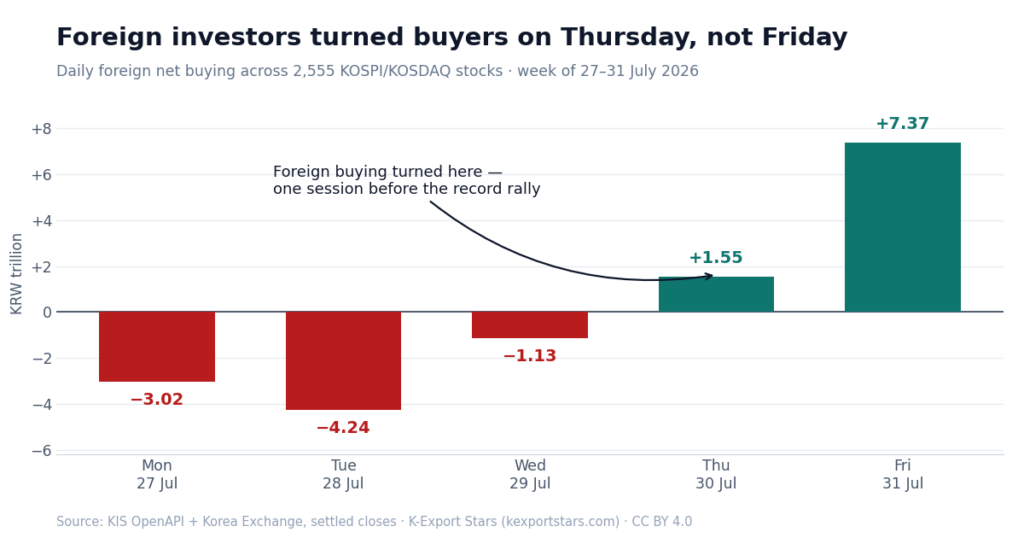
This is Foreign Flow Watch, our weekly read of where global capital is actually moving inside Korean equities. This is issue #4, following issue #3 on the week of 27–31 July — the week the market bottomed and then posted the largest single-session gain in its history.
📉 The Backdrop: The Week After the Record
The KOSPI bottomed at 5,593.56 on Thursday 30 July and rose 17.91% on Friday 31 July. The KOSDAQ rose 11.63% the same day. This week the two indices went separate ways.
| Session | KOSPI | Change | KOSDAQ | Change |
|---|---|---|---|---|
| Fri 31 Jul (base) | 6,595.45 | +17.91% | 719.76 | +11.63% |
| Mon 3 Aug | 6,257.45 | −5.12% | 737.35 | +2.44% |
| Tue 4 Aug | 6,358.95 | +1.62% | 780.72 | +5.88% |
| Wed 5 Aug | 6,598.26 | +3.76% | 799.59 | +2.42% |
| Thu 6 Aug | 6,296.38 | −4.58% | 801.67 | +0.26% |
| Fri 7 Aug | 6,258.77 | −0.60% | 798.81 | −0.36% |
| Week (31 Jul → 7 Aug) | — | −5.10% | — | +10.98% |
Korea Exchange settled closes. Weekly change is measured from the 31 July close throughout this issue, not from Monday’s — Monday itself fell 5.12%, and measuring from it would hide most of the week.
🤔 Why Did the KOSPI Fall While the KOSDAQ Rose?
The KOSPI’s decline is almost entirely two companies. Samsung Electronics and SK hynix were 51.2% of the index by market value on 31 July, and both fell hard while the rest of the market did not.
| Market value | 31 Jul | 7 Aug | Change |
|---|---|---|---|
| Samsung Electronics | ₩1,534.6tn | ₩1,350.5tn | −$129.3bn |
| SK hynix | ₩1,255.0tn | ₩1,038.8tn | −$151.9bn |
| Those two together | ₩2,789.6tn | ₩2,389.3tn | −$281.2bn |
| Entire KOSPI | ₩5,444.6tn | ₩5,159.4tn | −$200.4bn |
| Everything else on the KOSPI (residual, approximate) | ₩2,655.0tn | ₩2,770.1tn | ≈ +$80.9bn (+4.33%) |
Market capitalisation from the Korea Exchange Open API at each date’s settled close. USD at ₩1,423.51. Index totals include listing and delisting changes over the week, so the residual line is close to but not exactly the sum of its constituents.
Two names lost 140% of what the index lost. The residual line is a subtraction, not a constituent-level roll-up: index totals absorb listings, delistings and rights issues over the week, so read the other 700-odd KOSPI companies as gaining approximately 4.33% — the same direction as the KOSDAQ’s 10.98%, if not the same magnitude. There was no broad Korean sell-off this week. There was a memory sell-off inside an index that is half memory.
This is the mechanical answer to a question we have written about before — what actually differs between the KOSPI and the KOSDAQ. The scale gap is the whole point: the entire KOSDAQ was worth ₩397.8tn on 31 July — less than a third of SK hynix on its own (₩1,255.0tn), and about a seventh of the two memory names together. Its largest electronics grouping is ₩79.5tn, 20.0% of the board, and contains chip-equipment and component makers rather than a memory manufacturer. So no single position on the KOSDAQ can move it the way two names moved the KOSPI, and it traded on everything else.
📊 Where the Foreign Money Left
Foreign investors sold a net $4.03bn (₩5.73tn) of KOSPI shares over the five sessions. The concentration matches the market-cap picture.
| Company (ticker) | Foreign net, 5 sessions | Share of KOSPI selling | Share price, 31 Jul → 7 Aug |
|---|---|---|---|
| SK hynix (000660) | −$2.44bn | 61% | −17.23% |
| Samsung Electronics (005930) | −$0.90bn | 22% | −12.00% |
| Those two together | −$3.34bn | 83% | — |
| Samsung Electro-Mechanics (009150) | −$0.63bn | 16% | +11.91% |
Foreign net buying per stock, summed across the 3–7 August sessions and valued at each day’s settled close. Shares are net against foreign buying elsewhere in the index. Samsung Electronics’ preferred line (005935) is excluded — see the note below.
The third-largest sale went the other way, and it is worth pausing on
Samsung Electro-Mechanics rose 11.91% while foreigners sold $632M of it. Its market value went up $7.2bn (₩10.2tn), from $802 (₩1,142,000) to $898 (₩1,278,000) a share.
That is the clearest available evidence against a simple “foreign selling pushes the price down” reading, and it sits inside our own table. It is also a reason not to call this a semiconductor story: SEMCO makes MLCCs and FC-BGA substrates — components that go into chips and boards rather than memory itself. Its business is exposed to the AI build-out but not to DRAM pricing, and this week the market priced that difference.
So we are not claiming foreign flows moved these prices. Foreigners sold three large-cap names; two collapsed and one rallied. What the flow data establishes is where foreign capital repositioned, not what set the price. The market-cap arithmetic above is what explains the index gap, and it stands on its own without any causal claim about flows.
💊 What Foreigners Bought While Selling Memory
In the same five sessions foreign investors were net buyers of six large caps, and — testing the claim across a second window, as we now do for anything load-bearing — all six remain net-bought over 20 sessions.
| Company | Sector | 5 sessions | 20 sessions |
|---|---|---|---|
| Samsung C&T | Holding / construction | +$79M | +$131M |
| Kia | Autos | +$47M | +$139M |
| Celltrion | Biosimilars | +$62M | +$87M |
| Samsung Biologics | CDMO | +$56M | +$75M |
| SK | Holding | +$46M | +$43M |
| Hanwha Aerospace | Defence | +$52M | +$27M |
| Six names | — | +$342M | +$501M |
The amounts are an order of magnitude smaller than the memory selling — $342M in against $3.34bn out. Nobody should read this as money moving one-for-one from DRAM into biosimilars. What it does rule out is the simplest story: an investor liquidating a country does not buy its defence champion, its CDMO and its cheapest automaker in the same week. Two of the six — Hanwha Aerospace and SK — were net-sold across the preceding fifteen sessions and turned buyer only now, so for those two this week is the change rather than the continuation.
⚠️ The Two Memory Names Are on Different Clocks
Five sessions put Samsung Electronics and SK hynix side by side. Twenty sessions pull them apart, and this is where a one-week read would mislead you.
| Foreign net | SK hynix | Samsung Electronics common + preferred |
|---|---|---|
| This week (3–7 Aug) | −$2.44bn | −$1.01bn |
| Prior week (27–31 Jul) | −$0.61bn | −$0.17bn |
| 20 sessions (10 Jul–7 Aug) | −$3.72bn | −$0.51bn |
| Implied: first 15 of those 20 | −$1.28bn | +$0.50bn |
SK hynix has been sold for a month and the pace is rising. Foreigners were already net sellers of $1.28bn across the first fifteen sessions, then sold $2.44bn in the last five. Two thirds of a month’s outflow landed in one week.
Samsung Electronics is this week’s event, not this month’s. Across the full twenty sessions foreigners are net sellers of only $0.51bn — half what they sold this week alone — because over the first fifteen they bought $0.50bn. Whatever changed for Samsung changed in the last five days.
A note on which Samsung shares we counted. Samsung Electronics has a second listed line, the preferred shares (005935), and the choice of whether to include it moves the number materially. Issue #3 flagged this. For the 20-session window, foreigners were net buyers of $305M of the preferred while selling $822M of the common — so the combined figure is −$0.51bn rather than −$0.82bn, a 37% difference on the number we just told you to watch. The prior week moves the same way: −$0.17bn combined against −$0.49bn common-only.
This issue uses common + preferred in the table above, and common only in the per-stock selling table, where we are ranking single listed lines. Where a universe choice changes a headline number by this much, you should be told which one was made.
🧍 Retail Took the Other Side — and Got a Better Price
Foreigners sold $3.34bn of the two memory names; domestic institutions sold another $2.47bn across the three large caps in this issue. Korean individuals were net buyers of $6.25bn of those three. Net flows do not identify who traded with whom, so we will not say retail “bought from” foreigners — only that individuals were the class adding while both others reduced.
| Net, 3–7 August | KOSPI | KOSDAQ | Both markets |
|---|---|---|---|
| Foreign investors | −$4.03bn | −$0.89bn | −$4.91bn |
| Domestic institutions | −$1.58bn | +$0.45bn | −$1.14bn |
| Individuals | +$5.39bn | +$0.42bn | +$5.80bn |
The “both markets” column is the figure usually quoted as “foreigners sold $4.9bn of Korean stocks.” We publish the split because the KOSPI column is where the week’s story is, and the two are routinely conflated. In won: KOSPI −₩5.73tn / −₩2.25tn / +₩7.67tn.
Did retail buy the top?
Not on the round trip so far. The arithmetic, in shares rather than currency:
| Individuals in SK hynix | Shares | Price |
|---|---|---|
| Sold, 31 July (record session) | −2,463,959 | $1,207 (₩1,718,000) |
| Bought, 3–7 August | +2,919,878 | $1,063 (₩1,512,924) VWAP |
| Net effect | +455,919 shares | 11.9% below the sale price |
Individuals ended the fortnight owning more SK hynix than before, acquired at a volume-weighted price 11.9% under what they sold at. Measured against Friday’s close of $999 (₩1,422,000) the repurchase is 6.0% underwater; measured against the round trip it is ahead. Both are true and neither settles anything, because the position is open. As in issue #3, we are not going to tell you which side was right.
Over the full twenty sessions individuals are net buyers of $4.34bn of SK hynix while foreigners sold $3.72bn of it. That trade is still running.
🧾 Scorecard: How Issue #3 Held Up
Issue #3 published three conditions that would prove its read wrong. Two of them came true within the week. We would rather print that than let it pass.
| What issue #3 said would falsify it | What happened | Verdict |
|---|---|---|
| “If foreign buying stops now that prices have recovered, Thursday was a squeeze rather than accumulation.” | Foreigners sold $2.44bn of SK hynix — the heaviest five sessions of the whole 20-session window. | Failed |
| “If SK Square’s foreign inflow reverses within two weeks…” | SK Square went from +$514M to −$41M. | Failed |
| Retail selling on 31 July was profit-taking, not distribution. | Individuals bought back more shares than they sold, at a lower price. | Held |
The honest reading is that issue #3’s central claim — that foreign buying on 30 July was accumulation — did not survive contact with the following week. One week of buying at the bottom, followed by the heaviest selling of the month, looks more like a squeeze being covered than a position being built. We called it the other way.
⚠️ What Would Prove This Issue Wrong
- If the “rest of the KOSPI rose 4.33%” residual is an artifact of index composition changes rather than of prices, the central arithmetic weakens. Listings and delistings move the total; we flag it in the table note and will re-derive from constituent caps if a reader disputes it.
- If Samsung Electronics keeps being sold next week, “this week’s event, not this month’s” was wrong and it is the same unwind as SK hynix, five weeks behind.
- If the six buys reverse, “rotation, not exit” was a rebalancing week dressed up as a thesis. Hanwha Aerospace and SK are the weak links — both were net-sold across the prior fifteen sessions.
- If the KOSDAQ gives back its 10.98% next week, its rise was a low-liquidity bounce rather than the market trading on non-memory fundamentals, and our framing of it as “free to trade on everything else” was too generous.
🔭 Next Week’s Watch Points
- Samsung Electronics’ 20-session number, including the preferred line. One more week of selling turns a trim into an unwind.
- Whether individuals keep adding. $5.39bn of KOSPI buying in five sessions is a large commitment from one investor class. The question is not whether they are right but whether they have more to deploy.
- Whether the six buys persist. A second week would make this a rotation with legs.
- Whether the KOSDAQ holds without the KOSPI. Foreigners sold it too, including its own chip-equipment names — Simmtech, Jeju Semiconductor, Jusung Engineering and Wonik IPS were all net-sold — and it rose anyway. That is worth watching precisely because it cuts against a flow-driven reading.
📚 Lingo Check
- 순매수 / 순매도 (sun-mae-su / sun-mae-do) — net buying and net selling. The Korea Exchange publishes both daily, per stock, split into 외국인 (foreign), 기관 (institutional) and 개인 (individual). Very few markets disclose flows at this granularity, and it is the reason this column can exist.
- 우선주 (u-seon-ju) — preferred shares. Many Korean groups list a second, non-voting line that trades at a discount to the common. Samsung Electronics’ is 005935, and as this issue shows, whether you count it changes the answer.
- Settled close — the confirmed end-of-session figure. Korean intraday snapshots circulate widely and get republished as if final; every number here comes from a completed session.
- KOSDAQ — Korea’s secondary board, weighted toward biotech, gaming and small-cap manufacturing. It carries almost none of the memory-semiconductor market value that dominates the KOSPI, which is why the two can diverge as they did this week. We cover the distinction in our KOSPI-vs-KOSDAQ primer.
🎯 Why It Matters
“Foreigners sold $4.9bn of Korean stocks” is true and close to useless. It reads as a verdict on a country. The per-stock data says something narrower: foreign investors cut two memory positions, kept buying six other large caps in the same market, and an index that is half those two names fell 5% while everything else in it rose.
That distinction is only visible if someone publishes flow data stock by stock. Korea’s exchange does, daily, in Korean. We publish it in English for all 2,555 KOSPI and KOSDAQ common stocks, free and openly licensed — every number in this issue is reproducible from the files behind it. If you want the mechanism rather than the weekly read, we wrote up how foreign and institutional flows move Korean stocks, and why this index has been so volatile in 2026.
Conclusion
The headline was a 5% fall in the KOSPI. The event was two companies losing $281.2bn between them — more than the index lost in total — while the other seven hundred rose 4.33%. Foreign investors were reducing both names, heavily and, in SK hynix’s case, at an accelerating pace. They were also buying Korean defence, biosimilars and autos in the same week, which is not what leaving a country looks like.
Two things this issue will not claim. It will not say foreign selling caused the fall — the third-largest sale of the week rose 11.91%. And it will not grade Korean retail, who are now holding more SK hynix at a lower average price than a fortnight ago, with the position still open.
Sources, universe and method. Investor net-buy per stock from the Korea Investment & Securities OpenAPI; index closes, market capitalisation and sector indices from the Korea Exchange Open API; corporate filings from DART. Universe: 2,555 KOSPI and KOSDAQ common stocks; SPACs, ETFs and preferred lines are excluded from market-wide totals, with the Samsung preferred treated explicitly where noted. Flows arrive as share counts and are valued at each day’s settled close, then summed — valuing a whole week at a single price can shift the answer materially in a volatile week. USD at ₩1,423.51 throughout, the rate as of the 6 August close; figures quoted from issue #3 were struck at ₩1,436.60 and are not restated. Settled sessions only. The underlying files — foreign-flows-aggregates.csv and foreign-flows-latest.json, CC BY 4.0 — are at kexportstars.com/tools.
We log corrections rather than editing silently — see our corrections policy. Research and data, not investment advice; see our investment disclaimer.
→ Next issue: issue #5 grades the four falsification conditions above — three held, one open.