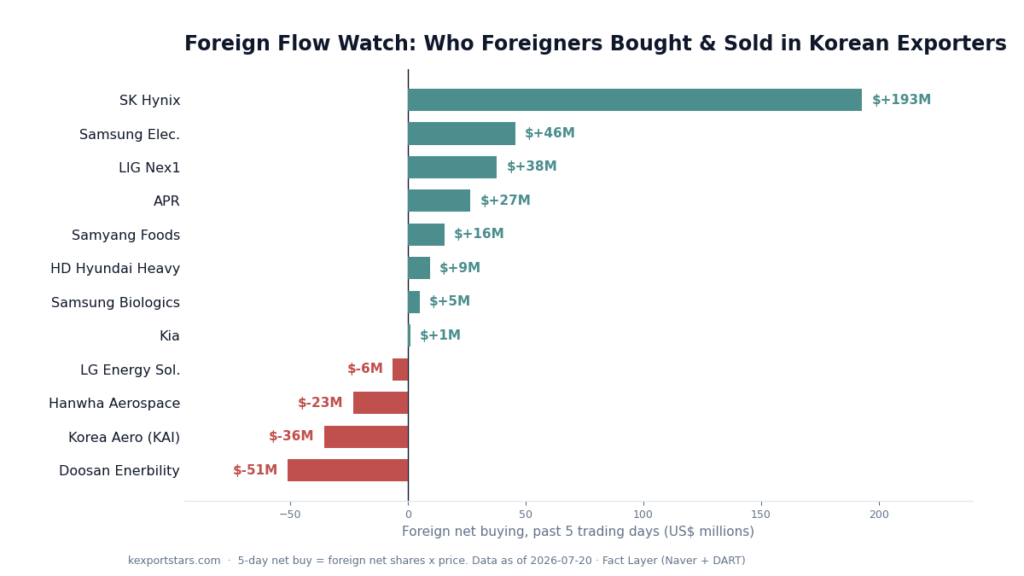
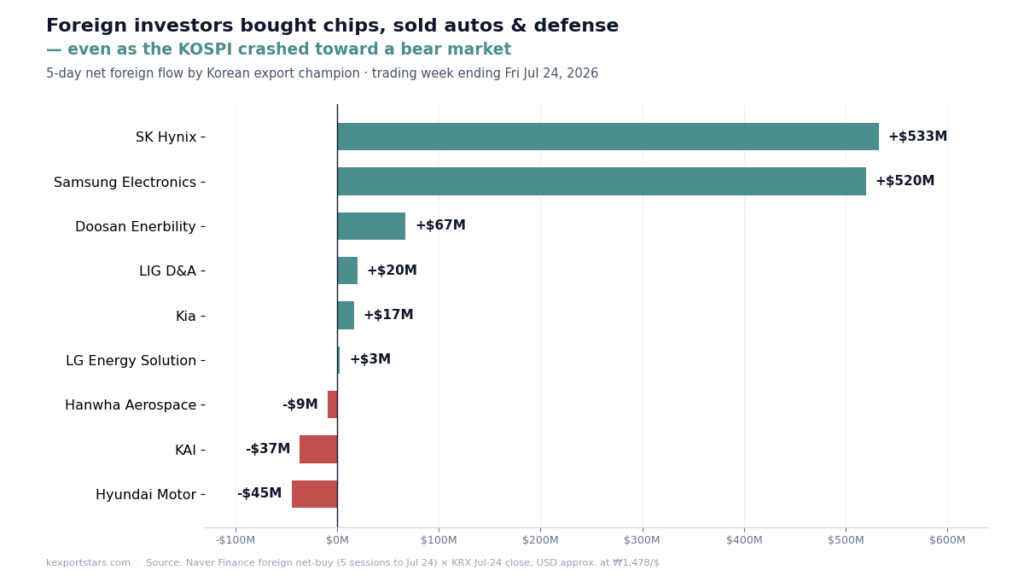
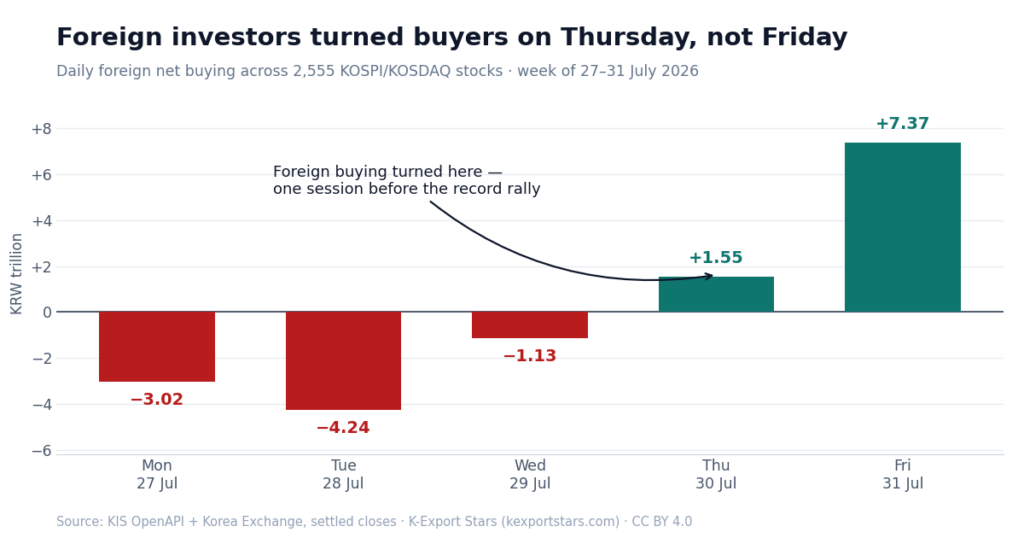
Last week two stocks lost 140% of the KOSPI’s decline. This week the same two put back 70% of its recovery, and the foreigners who had been selling them bought a combined $3.32bn of the two — 73% of everything they bought on the KOSPI. The index rose 10.77% in five sessions. The story is the same two names, pointed the other way.
🔑 Key Takeaways — Week of 10–14 August 2026
- The KOSPI rose 10.77%; the KOSDAQ rose 1.19%. Last week those numbers were −5.10% and +10.98%. The gap did not narrow — it inverted.
- Samsung Electronics and SK hynix added ₩417.2tn ($294.6bn) of market value — 69.8% of the KOSPI’s entire ₩597.7tn gain. They were 46.3% of the index by value on 7 August.
- Foreigners bought $1,626M of Samsung Electronics. They bought $1,695M of SK hynix. Combined, that is 73% of their $4.55bn of net KOSPI buying — and as reported in issue #4, they had sold $3.34bn of the same two the week before.
- Strip those two out and the rest of the KOSPI still rose 6.51%. Unlike last week, the move was not only the two — but it was mostly them.
- Every one of the six names we flagged last week was bought again. Including the two we named as the weak links.
- ⚠ Celltrion took $109M of foreign buying and closed the week unchanged (0.00%). We print that because it is the clearest evidence against reading flows as a price driver.
This is Foreign Flow Watch, our weekly read of where global capital is actually moving inside Korean equities. This is issue #5, following issue #4 on the week of 3–7 August — the week those same two names lost more than the whole index did.
📈 The mirror image
| Five sessions | Week of 3–7 Aug (issue #4) | Week of 10–14 Aug |
|---|---|---|
| KOSPI | −5.10% | +10.77% |
| KOSDAQ | +10.98% | +1.19% |
| Foreign net, KOSPI | −$4.03bn | +$4.55bn |
| Foreign net, KOSDAQ | — | −$0.41bn |
Two weeks, four numbers, every sign reversed. It is worth being precise about what that does and does not tell us: this is a description of what happened, not a claim that one caused the other. We set out below the one observation that argues against the causal reading.
🏆 Where the ₩597.7tn came from
The KOSPI’s total market value rose from ₩5,160.0tn to ₩5,757.7tn over the week — a gain of ₩597.7tn ($422.1bn). Two companies account for most of it.
| Market value | 7 Aug | 14 Aug | Change |
|---|---|---|---|
| Samsung Electronics | ₩1,350.5tn | ₩1,604.8tn | +₩254.3tn |
| SK hynix | ₩1,038.8tn | ₩1,201.7tn | +₩162.9tn |
| Two names combined | ₩2,389.3tn | ₩2,806.5tn | +₩417.2tn |
| KOSPI total | ₩5,160.0tn | ₩5,757.7tn | +₩597.7tn |
₩417.2tn of ₩597.7tn is 69.8%. The two names were 46.3% of the index by value at the start of the week and produced roughly seven-tenths of its gain.
But the comparison with last week matters more than the number itself. In issue #4 the residual — the rest of the index — moved opposite to the headline: the KOSPI fell while everything except two stocks rose. This week there is no such contradiction. Strip the two out and the remaining KOSPI still rose 6.51%, from ₩2,770.7tn to ₩2,951.2tn. Last week the index was misleading. This week it was merely top-heavy.
Note on method: this residual is a subtraction from index totals, so treat it as approximate. Listings and delistings move the total.
💰 Foreigners bought back what they sold
| Foreign net buying, 10–14 Aug | Amount | Share price, week |
|---|---|---|
| SK hynix (000660) | +$1,695M | +15.85% |
| Samsung Electronics (005930) | +$1,626M | +19.35% |
| Celltrion (068270) | +$109M | 0.00% |
| Samsung Biologics (207940) | +$60M | −1.34% |
| Hanwha Aerospace (012450) | +$48M | +0.69% |
| Kia (000270) | +$46M | +4.58% |
| SK (034730) | +$36M | +14.04% |
| Samsung C&T (028260) | +$35M | +9.82% |
The two memory names combined took $3.32bn of the $4.55bn foreigners put into the KOSPI — a two-stock subtotal of 73%. As published in issue #4, the same two absorbed 83% of their selling the previous week. The concentration did not change. Its direction did.
⚠ And here is the observation that cuts against the obvious reading. Celltrion took $109M of foreign buying — more than Kia, SK or Samsung C&T — and finished the week at exactly 0.00%. Samsung Biologics took $60M and fell 1.34%. If foreign buying moved prices, those two would not look like that. This issue makes no causal claim about flows, for the same reason issue #4 did not: the counter-examples are in our own table.
🧾 Scorecard: How Issue #4 Held Up
Issue #4 published four conditions that would prove its read wrong. We grade them here rather than let them pass.
| What issue #4 said would falsify it | What happened | Verdict |
|---|---|---|
| “If Samsung Electronics keeps being sold next week, ‘this week’s event, not this month’s’ was wrong.” | Foreigners bought $1,626M. The share rose 19.35%. | Held |
| “If the six buys reverse, ‘rotation, not exit’ was a rebalancing week dressed up as a thesis. Hanwha Aerospace and SK are the weak links.” | All six were net-bought again, including both named weak links (Hanwha Aerospace +$48M, SK +$36M). | Held |
| “If the KOSDAQ gives back its 10.98% next week, its rise was a low-liquidity bounce.” | The KOSDAQ added another 1.19%. It did not give the gain back — though foreigners were net sellers of $0.41bn there. | Held |
| “If the residual is an artifact of index composition changes rather than of prices, the central arithmetic weakens.” | Not tested. No reader disputed it and we did not re-derive from constituent caps. | Open |
Three held, one still open. That is a better week than issue #4 had grading issue #3, where two of three conditions failed within seven days. We report both kinds with the same prominence, because a scorecard that only appears when we were right is not a scorecard.
🧩 Prove This Issue Wrong
- If Samsung Electronics and SK hynix give back this week’s gain, then “bought back what they sold” was a bounce inside a longer unwind, and the two-week symmetry is a coincidence of endpoints rather than a round trip.
- If the $3.32bn concentration falls sharply next week while the index keeps rising, the recovery was broader than we describe and we over-weighted the two names.
- If the KOSDAQ turns down while foreigners keep selling it, our “held its gain” reading was one week early — foreigners were already net sellers there this week.
- The residual remains our weakest number. It is a subtraction from index totals, not a rebuild from constituents. If a reader disputes it, we will re-derive it.
🎯 Why It Matters
Two weeks ago the KOSPI’s headline number was actively misleading: the index fell while most of what it contains rose. This week the headline was directionally honest but still concentrated — seven-tenths of the gain in two companies that are just under half the index.
Neither week is a story about Korea. Both are stories about memory, told through an index that happens to be about half memory. If you are reading a single KOSPI percentage as a read on the Korean economy, these two weeks are the argument against doing that.
Method. Investor flows are net buying by investor type from Korean exchange data, valued at each day’s settled close and summed across the five sessions of 10–14 August 2026. Market capitalisation is from the Korea Exchange, compared at the 7 August and 14 August closes. Dollar figures use ₩1,416 per US dollar. Every figure is reproducible from our open dataset of 2,555 KOSPI and KOSDAQ names, updated every trading day, CC BY 4.0, DOI 10.5281/zenodo.21833374.