📌 As of 3 July 2026 — a point-in-time view. Financials corrected 30 Aug 2026.
✏️ Corrected 30 Aug 2026 — this report’s original three-year financial table was wrong, and the errors were large.
- FY2025 revenue was published as ₩11.5tn. The audited consolidated figure is ₩26.703tn — the published number was 2.3× too small.
- FY2025 operating profit was published as ₩1.20tn. The audited consolidated figure is ₩3.089tn.
- The order backlog was described as “₩30tn+”. The filing’s own total is ₩116.801tn.
- The Romania K9 award was described as “adding ₩1.4tn”. The filing records a contract value of ₩1.525tn with nothing delivered as of 31 Dec 2025.
- ROE was published as 25.5%; a forward P/E of 15.5x and an EV/EBITDA of 9.8x were published without a source. All three have been recalculated or withdrawn.
- The report described the company as a “pure-play defense investment vehicle.” It is not: 54.5% of FY2025 revenue is shipbuilding.
Second pass, 30 Aug 2026 — an independent re-check found two errors that the first correction itself introduced. Both are fixed above.
- Aviation-segment revenue was written as ₩1.83tn. That figure appears nowhere in the filing, and it contradicted this article’s own 9.44% segment share. The filing’s segment note reads ₩2,519,663m — ₩2.520tn. Corrected.
- The civil aero-engine share of the backlog was written as “roughly a fifth.” The table in this article prints the programme at ₩11.398tn against a ₩116.801tn total — 9.8%. Corrected.
Every corrected figure below is taken from the FY2025 annual report filed with Korea’s Financial Supervisory Service on 16 Mar 2026. Source: DART rcpNo 20260316001112. Our corrections policy explains why we disclose rather than silently edit.
- 💥 The name is misleading: 54.5% of FY2025 revenue came from shipbuilding and only 9.4% from aerospace. (Source: DART FY2025 annual report, rcpNo 20260316001112)
- 📈 Revenue tripled, margins fell: revenue rose from ₩11.240tn to ₩26.703tn, but the operating margin went the other way — 15.41% to 11.57%. The jump is an accounting-consolidation date, not organic growth.
- 🧾 The backlog is ₩116.801tn, not “₩30tn+” — and its single largest itemised line is a civil aero-engine partnership running to December 2060, not a weapon.
- 👥 36.2% of FY2025 net income belongs to somebody else. Minority holders of the consolidated subsidiaries take that share, and 42.3% of shareholders’ equity.
📌 Point-in-time record — 3 July 2026. Not a live quote.
Share price at time of writing: ₩1,175,000 — the KRX settled close on 3 July 2026, the last trading day before this report was published (Source: KRX). Shares in issue: 51,563,401 → market capitalisation of about ₩60.6tn at that price.
Target price as originally published: ₩1,680,000 — retained for the record and withdrawn as a view. It was built on revenue and profit figures now known to be wrong (see the correction above). We have not issued a replacement target, and the original “upside potential” line has been removed because it was arithmetic on a withdrawn number.
Original market report: 3 July 2026. Financials corrected 30 August 2026.
Hanwha Aerospace Valuation: K-Defense Global Dominance and Aerospace Pipeline
Hanwha Aerospace (KRX: 012450), the flagship defense and aerospace arm of Hanwha Group (whose naval affiliate is Hanwha Ocean), has become one of the fastest-growing military hardware suppliers in the world. It manufactures land defense platforms, precision guided weapons, and aviation engines. Its core products — the K9 Thunder self-propelled howitzer, the Chunmoo multiple launch rocket system (MLRS), and the Redback infantry fighting vehicle (IFV) — are securing export contracts across Europe, the Middle East, and Australia.
It also, since 26 December 2024, consolidates a shipyard. That single fact reshapes every financial figure in this report, and it is the reason the original version of this article was wrong. Below we work from the audited FY2025 annual report rather than from summary estimates.
📈 What Do Hanwha Aerospace’s Actual Financials Look Like?
Revenue rose 137.6% in FY2025 to ₩26.703tn while the operating margin fell from 15.41% to 11.57% — because the revenue jump is a shipyard arriving on the balance sheet, and that shipyard earns a lower margin than the artillery business.
The table below replaces the estimates published in the original article. Every figure is the audited consolidated number from the FY2025 annual report, using the filing’s own Korean account names.
| Consolidated (연결재무제표) | FY2023 | FY2024 | FY2025 |
|---|---|---|---|
| 매출액 Revenue | ₩7.890tn | ₩11.240tn | ₩26.703tn |
| 영업이익 Operating profit | ₩0.594tn | ₩1.732tn | ₩3.089tn |
| Operating margin (computed) | 7.53% | 15.41% | 11.57% |
| 당기순이익 Net income (total) | ₩0.977tn | ₩2.540tn | ₩2.202tn |
| — 지배기업의 소유주지분 attributable to owners | ₩0.818tn | ₩2.299tn | ₩1.405tn |
| — 비지배지분 non-controlling interests | ₩0.159tn | ₩0.241tn | ₩0.797tn |
| 기본주당이익 Basic EPS | ₩16,103 | ₩46,716 | ₩28,530 |
| 자본총계 Total equity | ₩4.684tn | ₩11.492tn | ₩16.788tn |
| — 지배기업 주주지분 owners’ equity | ₩3.528tn | ₩4.995tn | ₩9.685tn |
Source: DART annual report FY2025, rcpNo 20260316001112, filed 16 Mar 2026 — consolidated (연결) statements of financial position and comprehensive income. Figures are quoted in the filing’s own currency and units. Operating margin is computed by us from the filing’s revenue and operating-profit lines. FY2023 basic EPS combines the filing’s continuing-operations figure (₩14,563) and discontinued-operations figure (₩1,540); FY2024 combines ₩45,935 and ₩781. Perimeter warning: FY2023 and FY2024 pre-date the consolidation of Hanwha Ocean on 26 Dec 2024, and FY2023 also contains the security and industrial-equipment businesses demerged on 1 Sep 2024. Year-on-year percentages across that boundary are not like-for-like, and we do not compute them. The original “2026 (Est.)” column has been removed rather than re-estimated: it was built on the erroneous base above, and we do not publish replacement forecasts inside a correction.
Why the Margin Fell While Revenue Tripled
The FY2025 revenue jump is almost entirely the arrival of Hanwha Ocean. Because the shipyard was consolidated on 26 December 2024 — five days before the FY2024 year-end — FY2024 contains virtually none of its revenue and FY2025 contains all of it. Every “revenue more than doubled” headline about this company is describing that accounting date.
The margin tells you what was added. Across FY2025 the filing’s segment note puts marine at 54.52% of revenue, defense at 38.88%, aviation at 9.44%, IT services at 2.48%, and space at 1.25%. Defense produced roughly three-quarters of consolidated operating profit on 38.9% of revenue; marine produced the majority of the remainder on more than half of it. Adding a large lower-margin revenue base to a high-margin one pushes the blended margin down — which is exactly what happened, from 15.41% to 11.57%. That is dilution by mix, not deterioration in the artillery business.
Note on the segment percentages: the filing states each segment’s revenue before intersegment eliminations, but expresses the share against the consolidated total of ₩26.703tn, which is struck after a ₩1.756tn consolidation adjustment. The five shares therefore sum to 106.6%, not 100%. We quote the filing’s own percentages rather than restating them on a different base. (Source: DART rcpNo 20260316001112, “II. Business Overview, 1. Segment summary.”)
⚠️ The original article called this “a pure-play defense investment vehicle.” That was wrong. The 1 September 2024 demerger did remove the security and industrial-equipment businesses — but the 26 December 2024 consolidation of Hanwha Ocean added a shipyard that is now the largest single revenue line in the group. On the FY2025 segment split, this is a company that earns more than half its revenue building ships. (Source: DART FY2025 annual report, “II. Business Overview,” rcpNo 20260316001112.)
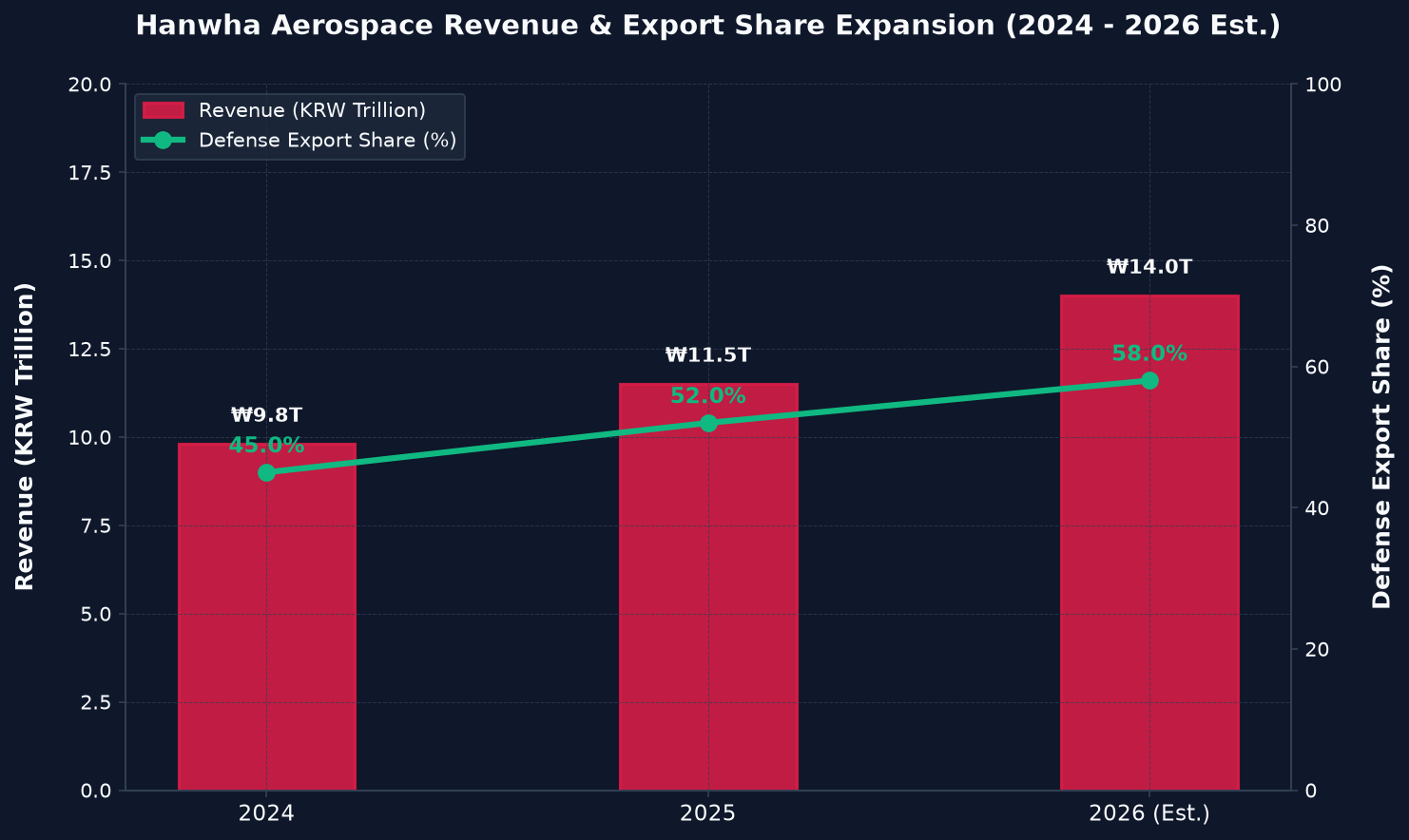
Figure: chart published with the original 3 July 2026 report. It was drawn from the revenue estimates corrected above and is retained only as a record of what was published; read the table, not the chart.
🚀 How Big Is the Order Backlog, and What Is Actually In It?
₩116.801tn at 31 December 2025 — not the “₩30tn-plus” the original article reported, and not all of it is weapons.
The backlog table sits in section II-4 of the Korean-language business report and runs to more than fifty line items, which is why English-language coverage tends to quote a round number instead. The filing’s own total line reads: total contract value ₩162.170tn, delivered ₩45.369tn, remaining backlog ₩116.801tn.
| Line, as named in the filing | Contract value | Delivered | Backlog |
|---|---|---|---|
| Other domestic/overseas orders (incl. Poland K9, Chunmoo) | ₩35.022tn | ₩10.744tn | ₩24.278tn |
| P&W GTF risk-and-revenue-sharing programme (civil aero engines, to Dec 2060) | ₩12.043tn | ₩0.646tn | ₩11.398tn |
| Australia Land 400 Ph.3 IFV (Redback) | ₩3.567tn | ₩0.498tn | ₩3.070tn |
| Egypt K9 | ₩2.510tn | ₩0.563tn | ₩1.947tn |
| Romania K9 (2024.07 → 2029.07) | ₩1.525tn | nil | ₩1.525tn |
| Australia K9 | ₩1.061tn | ₩0.313tn | ₩0.748tn |
| Group total (합계) | ₩162.170tn | ₩45.369tn | ₩116.801tn |
Source: DART annual report FY2025 (rcpNo 20260316001112), section II-4 “Order status” and the detailed-table appendix, base date 31 Dec 2025. Selected lines shown; the filing lists more than fifty. 🔴 Basis warning — do not compare these figures with the half-year filing. The FY2025 report states the Hanwha Aerospace order figures as total contract amounts including value-added tax; the half-year report to 30 Jun 2026 states them excluding VAT. Korea’s VAT is 10%, so the basis change alone moves those lines and any period-on-period change computed across the two filings is meaningless. Only the Hanwha Ocean marine lines carry identical methodology footnotes in both filings.
The Largest Single Itemised Contract Is Not a Weapon
It is the Pratt & Whitney geared-turbofan risk-and-revenue-sharing programme: ₩12.043tn of contract value, ₩11.398tn still to run, and a delivery horizon of December 2060. In a risk-and-revenue-sharing partnership the supplier funds development up front and earns it back across the engine’s service life — which is also why the aviation segment produces so little current profit: ₩13.5bn of operating profit on ₩2.520tn of revenue in FY2025 — a 0.5% segment margin, and 0.44% of consolidated operating profit. (Source: DART rcpNo 20260316001112, segment income note: 항공 수익 2,519,663백만원, 영업이익 13,503백만원.)
Any comparison of this backlog with another defense company’s is therefore a comparison of unlike things. That civil aero-engine partnership alone is 9.8% of the total — ₩11.398tn of ₩116.801tn, on the filing’s own numbers printed in the table above — and it runs for another thirty-five years; a large block of the remainder is commercial and naval shipbuilding. Our sector piece, How Korea Became Europe’s Arsenal, uses a defense-only basis across the Korean primes.
Poland Has No Line of Its Own
The contract that made this company famous is not itemised. It is folded into an aggregate the filing labels “other domestic and overseas orders (including Poland K9 and Chunmoo)” — ₩35.022tn of contract value, ₩10.744tn delivered, ₩24.278tn remaining. The filing gives the reason: for defense-project security, some order details are not described in full. Everything you read about specific Polish contract values therefore comes from press reporting, not from company disclosure, and should be treated accordingly.
Romania: Signed, Not Yet Delivering
The original article credited the Romanian K9 selection with “adding ₩1.4 Trillion to the order backlog.” The filing records ₩1.525tn of contract value for the Romania K9 programme (July 2024 to July 2029) — and a delivered amount of exactly nil as of 31 December 2025, with backlog equal to the full contract value. The award is real; the revenue has not started. Read Romania as a 2027-and-beyond contributor, not a 2026 one.
Australia and NATO Expansion
Winning the Australian Land 400 Phase 3 programme with the Redback IFV validated Hanwha’s technology against top-tier European competitors: ₩3.567tn of contract value with ₩3.070tn still to run through July 2033. By establishing local manufacturing in Geelong, Australia, Hanwha built a template for technology transfer that it is now using to target NATO members in Northern and Eastern Europe. Note the shape of that template, though — it is also the mechanism by which value migrates out of Korean factories, which we list as a risk below.
🔬 Aerospace Engines and the Space Launcher Pipeline
While defense platforms drive current profit, the aerospace engine division provides the long-term technology baseline — and currently earns very little.
Jet Engine Manufacturing and Maintenance
Hanwha Aerospace is the exclusive producer of gas turbine engines for South Korean military aircraft, and partners with General Electric, Pratt & Whitney, and Rolls-Royce on civil and military programmes — all three appear by name in the FY2025 order table. It is building out maintenance, repair, and overhaul (MRO) capability, which over time should convert some of that installed base into recurring revenue. On FY2025 numbers, though, the aviation segment was 9.44% of revenue and a marginal profit contributor: the risk-and-revenue-sharing structure of its largest programmes front-loads the cost and back-loads the return.
The Space Launcher (Nuri) Project
Hanwha Aerospace is the lead systems integration contractor for the Nuri (KSLV-II) space launch vehicle, managed by the Korea Aerospace Research Institute (KARI — 한국항공우주연구원), responsible for manufacturing liquid-fuel rocket engines and assembling the launch vehicle. In FY2025 the space segment was 1.25% of consolidated revenue and ran at an operating loss. It is a strategic position, not yet a financial one.
💡 Lingo Check: K-Defense, MLRS, and Non-Controlling Interests
| Term | What it means |
|---|---|
| K-Defense (K-방산) | The South Korean defense industry as an export category — characterised by fast production, price competitiveness, and willingness to transfer technology and set up local lines in buyer countries. Our pillar overview is How Korea Became Europe’s Arsenal. |
| MLRS (다연장로켓) | Multiple Launch Rocket System — rocket artillery firing salvos from a single vehicle. Hanwha’s Chunmoo is a wheeled, high-precision MLRS able to fire several rocket calibres. |
| Non-controlling interests (비지배지분) | The share of a consolidated subsidiary’s profit and equity owned by outside shareholders. Under IFRS a parent that controls a subsidiary consolidates 100% of its revenue and then strips out the part it does not own on this line — which is why “consolidated net income” can overstate what reaches the parent’s shareholders. |
| Risk-and-revenue-sharing partnership (RSP) | An aero-engine supply structure in which the supplier funds a share of development cost up front and collects a share of programme revenue over the engine’s service life — often 30 to 40 years. Depresses near-term margin by design. |
⚖️ What Does the Stock Actually Cost?
At the 3 July 2026 close of ₩1,175,000 the shares traded at roughly 43× the FY2025 profit that belongs to Hanwha Aerospace’s own shareholders — not the 15.5× forward multiple the original article published.
The original article’s multiples matrix quoted a forward P/E of 15.5x, an EV/EBITDA of 9.8x, and an ROE of 25.5% for Hanwha Aerospace, alongside forward multiples for Rheinmetall, General Dynamics, and L3Harris. None of those figures carried a source, and the Hanwha numbers do not reconcile with the audited financials above. We have withdrawn the peer multiples rather than replace them with numbers we cannot trace to a primary filing. What follows is arithmetic you can reproduce.
| Measure (3 July 2026 close, FY2025 accounts) | Value |
|---|---|
| Market capitalisation (₩1,175,000 × 51,563,401 shares) | ₩60.59tn |
| P/E on FY2025 profit attributable to owners (₩1.405tn) | 43.1× |
| P/E on FY2025 consolidated net income (₩2.202tn) | 27.5× |
| Price / book on total equity (₩16.788tn) — the screener number | 3.61× |
| Price / book on owners’ equity (₩9.685tn) | 6.26× |
| FY2025 ROE on average owners’ equity | 19.1% |
| FY2025 ROE on year-end owners’ equity | 14.5% |
| Share of FY2025 net income taken by minority holders | 36.2% |
| Share of FY2025 equity belonging to minority holders | 42.3% |
All ratios computed by us. Price: ₩1,175,000 — the KRX settled close on 3 July 2026, which is the figure the original report used. Every multiple below is struck at that close; re-date it against the live quote before use. Share count 51,563,401 (KRX, 3 July 2026). Earnings and equity from DART rcpNo 20260316001112. Average owners’ equity is the mean of the FY2024 and FY2025 year-end figures (₩4.995tn and ₩9.685tn); because equity nearly doubled during the year, the average-equity and year-end-equity versions of ROE differ materially, so we show both rather than pick the flattering one. The original forward P/E of 15.5x, EV/EBITDA of 9.8x, ROE of 25.5%, and all four peer multiples are withdrawn as unsourced.
⚠️ Potential Risk Factors
⚠️ The bear case starts with the accounting.
– Minority interests: 36.2% of FY2025 net income and 42.3% of equity belong to outside holders of the consolidated subsidiaries. Any headline valuation metric built on consolidated figures overstates what the parent’s shareholders own.
– Margin mix: the consolidated operating margin fell from 15.41% to 11.57% in FY2025. Consolidating a lower-margin shipyard did that, and it is a permanent feature of the structure, not a timing effect.
– Backlog composition: a large share of the ₩116.801tn is civil aero-engine and shipbuilding work, some of it running to 2060 at partnership economics. It is not ₩116.801tn of artillery.
– Execution concentration: several of the newest defense awards — Romania K9, SA-MSAM, L-SAM, the second India K9 programme — show nil or near-nil delivered amounts at 31 Dec 2025. That is future revenue, and it is also execution risk stacked into 2027–2034.
– Foreign exchange: a large share of revenue is contracted in USD or EUR, so KRW moves affect margin on conversion.
– Localised production demands: buyer-country requirements for local manufacturing and co-development reduce the profit share captured by Korean factories. The Geelong template cuts both ways.
– Supply chain: disruption in specialised alloys or defense electronics can slip production schedules on fixed-price contracts.
🎯 Why It Matters for K-Export Stars
This correction is the thesis of this site in miniature. The wrong revenue figure, the “₩30tn+” backlog, and the “pure-play defense” description were all available in English. The right figures — ₩26.703tn, ₩116.801tn, and a 54.5% shipbuilding revenue share — were sitting in a Korean-language filing that takes an afternoon to read. That gap is the arbitrage, and it is also the reason we publish our own errors rather than quietly deleting them.
🛡️ Conclusion
Conclusion
Hanwha Aerospace in FY2025 was a ₩26.703tn-revenue industrial group with a ₩116.801tn order book, an 11.57% operating margin, and a structure in which more than a third of reported profit belongs to somebody else. The defense franchise is genuinely strong: it generated the large majority of group operating profit on well under half of group revenue, and the export book — Poland, Egypt, Australia, Romania — extends into the 2030s.
The things to hold in mind are structural rather than cyclical. Consolidating Hanwha Ocean tripled revenue and cut the blended margin. Minority interests take 36.2% of net income, which is why the same share price supports a 27.5× multiple on one earnings base and 43.1× on another. And a meaningful part of the celebrated backlog is civil aero-engine work on partnership economics, not howitzers.
We are not restating a target price. The original ₩1,680,000 target was derived from financial estimates that were materially wrong, and the honest response to that is withdrawal, not replacement.
- 5 July 2026
Valuation: multiples and the export pipeline ← you are here — Where the market was pricing it, and why - 21 September 2026
The $84.6bn order book, decoded — What the segment note says the backlog actually earns
Disclaimer: This report is for informational and educational purposes only and does not constitute investment advice. Figures are point-in-time as noted and go stale; check the live quote and the current filings before acting. Investors should conduct their own research before making financial decisions.