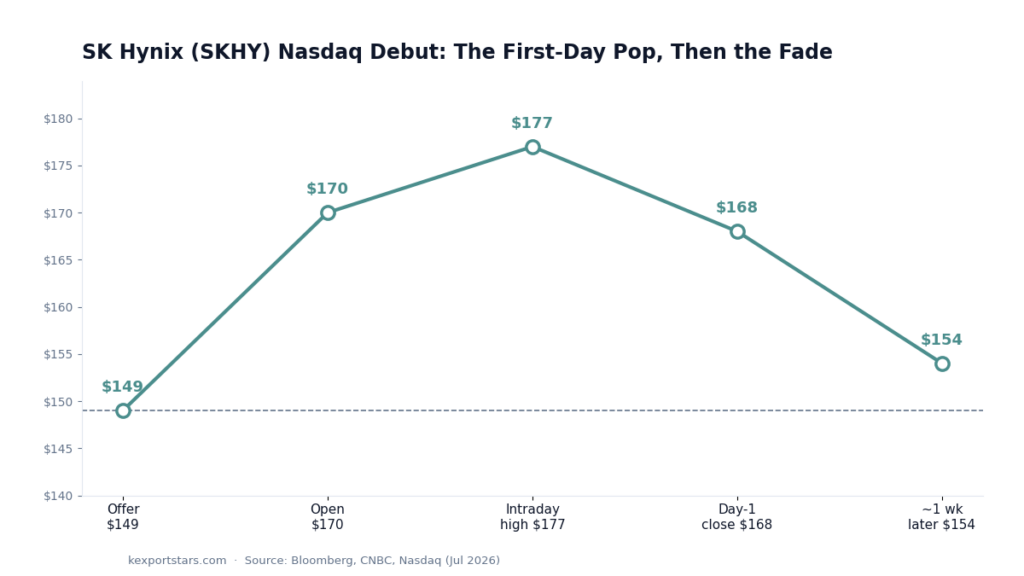
SK Hynix’s record-breaking Nasdaq debut didn’t happen in a vacuum. It sits on top of a bigger story: a memory “supercycle” driven by artificial intelligence — and two Korean giants sitting right at its center. Here’s how Samsung and SK Hynix came to power the machines that power the AI era.
🔑 Key Takeaways
- Two Korean firms dominate memory: Samsung and SK Hynix together control the majority of the world’s DRAM — the working memory inside every server, phone, and AI accelerator.
- AI changed the game: Training large AI models requires enormous High-Bandwidth Memory (HBM), turning a once-commoditized product into a scarce, high-margin strategic asset.
- “Supercycle” means unusually long, deep demand — not the short boom-bust swings memory was famous for.
- The risk cuts both ways: Memory has always been cyclical. The debate is whether AI has permanently changed the demand curve, or simply stretched the current up-leg.
🧩 First, What Is “Memory”?
Semiconductors split roughly into two families: logic chips that think (CPUs, GPUs) and memory chips that remember. Memory itself comes in two flavors:
- DRAM — fast, temporary “working memory” your device uses while running.
- NAND flash — slower, permanent storage that keeps data when the power is off.
Korea’s superpower is DRAM. And within DRAM, the crown jewel of the AI age is HBM (High-Bandwidth Memory) — DRAM stacked vertically and wired for extreme speed, so it can keep pace with the data appetite of AI chips.
🥊 Samsung vs. SK Hynix: The Duopoly
For decades, memory was a brutal commodity business — build too much, prices crash; build too little, miss the upturn. That volatility drove weaker players out, leaving a concentrated field where two Korean names lead the world.
| Company | Positioning | Edge |
|---|---|---|
| SK Hynix | The HBM specialist | First-mover lead in HBM; the go-to memory partner for AI accelerators. |
| Samsung Electronics | The scale giant | Enormous capacity, full-stack (memory + foundry + devices), racing to close the HBM gap. |
We cover each side of the duopoly in its own deep dive: Samsung Electronics’ memory-and-HBM valuation, SK Hynix’s HBM4E roadmap and pivot to commodity DRAM, and — for investors hunting an indirect, discounted angle — SK Square, the holding company that trades at a NAV discount to its SK Hynix stake. If you want SK Hynix in depth before the valuation angle — what it manufactures, the DRAM/NAND revenue split, who buys it and who controls it — start with our company reference.
SK Hynix’s Nasdaq listing — the largest-ever U.S. listing by a foreign company — was, in part, a victory lap for its HBM head start. (We broke down that $26.5 billion debut in detail here.) For overseas investors, one caveat: a hot ADR doesn’t always drag the home shares up with it — we showed how an ADR rally and the KOSPI can violently diverge — and if you just want the real dollar price, here’s how to read Samsung’s and SK Hynix’s shares in USD.
📈 Why “Supercycle,” Not Just “Cycle”?
A normal memory cycle lasts a few quarters: demand rises, prices spike, everyone builds capacity, supply floods in, prices collapse. Rinse, repeat. Investors learned to treat memory stocks as high-beta trades, not long-term holds.
The supercycle thesis argues AI broke that pattern. Building HBM is hard — low yields, complex stacking, years of R&D — so supply can’t flood in overnight. Meanwhile, every new AI data center multiplies memory demand. If that structural imbalance persists, the up-leg could last far longer than any prior cycle.
📚 Lingo Check
| Term | What It Means |
|---|---|
| DRAM | Fast temporary “working memory.” Korea’s stronghold. |
| NAND flash | Permanent storage that survives power-off (SSDs, phones). |
| HBM | Stacked, ultra-fast DRAM that feeds AI chips. The supercycle’s star. |
| Foundry | A factory that manufactures chips designed by others. Samsung has one; a pure-play memory firm does not. |
| Supercycle | An unusually long, strong demand phase that breaks the normal boom-bust rhythm. |
🎯 Why It Matters for K-Export Stars
Semiconductors are Korea’s single largest export category. When the memory cycle turns up, it lifts the country’s trade balance, its currency, and the whole KOSPI. When it turns down, the pain is just as broad. Understanding the memory cycle isn’t optional for anyone watching Korean equities — it’s the master variable. July 2026 showed just how violently that plays out: the KOSPI fell 10.84% in a single session and then posted the largest one-day gain in its history, +17.91%, three sessions later — almost entirely on memory-chip moves. We take that machinery apart in why the KOSPI is so volatile in 2026. The same wave lifts the component makers one level down the supply chain, such as Samsung Electro-Mechanics, a quiet backbone of the AI hardware build-out.
The AI boom has handed Samsung and SK Hynix a once-in-a-generation tailwind. The prize is enormous; so is the cyclicality lurking underneath. The winners will be the investors who respect both.
Conclusion
Korea’s chip duopoly turned a commodity into critical AI infrastructure — and SK Hynix’s Wall Street debut is the proof point. The supercycle thesis is compelling: hard-to-build HBM meets bottomless AI demand. But memory has humbled optimists before. Treat the AI tailwind as real and the cyclicality as equally real. The story is bullish; the discipline should be sober.
Disclaimer: This article is for informational and educational purposes only and does not constitute investment advice or a recommendation to buy or sell any security. Always do your own research and consult a licensed financial professional before investing.
Written by James Ju — a Seoul-based engineer who reads Korean-language DART and KRX filings, the primary sources most English-language coverage skips. About the author.
Company by company, from the filings
Deep dives into five companies in this supply chain, each built from its Korean-language DART filing rather than an English summary.
- Hanmi Semiconductor — the TC bonder that stacks HBM, and a quarter that reads two ways
- HPSP — high-pressure annealing, and a market share the company says cannot be computed
- Isu Petasys — the AI accelerator boards, billed 97% abroad
- Dongjin Semichem — photoresist, and the anonymous customer note that has names attached
- ISC — the test sockets, and the treasury stock that was never really treasury