Updated 2 October 2026 — the first-stage issue price now exists, and our pricing date was wrong.
The shares went ex-rights today. On 1 October the company filed the first-stage issue price: ₩1,174,000 a share, struck off 30 September as the reference date (DART 20261001800318), alongside a finalised-terms registration statement the same day.
And a correction. We wrote that the final issue price is set on 4 November. That is the reference date for the second-stage price, not the day the final price is published. The filing sets out a three-stage mechanic — a provisional price, a first-stage price (now ₩1,174,000), and a second-stage price struck off 4 November — and the final price is the lower of the first and second stages, to be disclosed on 5 November 2026, with a floor at 60% of the weighted-average price over the third-to-fifth trading days before subscription. Every date below is corrected.
Samsung Biologics owns 845,000 litres of bioreactor capacity — more than any company on earth. In August 2026 it asked its shareholders for another $2.18 billion. Not to build a sixth plant, but to buy a Swiss company that makes something its bioreactors physically cannot produce. The reason is sitting in a table on page after page of a Korean-language filing: six of the ten best-selling drugs in the world next year are not biologics at all.
🔑 Key Takeaways
- Utilisation fell 2.6 points year on year, to 69.9% in the first half of 2026 from 72.5% a year earlier. Capacity grew 7.8% between those half-years while output grew 3.8% — Samsung Biologics is adding tanks faster than it is filling them. (Source: DART half-year report rcpNo 20260814003375, filed 14 Aug 2026, and rcpNo 20260828001676)
- It is raising $2.18bn in a rights offering, and 90% of the money is not for factories. Of the ₩3,000.9bn raise, ₩2,706.2bn ($1.97bn) is earmarked “funds to acquire securities of another corporation” and only ₩294.8bn ($214.3m) is facility capex. (Source: DART securities registration, rcpNo 20260828001676, filed 28 Aug 2026)
- The target is PolyPeptide Group AG, a Swiss peptide CDMO, at CHF 44.31 per share — a 40% premium. PolyPeptide’s 2025 EBITDA margin was 12.0%. Samsung Biologics’ 2025 operating margin was 45.4%. On the summary accounts Samsung filed for it, PolyPeptide lost money at the net line in 2023, 2024 and 2025 — then posted a ₩15.5bn profit in the first half of 2026, with its EBITDA margin reaching 20.7%. (Source: DART rcpNo 20260828000016 and rcpNo 20260831800556; PolyPeptide FY2025 results)
- The offer is live, and settlement is set for 13 November 2026 — four days before the rights money arrives. The Swiss regulator cleared the prospectus on 31 August. The acquisition cost is fixed in won at ₩2,706,163,546,103; the rights proceeds are not fixed until the final issue price is published on 5 November (the first-stage price, ₩1,174,000, was filed on 1 October). (Source: DART rcpNo 20260831800556, filed 31 Aug 2026, and rcpNo 20260828000001)
- The market has already voted on the raise: −6.8% on the first session after it was announced, −9.2% since. The shares closed at ₩1,447,000 on 4 September against ₩1,594,000 on 27 August, the last close before the filing. (Source: Korea Exchange settled closes)
- The BIOSECURE Act windfall thesis needs correcting. The Act became law in December 2025 — but WuXi Biologics, the actual biologics-CDMO competitor, is not on the Pentagon’s 1260H list. WuXi AppTec, a different company, is. And the binding procurement list is not due until December 2026.
- Watch the denominator, not the EPS. First-half 2026 EPS rose 108%. Net income rose 28.6%. The gap is the November 2025 spin-off, which cut the share count from 71.17m to 46.29m.
Updated 7 September 2026: Samsung Biologics filed a further disclosure on 31 August (rcpNo 20260831800556) confirming that the Swiss regulator has cleared the tender-offer prospectus and that settlement is now scheduled for 13 November 2026 — not 30 November, as the August filings stated. The market snapshot, the flow figures and the share-price reaction to the rights offering have all been refreshed to the 4 September settled close.
A note on units, and on the two exchange rates below. Every money figure on this page is shown in US dollars, and the won is the underlying unit for everything that comes out of a Korean filing. Because this article mixes fixed contract amounts with a live market price, it uses two rates and labels each one:
- ₩1,375.67/$ — the 28 August 2026 close, used for every figure taken from a filing (the acquisition price, the rights offering, the income statement). These are amounts fixed in won on or before the 28 August filing date, so they are converted at the rate that applied then and do not move afterwards.
- ₩1,345.99/$ — the 4 September 2026 close, used only for the market snapshot: share price, market capitalisation and investor flows. These are current values and are converted at the current rate.
Both rates are the settled close for the last completed trading day in question, taken from our own FX series and cross-checked against the Korea Exchange. Applying a single rate across both groups would misprice one of them, so we do not. Share prices additionally show the won in parentheses because you will need it if you check a KRX quote. Figures quoted directly from a filing keep that filing’s own units — the PolyPeptide deal is struck in Swiss francs and PolyPeptide reports in euros, so those stay as filed.
🏢 What Is Samsung Biologics, and What Does It Actually Sell?
Samsung Biologics is a contract manufacturer: it builds and runs the factories that make other companies’ biologic drugs, and it does not own the drugs it makes. If Merck needs 20,000 litres of a monoclonal antibody made to FDA standard and does not want to spend four years and a billion dollars building a plant, it rents Samsung’s. Samsung gets paid for the manufacturing. Merck keeps the drug, the patent, and the profit on the prescription.
The company was founded on 22 April 2011 and is headquartered at 300 Songdo Bio-daero, Yeonsu-gu, Incheon — the Songdo free economic zone, on reclaimed land west of Seoul. It listed on the KOSPI in 2016 (Wikipedia entity page). The chief executive is John Rim, written 존림 (Rim John Chongbo) in the filings. (Source: DART FY2025 annual report, rcpNo 20260515001658)
Two things about the business are easy for a foreign investor to get wrong.
First, it is no longer the company it was a year ago. On 1 November 2025 Samsung Biologics completed a demerger (인적분할), spinning out Samsung Epis Holdings, which now owns 100% of Samsung Bioepis — the biosimilar developer. The filing states the purpose plainly:
“Through this demerger, by resolving concerns over conflict of interest with the biosimilar business and strengthening an independent decision-making structure, the company plans to further strengthen its global competitiveness as a pure contract development and manufacturing (CDMO) company.” — DART FY2025 annual report, rcpNo 20260515001658 (our translation)
The commercial logic is real. A CDMO’s customers are large pharmaceutical companies. While Samsung also owned a biosimilar developer, it was asking those customers to hand their molecules to a firm that also sold generic competitors to their drugs. The split removes that objection. It also removed a third of the revenue: the prospectus states that Bioepis accounted for 33.8% of 2024 consolidated revenue before the split.
Second, “biologics” is a narrower word than it sounds. Samsung Biologics’ plants are mammalian cell-culture bioreactors. They grow living cells that secrete large, complex protein molecules — antibodies. They cannot make small-molecule drugs, and they cannot make peptides. Hold on to that sentence; the rest of this article turns on it.
📊 Where Does the Revenue Actually Come From?
Almost all of it is product revenue from manufacturing, and almost all of it is billed to customers outside Korea — with Europe, not the United States, as the largest region. That last point tends to surprise people who assume a US-driven story.
| Revenue by customer region | FY2023 | FY2024 | FY2025 | 1H 2025 ⚠️ | 1H 2026 |
|---|---|---|---|---|---|
| Europe | $1,271.8m (59.5%) | $1,479.9m (58.2%) | $1,721.3m (52.0%) | $1,014.3m (53.9%) | $1,110.4m (59.3%) |
| Americas (미주) | $561.3m (26.3%) | $598.0m (23.5%) | $1,260.4m (38.0%) | $692.1m (36.8%) | $433.1m (23.1%) |
| Korea | $244.8m (11.5%) | $405.7m (16.0%) | $270.3m (8.2%) | $60.5m (3.2%) | $313.9m (16.7%) |
| Other | $58.3m (2.7%) | $58.6m (2.3%) | $60.7m (1.8%) | $114.5m (6.1%) | $16.6m (0.9%) |
| Total | $2,136.3m | $2,542.2m | $3,312.7m | $1,881.4m ⚠️ | $1,874.0m |
⚠️ The 1H 2025 column is not on the same basis as the rest of the table. We think it still includes Samsung Bioepis. Here is the check, and you can run it yourself in the same document. The 2023, 2024, 2025 and 1H 2026 regional totals tie exactly to the restated continuing-operations income statement printed a few pages later — ₩2,938.8bn, ₩3,497.1bn, ₩4,557.0bn and ₩2,578.0bn. The 1H 2025 regional total does not. It comes to ₩2,588.2bn against a restated 1H 2025 revenue of ₩2,013.8bn — a gap of ₩574.4bn. Annualised, that gap is close to the ₩1,060bn of revenue the demerger removed from FY2024. The most likely explanation is that this column was carried over from the half-year report published in August 2025, before the 1 November 2025 demerger.
So do not compute a like-for-like 1H25→1H26 change from this row. Taken at face value, Americas revenue fell 37.4%. Part of that fall is Samsung Bioepis leaving the company, not customers leaving Samsung Biologics — and the filing does not break out how much. We are showing the column because leaving it out would hide the problem, not because the comparison works.
Source: DART half-year report, rcpNo 20260814003375, section “4. Sales and Order Status”. Won figures converted at ₩1,375.67/$. Percentages are as printed in the filing. By type, first-half 2026 revenue was 97.6% product and 2.4% service.
The US line is the one worth staring at. It went 23.5% → 38.0% → 23.1%. Our own earlier research file described this as the US “halving,” and on the share numbers it does. But the three-year view says something more precise: 2025 was the outlier, not 2026. US share in the first half of 2026 is essentially back where it was in 2024.
In absolute dollars the swing is still real. US-billed revenue went from $598.0m in 2024 to $1,260.4m in 2025 — it more than doubled — and the first half of 2026 is running at $433.1m, an annualised pace roughly a third below the 2025 full-year figure. Something pulled a large amount of US-billed work into 2025 and it has not repeated. The filings do not explain why, and we are not going to invent a reason. We looked specifically: the half-year report gives the regional split and then characterises it as “stable revenue” across Europe (59.3%), the Americas (23.1%), Korea (16.7%) and other markets (0.9%), with no commentary on the swing at all. Management is not treating the 2025 US spike as an event worth explaining — which is itself a data point, though not a reassuring one for anyone who built a US-growth thesis on the 2025 number. What the filings do give us is the company’s own list of what it is worried about in the United States, and it is not what most English-language coverage assumes. That comes below.
🗓️ How Samsung Biologics Got Here: A Short History
Fifteen years, one site, and a decision to build ahead of demand — repeatedly.
| Date | What happened |
|---|---|
| Apr 2011 | Founded in Songdo, Incheon. |
| Jul 2012 | Plant 1 completed (30,000 L). |
| 2016 | Lists on the KOSPI. |
| Oct 2022 | Plant 4 completed, finishing Bio Campus 1 at roughly 604,000 L. |
| Apr 2022 | Acquires 100% of Samsung Bioepis, folding the biosimilar developer in as a division. |
| Mar 2023 | Board approves Plant 5 — a build that ultimately cost about ₩2tn. |
| Apr 2025 | Plant 5 completed (180,000 L), opening Bio Campus 2. Songdo capacity reaches 785,000 L. |
| 1 Nov 2025 | Demerger completed. Samsung Epis Holdings is created and takes Samsung Bioepis. Share count falls from 71,174,000 to 46,290,951. |
| Dec 2025 | Agrees to buy Human Genome Sciences, a GSK subsidiary in Rockville, Maryland (60,000 L). |
| 31 Mar 2026 | Rockville acquisition completes. Total capacity reaches 845,000 L, with a US footprint for the first time. |
| 20 Jul 2026 | Announces the acquisition of PolyPeptide Group AG. |
| 28 Aug 2026 | Files a ₩3,000.9bn ($2.18bn) rights offering to pay for it. |
| 31 Aug 2026 | Swiss authorities approve the tender-offer prospectus published by Samsung Peptide AG, the Swiss acquisition vehicle Samsung set up for the deal. Settlement scheduled for 13 Nov 2026. |
| 3 Sep 2026 | Holds an online briefing for minority shareholders on the rights offering. |
| by 2032 | Plants 6–8 planned for Bio Campus 2. |
Sources: DART annual report rcpNo 20260515001658; half-year report rcpNo 20260814003375; securities registration rcpNo 20260828001676. KOSPI listing year via Wikipedia.
🌍 Is Samsung Biologics Really the World’s Largest?
By installed bioreactor volume, yes — and the company says so in a regulated filing, which is a meaningfully higher bar than a press release. The securities registration states it is “the world’s number one bio-CMO company on a production-facility basis,” with 785,000 L in Songdo as of June 2026.
| Facility | Capacity | Status |
|---|---|---|
| Plant 1 (Songdo) | 30,000 L | Operating since 2012 |
| Plant 2 (Songdo) | 155,000 L | Operating |
| Plant 3 (Songdo) | 180,000 L | Operating |
| Plant 4 (Songdo) | 240,000 L | Operating since 2022 |
| Plant 5 (Songdo) | 180,000 L | Completed Apr 2025 |
| Rockville, Maryland (ex-GSK) | 60,000 L | Acquired 31 Mar 2026 |
| ADC dedicated plant | 500 L | Operating — additional to the 845,000 L headline |
| Total | 845,000 L | 785,000 L Songdo + 60,000 L US |
Source: DART half-year report rcpNo 20260814003375 and securities registration rcpNo 20260828001676. Note that this is installed capacity, all of it either operating or completed — not a construction pipeline.
One correction worth making, because the number circulates in a slightly wrong form: the Songdo figure is 785,000 litres, not 784,000. The filing itself itemises it — 30,000 + 155,000 + 180,000 + 240,000 + 180,000. And the headline total most write-ups use omits Rockville, which has been owned since March 2026.
The company names its own peer set: the CDMOs with more than 300,000 L of global capacity in 2026 are Lonza (Switzerland), WuXi Biologics (China), and FUJIFILM Biotechnologies (Japan). Two caveats belong here. Capacity is not market share — the filing gives no revenue-share figure, and we are not going to construct one. And “largest” is a claim about litres, which is only the right metric while the drugs the world wants are made in litres.
📈 Is the Business Getting Better or Worse?
On margins it is getting better; on capacity occupancy it is getting worse; and the two are being driven by different things. Before the table, one warning that determines whether any of these numbers mean anything.
⚠️ Do not compare Samsung Biologics to its own pre-2026 headlines. Because of the November 2025 demerger, the income statement has been restated onto a continuing-operations basis — the filing says so explicitly. FY2024 revenue as originally reported was ₩4.55tn. FY2024 revenue as restated is ₩3.50tn ($2.54bn). The ₩1.05tn difference is Samsung Bioepis. Any article comparing a 2026 figure to a pre-restatement 2024 figure is comparing two different companies. Every number in the table below is on the restated basis.
| Continuing operations | FY2023 | FY2024 | FY2025 | 1H 2025 | 1H 2026 |
|---|---|---|---|---|---|
| Revenue | $2.14bn | $2.54bn | $3.31bn | $1.46bn | $1.87bn |
| Gross margin | 50.7% | 48.9% | 55.2% | 55.0% | 53.5% |
| Operating profit | $0.88bn | $0.96bn | $1.50bn | $0.66bn | $0.85bn |
| Operating margin | 41.0% | 37.8% | 45.4% | 45.1% | 45.3% |
| Net income | $0.62bn | $0.79bn | $1.30bn | $0.51bn | $0.65bn |
| Net margin | 29.2% | 31.0% | 39.2% | 34.8% | 34.9% |
| EPS, continuing ops | ₩13,334 | ₩14,616 | ₩24,091 | ₩9,342 | ₩19,462 |
| Companies consolidated | 14 | 14 | 1 | 14 | 2 |
Source: DART securities registration rcpNo 20260828001676, summary consolidated income statement. Won converted at ₩1,375.67/$. EPS left in won deliberately — see the warning below.
A 45.3% operating margin on a manufacturing business is genuinely excellent, and the margin has held steady half-on-half. But look one line up: gross margin fell from 55.0% to 53.5%. Plant 5 and Rockville are now depreciating. The fixed-cost base got bigger before the revenue did.
The EPS number is going to mislead a screener
First-half 2026 EPS from continuing operations rose 108.3% year on year. Net income rose 28.6%. The difference is not performance — it is the share count. (The net-income growth is computed on the won figures — ₩699,940m to ₩899,900m; the dollar column in the table above is rounded to two decimals and will not reproduce it exactly.)
The half-year report gives the weighted-average share counts outright: 71,174,000 shares for the first half of 2025, and 46,239,518 for the first half of 2026. The demerger cancelled 24,883,049 shares. So the same earnings are now divided among 35% fewer shares. Any stock screener ranking Korean pharma by EPS growth will show Samsung Biologics near the top of the list this year, and roughly three-quarters of that ranking is arithmetic.
The same trap sits in the FY2025 figure. DART reports FY2025 EPS of ₩26,628, but that is struck on a weighted-average count spanning the 1 November demerger — most of the year at 71.17m shares. Divide today’s price by it and you get a P/E in the mid-50s. Divide the market capitalisation by FY2025 net income and you get 37.5x. The second one is right. This is the sort of thing that quietly poisons a peer table.
🔍 The Discovery: Six of 2026’s Ten Biggest Drugs Cannot Be Made in Any of Its 845,000 Litres
Samsung Biologics’ own prospectus contains a table of the world’s ten best-selling drugs for 2026 — and it labels six of them “synthetic,” not biologic. Four of those six are GLP-1s, together forecast at $80.6bn. That is the single most important fact in the filing, and it is the reason for everything the company has done since July.
| # | Drug | Company | Type | 2026E sales |
|---|---|---|---|---|
| 1 | Keytruda | Merck & Co. | Biologic (mAb) | $33.8bn |
| 2 | Mounjaro | Eli Lilly | Synthetic (GLP-1/GIP) | $25.8bn |
| 3 | Skyrizi | AbbVie | Biologic (mAb) | $21.0bn |
| 4 | Dupixent | Sanofi | Biologic (mAb) | $19.8bn |
| 5 | Zepbound | Eli Lilly | Synthetic (GLP-1/GIP) | $19.7bn |
| 6 | Ozempic | Novo Nordisk | Synthetic (GLP-1) | $19.7bn |
| 7 | Darzalex | Johnson & Johnson | Biologic (mAb) | $16.1bn |
| 8 | Wegovy | Novo Nordisk | Synthetic (GLP-1) | $15.4bn |
| 9 | Biktarvy | Gilead | Synthetic | $14.8bn |
| 10 | Eliquis | Bristol-Myers Squibb | Synthetic | $12.1bn |
Source: reproduced from DART securities registration rcpNo 20260828001676, which cites Nature, “Top product forecasts for 2026” (Dec 2025). Highlighting is ours. Classification of drug type is the filing’s own.
The filing states the split in its own words: four of the top ten are biologics, and the highest-selling of all is one — Keytruda. The other six are small molecules and peptides. It also notes that in 2003 only one of the top ten was a biologic, which is the point it is making about how fast biologics grew. The point we are making is what happened next.
Now put that next to the market Samsung Biologics actually serves. The same prospectus sizes the biologics CDMO market at $28.4bn in 2026 — up 14.6% on 2025 — and projects a 15.6% compound annual growth rate over the following three years to $43.9bn in 2029. (Two different growth figures, two different meanings: 14.6% is the single-year step into 2026; 15.6% is the CAGR from there to 2029.)
Read those two numbers together. The four GLP-1 drugs alone, at $80.6bn, are worth nearly three times the entire global biologics contract-manufacturing market that Samsung’s 845,000 litres compete for. The biggest thing that has ever happened to pharmaceutical manufacturing demand is happening in a molecule class Samsung Biologics could not make.
Peptides like semaglutide and tirzepatide are built by solid-phase chemical synthesis, not grown in mammalian cells. A 240,000-litre bioreactor is not underused for that job; it is the wrong machine entirely. So Samsung Biologics did the only thing that closes the gap in less than a decade. It went shopping.
What it is buying, and what it is paying
On 17 July 2026 the board resolved to acquire PolyPeptide Group AG, a Swiss-listed peptide CDMO, announcing it on 20 July. The terms, from the DART filing:
| Term | Detail |
|---|---|
| Target | PolyPeptide Group AG (Switzerland), peptide CDMO |
| Structure | All-cash public tender offer, made through Samsung Peptide AG, a Swiss subsidiary set up for the purpose |
| Shares sought | 33,016,411 — every share in issue (33,125,001) except PolyPeptide’s own 108,590 treasury shares. That is the maximum: it assumes every holder tenders |
| Stake if fully taken up | 100%, measured against shares outstanding excluding treasury. The filing states the actual stake will depend on how many shares are tendered |
| Offer price | CHF 44.31 per share (DART). A 40% premium to an undisturbed price of CHF 31.65 — that premium and reference price are from the companies’ joint announcement, not the DART filing. |
| Consideration as filed | ₩2,706,163,546,103 ($1.97bn at our rate) — which the filing states it computed from CHF at CHF/KRW 1,849.79, the base rate of 16 Jul 2026 |
| Size vs Samsung Biologics | 24.47% of total assets · 36.32% of equity |
| Locked-up support | Irrevocable undertaking from the largest holder (Draupnir Holding B.V.), ~55.65% |
| Minimum acceptance | 66⅔% |
| Fairness opinion | Deloitte Anjin: CHF 31.43–63.22 range; CHF 44.31 found not unreasonable |
| Regulatory status | Swiss authorities approved the tender-offer prospectus on 31 August 2026; the offer is open |
| Scheduled settlement | 13 November 2026 — the settlement date for shares acquired in the offer. The filing warns it can move with the offer’s progress and with merger-control and foreign-investment approvals |
Source: DART material-event report, rcpNo 20260828000016, board resolution 17 Jul 2026; structure, share counts, stake, regulatory status and settlement date from the subsidiary disclosure rcpNo 20260831800556, filed 31 Aug 2026. The premium and undisturbed price come from the tender-offer announcement.
Read the “100%” carefully. It is not a completed purchase — it is the ceiling. Samsung is bidding for all 33,016,411 non-treasury shares, and the filing says plainly that the number it actually ends up with depends on how many holders accept. Two things make the ceiling likely rather than hopeful: Draupnir Holding B.V., which owns 55.65%, has irrevocably committed to tender all of it, and the offer only completes at all if two-thirds of the fully-diluted capital is tendered. Draupnir alone gets Samsung most of the way to that threshold.
A small reconciliation, since two different dollar figures are circulating. The company’s English press release put the deal at CHF ~1.46bn / ~$1.8bn. The DART filing records ₩2,706.2bn, which converts to $1.97bn at our ₩1,375.67/$. Both are correct: the won figure was struck at CHF/KRW 1,849.79 on 16 July, and the dollar figures differ only because they route through different currency pairs on different dates. The underlying deal is the same CHF 44.31 × 33,016,411 shares.
PolyPeptide is a real GLP-1 beneficiary, and the prospectus contains Samsung’s own diligence on it. Revenue went €336.8m (2024) → €389.3m (2025), and first-half 2026 revenue was €236.6m against €167.1m a year earlier. The growth is almost entirely one thing: metabolic (GLP-1) revenue rose 65.4% in 2025 and 72.7% in the first half of 2026, and the filing states it accounted for about 98% of first-half revenue growth, lifting metabolic from 56.7% of revenue to 68.4%. PolyPeptide raised its own 2026 full-year guidance — revenue growth from 20–25% to 25–30% at constant currency, and EBITDA margin from mid-to-high teens to high teens, with capex held at 15–20% of revenue. (Source: PolyPeptide’s 2026 half-year earnings presentation, reproduced in rcpNo 20260828001676.)
And here is the part a buyer’s press release will not lead with. PolyPeptide’s 2025 EBITDA margin was 12.0% — up from 7.5% in 2024, but 12.0%. Samsung Biologics’ 2025 operating margin was 45.4%. Samsung is paying a 40% premium to buy a business whose profitability is a quarter of its own, on the thesis that GLP-1 volume fixes that. It might, and the first half of 2026 is the first evidence for it: PolyPeptide’s EBITDA margin reached 20.7% in that half, against 12.0% for 2025 as a whole. The longer-dated projection in the filing is for revenue to compound at more than 10% a year from 2026 to 2031, with the EBITDA margin exceeding 30% by 2031 — which would still be well short of what Samsung earns today, and is five years out.
The 31 August filing added the line EBITDA leaves out
PolyPeptide lost money at the net line in 2023, 2024 and 2025 — and then turned a profit in the first half of 2026. Korean disclosure rules require an acquirer to file a summary of the target’s accounts, and the filings do. This is the table, exactly as printed — in millions of won, all four periods.
| PolyPeptide Group AG (as filed, ₩m) | 2023 | 2024 | 2025 | 1H 2026 |
|---|---|---|---|---|
| Revenue | 554,641 | 578,402 | 669,198 | 421,547 |
| Net income | −87,827 | −33,403 | −36,143 | +15,504 |
| Assets, end of year | 1,176,521 | 1,291,748 | 1,410,209 | 1,469,648 |
| Liabilities, end of year | 525,633 | 681,803 | 828,686 | 869,999 |
| Equity, end of year | 650,888 | 609,944 | 581,523 | 599,649 |
Source: DART subsidiary disclosure rcpNo 20260831800556, “summary financial position of the issuer” (발행회사의 요약 재무상황). The same table appears in the securities registration rcpNo 20260828001676, which is where the 1H 2026 column comes from. The Korean line names are 매출액, 당기순이익, 자산총계, 부채총계 and 자본총계, in that order. Balance-sheet lines are stocks at each period end; revenue and net income are flows — and the last column is a half-year, not a year.
On the currency, and why this table can be checked. PolyPeptide reports in euros, and the filing states the rate it applied: the 16 July 2026 base rates of EUR/KRW 1,707.36 and CHF/KRW 1,849.79. Dividing through confirms it — ₩554,641m → €324,853k, ₩669,198m → €391,952k, ₩421,547m → €246,900k, against €324,853k, €391,949k and €246,900k in the filing’s euro table. Note which euro line it reconciles to: total income (매출총액), not revenue (매출액). That is why the 2025 figure maps to €391,949k rather than the €389,827k of revenue quoted earlier in this article — a difference of other income, not an error.
Three consecutive annual losses — −₩87.8bn, −₩33.4bn, −₩36.1bn — and then +₩15.5bn in the first half of 2026. The 2023-to-2024 improvement is real and large; it then stalled, with the 2025 loss widening slightly even as revenue grew. The most recent reporting period, though, is the one that breaks the pattern, and it belongs in any honest reading of this table.
And the filing says why the losses happened, so we do not have to guess. Its explanation is that despite rising revenue, PolyPeptide kept posting net losses “because non-operating losses, including foreign-exchange and financial items, exceeded operating profit.” That is a materially different diagnosis from an unprofitable business: operating profit was positive. The euro table bears it out — PolyPeptide’s gross margin ran 2.8% → 11.7% → 17.1% → 26.9% across 2023, 2024, 2025 and 1H 2026, and its EBITDA margin went −1.8% → 7.5% → 12.0% → 20.7%. The company reports a 9.3% operating margin in the first half of 2026, up 17.5 percentage points year on year, which it credits to the ramp-up of its Braine-l’Alleud plant in Belgium completing, better yields, and start-up costs falling away.
The balance sheet is the part that has not turned. Liabilities rose from ₩525.6bn to ₩870.0bn between 2023 and the 2026 half, while equity fell from ₩650.9bn to ₩599.6bn. (Those movements are read off the filing’s printed figures.) Total liabilities are now about 1.45 times equity — and that is total liabilities, which includes payables and lease obligations, not a borrowings figure; the filing does not break out debt.
So what is actually being bought is more specific than either the bull or the bear version. Not a profitable peptide franchise, and not a broken one either: a business whose operations turned the corner in the most recent half, whose reported losses came from below the operating line, and which carries more liabilities than equity. Samsung is paying a 40% premium for that, with cash raised from its own shareholders. The GLP-1 thesis still has to carry the premium — it just no longer has to carry an operating turnaround as well.
Who pays for it: you do
The rights offering filed on 28 August funds the deal. The board fixed the size: 2,270,000 new shares, equal to 4.90% of the 46,290,951 shares outstanding. Structure: subscription by existing holders, with any unsubscribed shares offered publicly and the leads taking the residual.
The price is the part that is not yet fixed. The registration carries an indicative issue price of ₩1,322,000 ($961), struck at a 15% discount to a ₩1,566,591 base price. The final price is not set until 4 November 2026, so the ₩3,000.9bn ($2.18bn) headline is an estimate that moves with the share price between now and then.
| Use of proceeds | Amount | Share |
|---|---|---|
| Acquisition of another company’s securities | $1,967.2m | 90.2% |
| Facility investment | $214.3m | 9.8% |
| Total raise | $2,181.6m | 100% |
| Issuance expenses (separate) | $7.4m | — |
Source: DART securities registration rcpNo 20260828001676 and material-event report rcpNo 20260828000001, both filed 28 Aug 2026.
The dates matter if you hold the stock. Ex-rights was 2 October 2026 and the record date is 6 October. Rights certificates trade 26–30 October. The second-stage price is struck off 4 November and the final issue price is published on 5 November — the lower of that and the first-stage ₩1,174,000 filed on 1 October; existing holders subscribe 9–10 November, the public offering runs 12–13 November, subscription money is paid in on 17 November, and the new shares list on 30 November 2026. Note also that anyone who short-sold the stock between 31 August and 4 November is barred from participating.
Two dates that do not line up
Samsung is scheduled to pay for PolyPeptide on 13 November, but the rights-offering money is not paid in until 17 November. The tender settles four days before the cash it is supposed to be funded by arrives. The acquisition filing is candid about this — it says the offer consideration will be funded “through a rights offering and other means,” and that “other means” is doing real work over those four days. A company with net cash and an AA domestic rating has obvious ways to bridge four days, so this is a plumbing detail rather than a solvency question. It is worth knowing anyway, because it tells you the rights offering is a refinancing of a commitment Samsung has already made, not a condition of making it.
There is a second mismatch, and this one has teeth. The acquisition cost is fixed in won. The rights proceeds are not. Samsung owes ₩2,706,163,546,103 — a number locked in at the CHF/KRW rate of 16 July. But the issue price is recalculated from market prices shortly before the subscription date, so the ₩3,000.9bn headline is an estimate. The indicative ₩1,322,000 was struck at a 15% discount to a ₩1,566,591 base price, and the 4 September settled close on the Korea Exchange sits 7.6% below that base. If the shares are still near this level in early November, the final issue price, and therefore the amount raised, comes in below the indicative figures.
The fixed cost does not shrink with it. Of the ₩3,000.9bn indicative raise, ₩2,706.2bn is spoken for, leaving ₩294.8bn ($214.3m) for facility investment. That ₩294.8bn is the entire buffer. A roughly 10% shortfall in the raise would consume it, and the capex bucket — not the acquisition — is the line that gives way first. Watch the 4 November price fixing.
One governance detail worth flagging: the employee stock ownership association gets a 20% preferential allocation and that tranche is locked up. The rest is not. The filing itself warns that the unlocked portion could hit the market at once.
🧪 So Did the BIOSECURE Act Actually Deliver the Windfall?
Not yet, and probably not in the form most coverage described — because the company whose business Samsung was supposed to inherit has not been designated. This deserves care, because it is the most widely repeated claim about this stock and it rests on a company-name confusion.
Here is the sequence, as best it can be established from the legal record:
- The BIOSECURE Act became law on 18 December 2025, folded into the FY2026 National Defense Authorization Act. So “the Act passed” is correct — earlier reporting that treated it as pending is out of date. (See Ropes & Gray, “BIOSECURE Act Enacted”.)
- The enacted text does not name any company. Unlike earlier drafts, which listed WuXi AppTec, WuXi Biologics, BGI and others by name, the law works by reference to the Department of Defense’s “Chinese military companies” list under Section 1260H.
- On 8 June 2026 the Pentagon added WuXi AppTec to the 1260H list. WuXi Biologics was not added.
- WuXi AppTec and WuXi Biologics are separate listed companies, independently carved out of the former WuXi PharmaTech. WuXi Biologics — the one Samsung actually competes with, and the one named as a peer in Samsung’s own filing — is the biologics CDMO. WuXi AppTec is the other one.
- Even for a designated entity, the restrictions bite on federal contracting and grants, not on private pharmaceutical companies’ commercial sourcing. And the implementation clock is slow: OMB must publish the operative list by December 2026, issue guidance within 180 days after that, and the FAR Council then has a year to write it into procurement rules.
So the mechanism that was supposed to push antibody manufacturing out of China and into Songdo has not been switched on, and the specific Chinese competitor in Samsung’s own peer list is not currently subject to it. That is not a prediction about whether it eventually will be — it may well be. It is a statement about what has happened so far.
This matters because it reconciles two things that otherwise look contradictory. A company absorbing a flood of displaced Chinese volume would be posting a step-change in output. Samsung Biologics produced 378 batches in the first half of 2026 against 364 a year earlier — 3.8% more, on 7.8% more capacity. Utilisation fell as a result. The company attributes that to Plant 5 and Rockville starting up, which is a fair explanation of the ratio; it is not an explanation of why the numerator grew 3.8% in the year the windfall was supposed to arrive. The windfall thesis and the production line cannot both be right, and the production line is the audited one.
What the company is actually worried about in the US: tariffs
Samsung Biologics’ own risk factors reveal a different American variable. The prospectus reproduces a White House timeline showing that on 2 April 2026 a Section 232 proclamation imposed tariffs of up to 100% on imported patented pharmaceuticals for firms without US manufacturing or a pricing agreement — with Korea and other key partners receiving a preferential 15% rate. Subsequent notes record confirmation on 4 June 2026 that Korean tariffs would not exceed 15%.
The company then states its own exposure directly: because its production facilities are mostly in Korea, a pharmaceutical tariff would erode its price competitiveness against rivals that manufacture inside the United States. The filing goes on to list exactly that — Lonza built a Texas plant in 2018 and bought a Roche facility in California in 2024; WuXi Biologics is building 36,000 L in Massachusetts; Catalent is American.
Seen through that lens, the $353m Rockville purchase stops looking like opportunistic capacity and starts looking like a tariff hedge — a US address. It is 60,000 litres against 785,000 at home, so it is a small hedge. But it is the first one.
📉 What Does the Utilisation Rate Say?
Utilisation fell 2.6 percentage points year on year in the first half of 2026, to 69.9% — because capacity grew faster than output, not because output shrank. The filing prints five periods, and all five belong in the table. Three of them get quoted; two of them are the ones that stop you drawing the wrong conclusion.
| Batches | FY2023 | FY2024 | FY2025 | 1H 2025 | 1H 2026 |
|---|---|---|---|---|---|
| Production capacity | 733 | 833 | 1,034 | 502 | 541 |
| Actual production | 523 | 626 | 733 | 364 | 378 |
| Utilisation | 71.4% | 75.2% | 70.9% | 72.5% | 69.9% |
Source: DART securities registration rcpNo 20260828001676, table “당사 가동률 추이”, which reproduces the same series from the half-year report (rcpNo 20260814003375). Measured in batches, with scheduled slowdowns and product changeovers already deducted from available hours. Full-year and half-year columns are different period lengths and must not be read as one sequence.
⚠️ A correction to a claim you will see elsewhere — including in an earlier version of this article. Utilisation has not fallen three years running. It rose in 2024, from 71.4% to 75.2%. The full-year series is 71.4% → 75.2% → 70.9%, which is up then down, and 69.9% is a half-year figure that does not belong on the end of that run. The comparison the filing itself makes is like-for-like: first half 2025 at 72.5% against first half 2026 at 69.9%, a fall of 2.6 percentage points. That decline is real, and it is the number to use.
The mechanism matters more than the level. Between the two half-years, capacity went from 502 batches to 541 (+7.8%) while production went from 364 to 378 (+3.8%). Output grew. The denominator grew faster. That is a very different fact from a plant standing idle, and the company says so directly, attributing the decline to Plant 5 and Rockville being in their start-up phase and stating it expects utilisation to rebound as Plant 5 ramps and Rockville comes into service in the second half. That is management’s expectation, not a disclosed result, and the second-half figures will settle it.
But note what the mechanism does not rescue. A company absorbing a flood of displaced competitor volume would show output surging, not growing 3.8% in a half-year. The ramp-up explanation and the windfall thesis are both about the same 39 extra batches of capacity, and only one of them is consistent with 14 extra batches of production.
Management’s position, stated in the prospectus, is that the long-term order book plus Plant 5, the ADC line and Rockville mean revenue keeps growing. That is a reasonable expectation and the revenue line has so far supported it. But the filing also concedes the structural risk in the same breath: this is a business with heavy fixed costs in labour and depreciation, so maintaining utilisation through steady order intake is critical, and a shrinking backlog would hurt profitability.
Which brings us to the backlog — and this is where the counterweight is.
| Order book (as of 30 Jun 2026) | Minimum-purchase basis | Upside scenario |
|---|---|---|
| Cumulative bookings | $21,689m | $24,292m |
| Delivered to date | $11,766m | $11,766m |
| Remaining backlog | $9,923m | $12,526m |
Source: DART half-year report rcpNo 20260814003375. Already denominated in US dollars in the filing — no conversion applied. Contracts date from 2015 with deliveries scheduled out to 2037. Excludes raw-material pass-through, tech transfer and analytical service revenue.
A $9.9bn contracted backlog against $3.31bn of annual revenue is roughly three years of work already signed, on minimum purchase commitments, running to 2037. That is the honest answer to the “client lock-in” question — not a vague claim about switching costs, but a disclosed, take-or-pay-style order book with a maturity date. It is also the reason a 69.9% utilisation rate is uncomfortable rather than alarming.
But there is a second reading, and it is less flattering — and it needs a longer table than the one usually quoted, because the answer flips depending on which two columns you pick. The company prints the backlog for five periods.
| $m, minimum-purchase basis | FY2023 | FY2024 | FY2025 | 1H 2025 | 1H 2026 |
|---|---|---|---|---|---|
| Cumulative bookings | 12,027 | 16,346 | 21,153 | 18,726 | 21,689 |
| Order backlog | 5,932 | 8,271 | 10,704 | 9,613 | 9,923 |
| Backlog, upside scenario | 12,355 | 12,731 | 13,432 | 12,623 | 12,526 |
Source: DART securities registration rcpNo 20260828001676, table “당사 수주 추이”. Every figure here is printed by the company; none of it is our arithmetic. The filing notes these amounts exclude raw-material sales and revenue from technology transfer and quality-analysis services — so they are not on the same basis as reported product revenue, and the two should not be netted against each other.
Against year-end 2025 the backlog fell $781m, from $10,704m to $9,923m. Against the same point a year earlier it rose $310m, from $9,613m. Both are true, and they are the same number seen through two windows. A backlog that is drawn down through the first half and rebuilt in the second is what a business with lumpy multi-year contracts looks like; the 1H25 column exists precisely so you can check whether this half is unusual, and on the minimum-purchase basis it is not.
The upside-scenario line is the one that does not cooperate. It fell on both windows — $13,432m to $12,526m against year-end, and $12,623m to $12,526m against the prior half. That series depends on customers’ development programmes succeeding, so it moves when a client’s pipeline slips rather than when Samsung loses work. It is the softer number and it is drifting the wrong way on every comparison available.
An earlier version of this article estimated the backlog change by subtracting product revenue from the movement in cumulative bookings. That was wrong twice over: the company discloses the backlog directly, and product revenue is measured on a different basis than the bookings series. The disclosed figures are above.
💰 What Do You Actually Pay for Samsung Biologics Today?
About 38 times earnings before the rights offering, and about 39 times after it — for a business that grew revenue 28.0% year on year in the first half of 2026 and earns a 45% operating margin, with net cash. That multiple has come down since the deal was announced, and not because earnings rose.
| Metric | Value |
|---|---|
| Share price (settled close, 4 Sep 2026) | $1,075.05 (₩1,447,000) |
| Change since 27 Aug (last close before the filing) | −9.2% (from ₩1,594,000) |
| Market capitalisation | $49.76bn (₩66.98tn) |
| Shares outstanding / treasury | 46,290,951 / 51,433 (0.11%) |
| P/E — market cap ÷ FY2025 net income | 37.5x |
| P/E — on annualised 1H26 net income | 37.2x |
| P/E — post-rights, 48,560,951 shares | 39.4x |
| 52-week range | ₩1,243,000 – ₩1,965,000 (28.3% of range) |
| Year to date | −14.6% |
| Dividend | None |
| Debt-to-equity (1H26, consolidated) | 51.3% |
| Net borrowings / assets | −9.7% (net cash) |
| Credit rating (KR domestic bonds) | AA |
Sources: price, market capitalisation and share count are the Korea Exchange (KRX) settled close for 4 September 2026, the last completed trading day before publication, converted at ₩1,345.99/$ (the 4 September FX close); net income from DART; leverage and rating from rcpNo 20260828001676; dividend status from DART’s dividend disclosure, which reports no cash or stock dividend. Every P/E on this table uses FY2025 net income of ₩1,784.4bn except the row that says otherwise, which annualises first-half 2026 net income of ₩899.9bn — the two bases are kept separate on purpose. The post-rights P/E adds the 2,270,000 new shares at the current price, holds FY2025 earnings flat, and assumes no PolyPeptide contribution. The 52-week range sits entirely after the 1 November 2025 demerger, so it compares the current company with itself.
The dilution is modest — 37.5x to 39.4x on the same FY2025 earnings — because 4.90% is a small issue. The real question is not the dilution; it is whether $1.97bn buys enough future earnings to justify it. On PolyPeptide’s 2025 EBITDA of €46.8m, it does not, not remotely. On the filing’s 2031 projection it starts to. You are being asked to underwrite a five-year integration.
One more thing the table says quietly. The multiple fell from about 41x to about 38x in six trading sessions, and none of that was earnings — it was the share price, down 9.2% since the last close before the rights offering was filed, and down 14.6% for the year. The de-rating is the market pricing the deal, not the business. Whether that is an opportunity or a warning depends entirely on the PolyPeptide integration, which is the one thing nobody can check yet.
For a same-sector Korean comparison at a very different price, see our head-to-head on Celltrion vs Samsung Biologics — which explains why these two are not actually competitors, and why the company that does compete with Celltrion is the one Samsung just spun off.
🏛️ Who Controls Samsung Biologics, and What Do Minority Holders Get?
Two Samsung affiliates hold 74.28% between them, there is no dividend, and the company has just asked everyone else for $2.18bn.
| Holder | Shares | Stake |
|---|---|---|
| Samsung C&T (삼성물산) | 19,932,350 | 43.06% |
| Samsung Electronics | 14,449,944 | 31.22% |
| National Pension Service | 3,407,992 | 7.36% |
| Employee stock ownership assoc. | 43,662 | 0.09% |
| Named in the register | 37,833,948 | 81.73% |
| Treasury shares | 51,433 | 0.11% |
| Everyone else (residual) | 8,405,570 | 18.16% |
Source: DART FY2025 annual report rcpNo 20260515001658, as of 31 Dec 2025 (shareholder register via Korea Securities Depository). Foreign ownership was 13.1% as of 4 September 2026 (source: our stock fact-sheet lookup against exchange data, 4 Sep 2026).
The flow data is worth a paragraph of its own, because it cuts against the price action: Samsung Biologics (207940) fell 7.0% over the twenty sessions to 4 September, and foreign investors bought all the way down.
| Samsung Biologics (207940) — net buying, to 4 Sep 2026 | 6 sessions (since the filing) | 5 sessions | 20 sessions |
|---|---|---|---|
| Foreign | −3,462 sh · −$3.43m | +11,810 sh · +$13.4m | +83,820 sh · +$98.3m |
| Institutional | −25,473 sh · −$28.06m | −17,220 sh · −$18.9m | −25,072 sh · −$26.6m |
| Retail | +26,603 sh · +$28.89m | +3,429 sh · +$3.31m | −55,120 sh · −$67.35m |
Source: our own investor-flow series, built from Korean exchange data. Dollar values are computed by multiplying each day’s net share count by that day’s close and summing, then converting at ₩1,345.99/$ — an approximation, not execution prices. Sessions are trading days, so the five-session window runs 31 August to 4 September and the twenty-session window runs 7 August to 4 September.
The sign of foreign flow flips depending on where you start the window, so here are all three. Over twenty sessions foreigners bought 83,820 shares while Samsung Biologics fell 7.0%. That slide runs from a close of ₩1,556,000 on 7 August down to ₩1,447,000 on 4 September. Over the last five sessions they bought 11,810 more. But start the clock at the rights offering itself and the sign reverses: across the six sessions from 28 August, foreigners were net sellers of 3,462 shares.
The whole reversal sits in one session. The filing landed after the close on 27 August; on 28 August the shares fell 6.8% and foreigners sold 15,272 shares — more than they bought across the five sessions that followed. The five-session window starts on 31 August and therefore excludes that day. It is not a wrong window, but it is the one that makes foreign investors look like buyers of this news, and they were not. They sold it, then bought part of it back.
Note who was on the other side. On 28 August retail investors absorbed 23,174 shares, and across the six sessions since the filing retail has been the only net buyer of the three groups — +26,603 shares against foreign −3,462 and institutional −25,473. So the drawdown was not simply domestic selling. On the single day that produced most of it, the largest seller was foreign and the largest buyer was Korean retail; over twenty sessions the pattern runs the other way. Both windows are in the table, and neither alone is the story.
Read all of it carefully rather than triumphantly. These are small numbers against a $49.8bn company — the largest is under $100m — a few weeks is a short look, and none of it tells you whether the deal is good. What it does tell you is that no single window supports a clean narrative about who is right, which is more useful than a clean narrative would have been.
Three observations a foreign investor should not skip.
1. This is a chaebol asset, held through the group’s de facto holding company. Samsung C&T sits near the top of the Samsung ownership chain, and its stake in Samsung Biologics is one of the group’s largest single holdings. For how that structure works and why it drives the Korea Discount, see our explainer on the Korea Discount.
2. There is no shareholder return, of any kind. DART’s dividend disclosure for FY2025 returns no cash dividend, no stock dividend, no payout ratio and no yield. There is no buyback programme: the 51,433 treasury shares exist only because the demerger created fractional shares, which the company states plainly. Samsung Biologics is not participating in the shareholder-return trend that has reshaped the rest of the Korean large-cap market — a trend we cover in our guide to the Korea Value-Up Program. Every won of profit is reinvested.
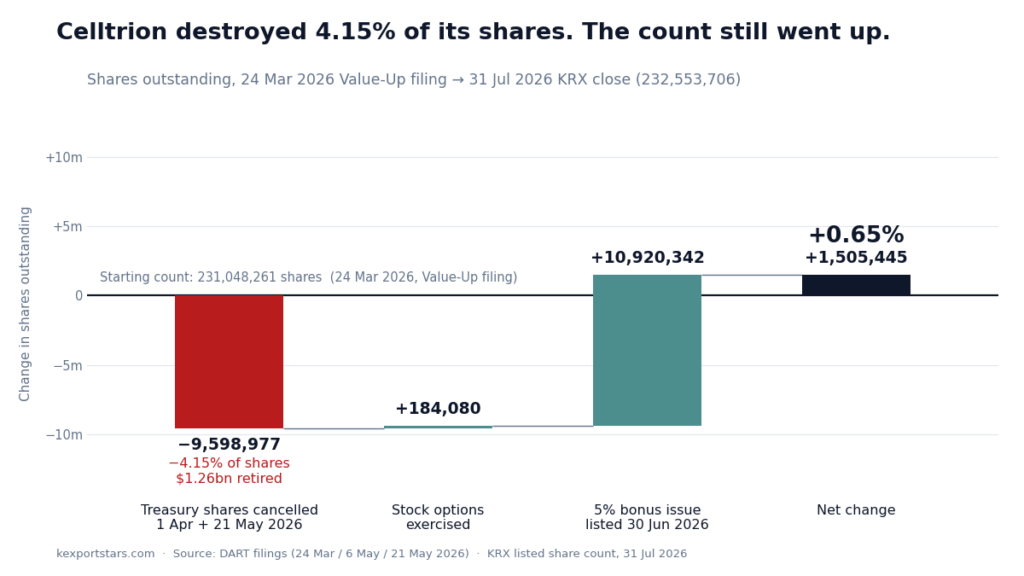
3. The capital flow currently runs the wrong way. Most Korean governance stories of 2026 are about companies returning cash. This one is a company taking it in — and doing it through a rights offering, which asks existing holders either to write a cheque or accept dilution. That is not improper; it is a standard Korean structure and the discount partly compensates. But it is the opposite of a buyback, and it is worth seeing clearly next to a peer like Celltrion, which promised to cancel 4% of itself and did — while its share count still went up.
⚠️ The Bear Case
- Utilisation is falling on a like-for-like basis. 72.5% in the first half of 2025 against 69.9% in the first half of 2026. The company built Plant 5 (₩2tn) and bought Rockville into a falling occupancy rate, and depreciation lands whether or not the tanks are full — gross margin already slipped from 55.0% to 53.5%. Management expects a rebound as both ramp; that is an expectation, not a result.
- The backlog fell against year-end, and the upside case fell on every window. Minimum-purchase backlog went $10,704m at end-2025 to $9,923m at the half — though it was up against the $9,613m of a year earlier. The development-success backlog fell on both comparisons, $13,432m and $12,623m to $12,526m. If second-half intake does not rebuild it, the three-year cushion thins.
- The BIOSECURE tailwind is not in the numbers. The Act is law, but WuXi Biologics is not designated, the operative OMB list is not due until December 2026, and the restrictions target federal procurement. Any model that has already booked displaced Chinese volume is modelling something that has not happened.
- The acquisition is margin-dilutive on day one, and earnings-dilutive too. PolyPeptide earned a 12.0% EBITDA margin in 2025 against Samsung’s 45.4% operating margin, and Samsung is paying a 40% premium for it. Below EBITDA it is worse: on the summary accounts Samsung filed, PolyPeptide lost money at the net line in 2023, 2024 and 2025, and its liabilities rose 57.7% over those two years while equity fell. The deal also concentrates the group into GLP-1: metabolic products are already 68.4% of PolyPeptide’s revenue, and its oncology line is shrinking (−45.4% in 1H26).
- The deal is not done, and the funding is not fixed. The tender offer only completes if two-thirds of PolyPeptide’s fully-diluted capital is tendered, and settlement is scheduled for 13 November 2026 subject to merger-control and foreign-investment clearances. Meanwhile the ₩2,706.2bn cost is fixed in won but the rights proceeds are not set until 4 November — and with the shares 7.6% below the base price used for the indicative terms, the ₩294.8bn facility-investment bucket is the buffer that absorbs any shortfall.
- Tariff exposure is structural. 785,000 of 845,000 litres are in Korea. Korea’s 15% preferential rate under the April 2026 Section 232 proclamation is a policy setting, not a treaty, and competitors with US plants do not carry it.
- You get paid nothing to wait. No dividend, no buyback, no cancellation — and a rights offering that asks you to add capital at about 38x earnings.
- Concentration is disclosed only in the negative. Customers are not named and no customer-level revenue split is given. The filing describes minimum-volume and capacity-reserve clauses but discloses no customer concentration figure, so the top-client exposure cannot be measured from public filings.
📚 Lingo Check
| Term | What it means | 한국어 |
|---|---|---|
| CDMO | Contract Development and Manufacturing Organization — a firm that develops and manufactures drugs on contract for the companies that own them. It never owns the medicine. | 위탁개발생산 |
| Demerger / spin-off | A Korean 인적분할 splits a company in two and hands existing shareholders stock in both, in proportion to their holding. The parent’s own share count is reduced. Contrast with a 물적분할, where the parent keeps 100% of the new entity. | 인적분할 |
| Rights offering | Issuing new shares, usually to existing holders at a set ratio and a discount, to raise cash. Dilutive to anyone who does not subscribe. Korea’s common variant offers any unsubscribed shares to the public, with underwriters taking the residual. | 유상증자 |
| Ex-rights date | The session from which the share trades without the entitlement to subscribe. The quoted price steps down mechanically that morning; it is not a sell-off. | 권리락 |
| Order backlog | Signed orders not yet delivered. Samsung Biologics reports it two ways — on contracted minimum purchase volumes, and on an upside scenario if customers’ products succeed. Use the first. | 수주잔고 |
| Utilisation rate | Batches actually produced divided by batches producible, after scheduled maintenance and product changeovers. In a fixed-cost manufacturing business it is the profitability driver. | 가동률 |
| Continuing operations | The accounting basis that strips out a divested business from prior-year comparatives, so growth rates compare like with like. Essential here because of the 2025 demerger. | 계속영업 |
| Peptide | A short chain of amino acids — bigger than a typical small molecule, far smaller than an antibody. Made by chemical synthesis, not cell culture. GLP-1 drugs are peptides, which is why bioreactor capacity does not help. | 펩타이드 |
| 1260H list | The US Department of Defense’s list of “Chinese military companies.” The enacted BIOSECURE Act keys off this list rather than naming firms directly. | 중국 군사기업 목록 |
🎯 Why It Matters for K-Export Stars
This article exists because of a gap between two languages. The English-language narrative on Samsung Biologics has been, for two years, a geopolitics story: American law pushes work out of China, Korea’s giant catches it. That story is clean, and it is the one that got translated.
The Korean-language filings tell a harder story, and they tell it in tables rather than adjectives. Utilisation down year on year on the company’s own like-for-like comparison. An Americas revenue share that round-tripped, on a series whose prior-half column does not even sit on the same basis. A restated income statement that makes every pre-2026 comparison invalid. An EPS line inflated by a share cancellation. A backlog that fell in the half. And a management team that responded not by waiting for a windfall, but by spending 36% of its equity on a Swiss chemistry company because the biggest drugs of the decade turned out not to be antibodies.
None of that is hidden. It is filed, in Korean, in documents that run to hundreds of thousands of characters. That is the whole thesis of this site: the primary sources for Korean companies are public, and the gap between what they say and what gets reported in English is where an investor’s edge actually lives.
Conclusion
Samsung Biologics is the world’s largest antibody manufacturer, earning a 45% operating margin with net cash and a $9.9bn contracted order book running to 2037. It is also a company whose plants ran at 69.9% in the first half of 2026, down from 72.5% a year earlier, whose backlog fell against year-end, and which has just asked shareholders for $2.18bn to buy a lower-margin Swiss peptide maker at a 40% premium.
Both descriptions are true, and they are the same fact seen from two ends. The company built the largest possible bet on antibodies, and the drug market’s centre of gravity moved to peptides. PolyPeptide is the correction. Whether it was bought well is a question that will be answered by the 2031 margin, not by the 2026 announcement.
What has changed since this was first written is that the deal stopped being an announcement. The Swiss regulator cleared the offer on 31 August, PolyPeptide’s 55.65% holder is contractually committed to tender, and settlement is booked for 13 November 2026. Two dates before that were worth a diary entry: 2 October, when the shares went ex-rights, and 4 November, the reference date for the second-stage price. The final price is published on 5 November, and that is when the size of the raise stops being an estimate. The market has marked the stock down 9.2% since the filing, and foreign investors sold into that move before buying part of it back — net sellers over the six sessions since the filing, net buyers over twenty. The second-half operating numbers, not the flow tape, will settle it.
The dates to diarise: 2 October 2026 (ex-rights — now past), 4 November (second-stage reference date), 5 November (final issue price published), 13 November (PolyPeptide settlement, per the 31 August filing), and 30 November (new shares list). Related reading: Celltrion vs Samsung Biologics · our Samsung Biologics valuation report · LigaChem Bio, which out-licensed its ADC platform to J&J and Ono — and has been buying rights rather than selling them since.
Disclaimer: This article is for informational and educational purposes only and is not investment advice, a recommendation, or an offer to buy or sell any security. Figures are drawn from public regulatory filings and market data as of the dates stated and may since have changed; prices, valuations and pending corporate actions are especially time-sensitive. The PolyPeptide acquisition and the rights offering described here were both incomplete at the time of writing and may be revised, delayed or withdrawn. Do your own research and consult a licensed financial adviser before making any investment decision. See our corrections policy.