English coverage of Korean biologics keeps pairing two names: Celltrion and Samsung. Headlines describe a “duel” and a race for the same drugs. The pairing is right about the rivalry and often wrong about which Samsung is in it — because in 2026 Samsung Biologics spun off the business that actually competes with Celltrion, and said so in the filing.
🔑 Key Takeaways
- Celltrion’s competitor is Samsung Bioepis, not Samsung Biologics. Bioepis makes biosimilars; Biologics is now a pure contract manufacturer. They were one company until the 2026 spin-off.
- The company gave the reason itself. The stated purpose of the split was to “resolve concerns about conflict of interest with the biosimilar business” — language from the filing, not our inference.
- That changes what Samsung Biologics is to Celltrion: from a factory owned by a competitor to a neutral one. Whether Celltrion would ever use it is unknown — it has its own capacity.
- The two are good at opposite things. Celltrion grows faster (first-half operating profit +97.4% against +28.6%); Samsung Biologics earns more per unit of revenue (second-quarter operating margin 44.4% against 32.4%).
- Nearly identical revenue, very different market value. Second-quarter revenue was ₩1,393.7bn versus ₩1,320.9bn — but Samsung Biologics is capitalised at roughly 1.5× Celltrion.
- ⚠ The margin advantage rests on utilisation, and utilisation has fallen three years running: 75.2% → 70.9% → 70.6%. Capacity is being added faster than orders.
Who these companies are
Celltrion (068270.KS) develops and sells biosimilars — follow-on versions of biologic drugs whose patents have expired. It carries its own regulatory, litigation and sales burden, and keeps the margin when a product wins.
Samsung Biologics (207940.KS) is a CDMO — a contract development and manufacturing organisation. It makes other companies’ biologics. The customer carries the commercial and regulatory risk; the manufacturer’s economics are driven by how full the plants are.
Both are headquartered in the Songdo district of Incheon, which is how they came to be discussed together in the first place. Korean biosimilar makers have become significant suppliers to the European market (KED Global), and Western coverage has tended to treat the two Songdo names as one story.
🔄 How they got here — and why the pairing broke
Until 2026 the same listed company contained both businesses: a factory-for-hire and, in Samsung Bioepis, a maker of follow-on versions of other firms’ drugs.
That combination has an obvious problem, and in 2026 the company removed it. Samsung Biologics completed a spin-off of Samsung Bioepis. The filing describes the purpose directly:
“Completed the spin-off, transitioning to a structure focused on its core contract development and manufacturing (CDMO) business … resolving concerns about conflict of interest with the biosimilar business and strengthening an independent decision-making structure, thereby further reinforcing global competitiveness as a pure CDMO company.”
Read that from a customer’s side. A global pharmaceutical company deciding where to manufacture a biologic had, until the split, to accept that the manufacturer’s affiliate sold biosimilars — that is, that it was handing production to a company related to its future generic competitor. The spin-off removes a real commercial obstacle, and the company said so in writing rather than leaving it to analysts.
It also rearranges who is fighting whom:
Samsung Biologics ──(spin-off, 2026)──→ Samsung Bioepis ←── competes ──→ Celltrion
        │
        └─ remains a pure CDMO  →  a neutral plant, and a possible partner
🔲 What we do not know: whether Celltrion would actually contract with Samsung Biologics. Celltrion has substantial capacity of its own and has been adding more. “Could be a partner” and “is a partner” are different claims, and only the first is supported.
📊 The numbers, side by side
| Second quarter 2026 | Celltrion | Samsung Biologics |
|---|---|---|
| Business | Biosimilars | CDMO |
| Revenue | ₩1,393.7bn | ₩1,320.9bn |
| Operating profit | ₩451.8bn | ₩586.4bn |
| Operating margin | 32.4% | 44.4% |
| First-half revenue growth | +40.8% | +28.0% |
| First-half operating profit growth | +97.4% | +28.6% |
| Market capitalisation | ₩46.98tn | ₩71.70tn |
| Annualised P/E | 32.6× | 39.8× |
Figures as of 12 August 2026. At about ₩1,416 to the US dollar on that date, the two revenue lines are roughly $0.98bn and $0.93bn.
The revenue lines are almost the same size. The market values are not. Samsung Biologics carries about half again the capitalisation on slightly less revenue, and a higher earnings multiple on slower growth. What the market is paying for is the margin — and the durability that a contract-manufacturing book is assumed to have.
⚠️ The number that decides whether that premium holds
A CDMO’s economics are utilisation. Fixed plant, and the margin arrives once the plant is full. Samsung Biologics’ utilisation has moved the wrong way for three consecutive periods:
| Period | Capacity (batches) | Produced | Utilisation |
|---|---|---|---|
| 2024 | 833 | 626 | 75.2% |
| 2025 | 1,034 | 733 | 70.9% |
| Q1 2026 | 272 | 192 | 70.6% |
Capacity rose 24.1% between 2024 and 2025 while output rose 17.1%. Building is outrunning selling. And the company kept building: total capacity is now around 845,000 litres, including a Maryland plant acquired from a GSK subsidiary and completed in March 2026 — a purchase made while utilisation was already in the low 70s. The company frames it as securing US production and supply stability, which reads as a response to tariff exposure. It is also more fixed cost.
Where each one stands
Samsung Biologics is the largest of a field of four. Its own filing states that the CDMOs holding more than 300,000 litres of global capacity as of 2025 are itself, Lonza, WuXi Biologics and FUJIFILM Biotechnologies. At roughly 845,000 litres it leads that group on capacity — a market share position stated in a primary filing rather than estimated by us.
For Celltrion we do not have an equivalent figure and will not invent one. Biosimilar share is measured product by product and market by market, and a single company-level number would be misleading. What is documented is that Korean biosimilar makers collectively hold a substantial share of the European market — but that total belongs to Celltrion and Samsung Bioepis together, which is precisely the conflation this article is about.
Scale is genuinely a moat here. Being largest is worth something. It is worth less if the other three are expanding into the same 2028 pricing — and we have not verified their build plans.
🔍 The gap we cannot close
One line in the filings changed sharply and we do not know why. Revenue by region:
| Region | 2024 | 2025 | Q1 2026 |
|---|---|---|---|
| United States | 23.5% | 38.0% | 20.0% |
| Korea | 16.0% | 8.2% | 24.4% |
| Europe | 58.2% | 52.0% | 54.6% |
US revenue share halved and Korean share tripled in a single quarter. We can think of three explanations — contracting entities moved onshore ahead of tariffs, batch timing for one large customer, or a change in how regions are classified after the spin-off — and we cannot distinguish between them from public filings. It is also one quarter, so it may be noise rather than trend. We flag it because it is the largest unexplained item in either company’s disclosure, and because the half-year report should settle it.
🧩 What would prove this wrong
- Celltrion contracting with Samsung Biologics. It would confirm the “neutral plant” reading faster than any argument here. Its absence proves nothing either way — Celltrion has its own capacity.
- Utilisation turning up. If the next disclosure shows utilisation recovering, the premium is about scale winning orders, and the three-year decline was a build-ahead phase rather than a demand problem.
- The regional swing reversing. If US share returns toward 38% next quarter, the Q1 figure was timing and this section is noise.
- Bioepis outgrowing Celltrion. The rivalry framing survives regardless of which corporate entity holds it; our point is about which entity, not about whether competition exists.
🎯 Why It Matters
The useful version of this is not “the press got a name wrong.” It is that a corporate structure changed in a way that changes what the companies are to each other, and the change is documented in a filing rather than argued in a note. One of them stopped being a competitor and became a supplier that could, in principle, serve the other.
For anyone comparing the two as investments, the practical consequence is narrower: they are not two ways to own the same thing. One sells drugs and is growing quickly at a lower margin. The other rents capacity, earns a much higher margin, and is priced as if the capacity fills. Those are different questions, and the second one has a number attached to it that has moved the wrong way three years in a row.
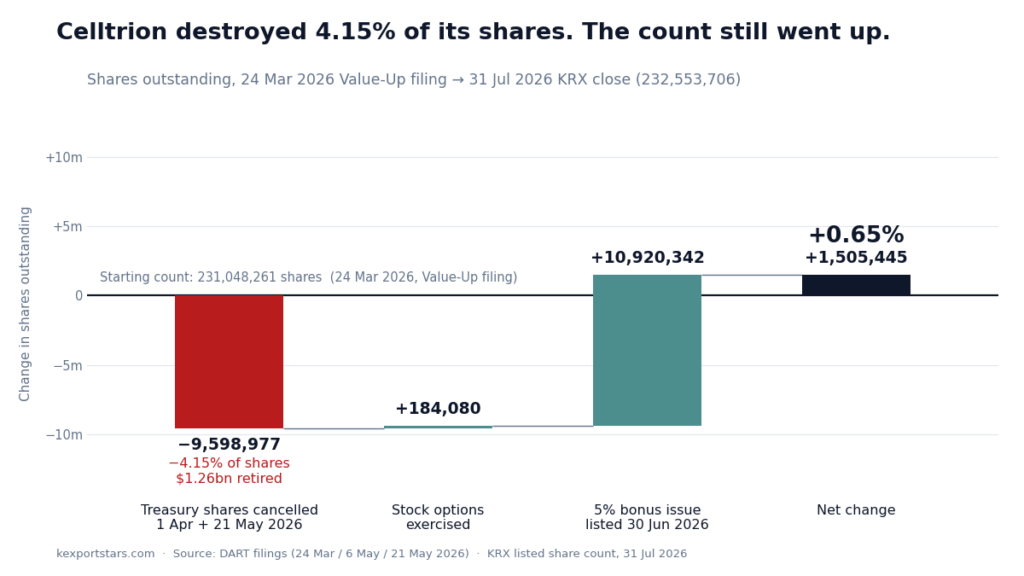
Sources. Company filings via DART — quarterly report body text, second-quarter preliminary results, capacity and utilisation disclosures, and regional revenue breakdowns. Market data as of 12 August 2026. Celltrion’s own share-count arithmetic — a 2026 cancellation offset by a larger bonus issue — is covered separately in our piece on its buyback.
Disclosure. The author holds no position in either company. This is analysis of public filings, not investment advice.