For thirty trading sessions, a single unnamed buyer has absorbed almost everything foreigners and retail investors sold in Samsung Electronics and SK hynix — about $1.21bn of net buying per session. That buyer is the two companies themselves, and one of the two programmes is now roughly one session from running out.
Samsung Electronics has spent 96.3% of a ₩15.0tn ($11.17bn) buyback authorisation. SK hynix has spent 81.5% of a ₩40.0tn ($29.79bn) one. Neither company has filed the report that confirms completion, so these are our figures, not theirs — we explain below exactly how they are built and where they can be wrong.
The interesting part is not the arithmetic of when they end. It is that the two programmes leave opposite legacies. SK hynix is cancelling the shares it buys: 24,070,000 of them, 3.31% of shares outstanding, permanently gone. Samsung is buying its shares to hand to employees. Those shares come back.
Key Takeaways
- About $1.21bn per session of buying is about to stop. That is the average of the residual buyer across the five most recent settled sessions, 23 September to 1 October 2026, in these two stocks combined.
- Samsung is ~1 session from exhaustion; SK hynix ~7. On our run-rate, Samsung finishes around 6 October 2026 and SK hynix around 15 October — against disclosed programme windows of 21 November and 19 November.
- The residual matches the disclosed spend to within 0.6%. Across 29 settled sessions plus the one unsettled session that follows, the residual comes to ₩32.57tn for SK hynix against ₩32.62tn executed, and ₩14.35tn for Samsung against ₩14.44tn. That agreement is the reason we are willing to publish the estimate at all.
- Only one of the two shrinks the share count. SK hynix cancels; Samsung’s shares are for employee compensation and return to the market later. Identical headlines, opposite effect on per-share value.
- We are scoring our own earlier calls here. On 5 September we wrote that both programmes would finish in October, not November. That is landing. One of our two dated predictions is off by a single session.
- What we cannot tell you: neither company has filed an acquisition-results report, so completion is unconfirmed; and the flow category we use contains other corporates’ trading too, not only the issuer’s own bid.
How much buying is about to stop?
About $1.21bn a session, and most of it is SK hynix.
| Programme | Authorised | Spent (est.) | Left | Done | Disclosed window ends |
|---|---|---|---|---|---|
| Samsung Electronics (005930) | $11.17bn | $10.76bn | $0.42bn | 96.3% | 21 November 2026 |
| SK hynix (000660) | $29.79bn | $24.30bn | $5.50bn | 81.5% | 19 November 2026 |
Authorised amounts are from the companies’ own material-event filings: Samsung ₩15.0tn (rcpNo 20260821000616, decided 21 August 2026) and SK hynix ₩40.0tn (rcpNo 20260819000254, decided 19 August 2026). Spend is our estimate, described in the next section. Won is the primary unit; USD uses a single rate of ₩1,342.56/$1 (4 October 2026, FinanceDataReader) throughout this article.
At the current pace Samsung has roughly one session of authorisation left and SK hynix roughly seven. Korea’s market is closed on 9 October for Hangul Day, so SK hynix’s seven sessions run past mid-month. The 2026 holiday schedule is in our Korea market calendar if you want to count the sessions yourself.
Who was actually buying?
Nobody you can name from the public tape — which is the point.
Korea’s exchange publishes daily net buying by foreigners, institutions and individuals for every listed stock. It does not publish a line for “the company buying its own shares.” That trade lands in a fourth bucket, other corporates, which you can only recover by subtraction: whatever the three published groups did not do, something else did.
Over the 29 settled sessions from 20 August to 1 October 2026 — the window that starts when both programmes began executing — the subtraction looks like this. We stop at 1 October deliberately: on 2 October our stored closes disagree with the exchange’s settled closes for 2,039 of 2,544 common stocks, so that session is not yet settled in our data and we leave it out of every flow total below.
| Net buy, 29 sessions | Foreign | Institutions | Retail | Residual |
|---|---|---|---|---|
| SK hynix (000660) | −$12.06bn | −$1.89bn | −$9.63bn | +$23.58bn |
| Samsung Electronics (005930) | −$4.50bn | +$0.98bn | −$6.77bn | +$10.29bn |
Our own database, built from exchange-published daily net quantities by investor group and valued at each session’s settled close. Residual = −(foreign + institutions + retail). Window 20 August to 1 October 2026, 29 settled sessions. Minus means net selling.
Two things are worth stopping on. First, in SK hynix (000660) all three published groups were net sellers — foreigners, institutions and retail together sold $23.58bn — and over exactly that window 000660 went from ₩1,691,000 to ₩1,833,000, up 8.40%. Samsung Electronics (005930) saw its three groups net sell $10.29bn on balance while 005930 went ₩271,000 to ₩276,000, up 1.85%. A stock can rise while every investor group you can see is selling it, provided something you cannot see is buying. That is the whole mechanism this article is about. Second, in Samsung, retail sold more than foreigners did, which is the opposite of the story most English coverage tells about Korean memory stocks.
The cross-check that makes this publishable
A residual is a subtraction, and subtractions absorb every error in the inputs. So we test it against something the companies disclosed themselves.
| Company | Residual, 30 sessions | Our executed estimate | Gap |
|---|---|---|---|
| SK hynix | ₩32.57tn | ₩32.62tn | 0.16% |
| Samsung Electronics | ₩14.35tn | ₩14.44tn | 0.60% |
The residual rows above are the 29 settled sessions plus the 2 October session we excluded from the flow tables, because our executed estimate runs one session further along; the settled-only residual is ₩31.66tn for SK hynix and ₩13.81tn for Samsung. Two numbers built from different data, agreeing to within a percent. That does not prove the residual is the buyback — it proves the two move together at the size the companies authorised. It is the strongest evidence available until an acquisition-results report is filed, and it is also the reason the residual’s weaknesses, set out further down, matter less than they would otherwise.
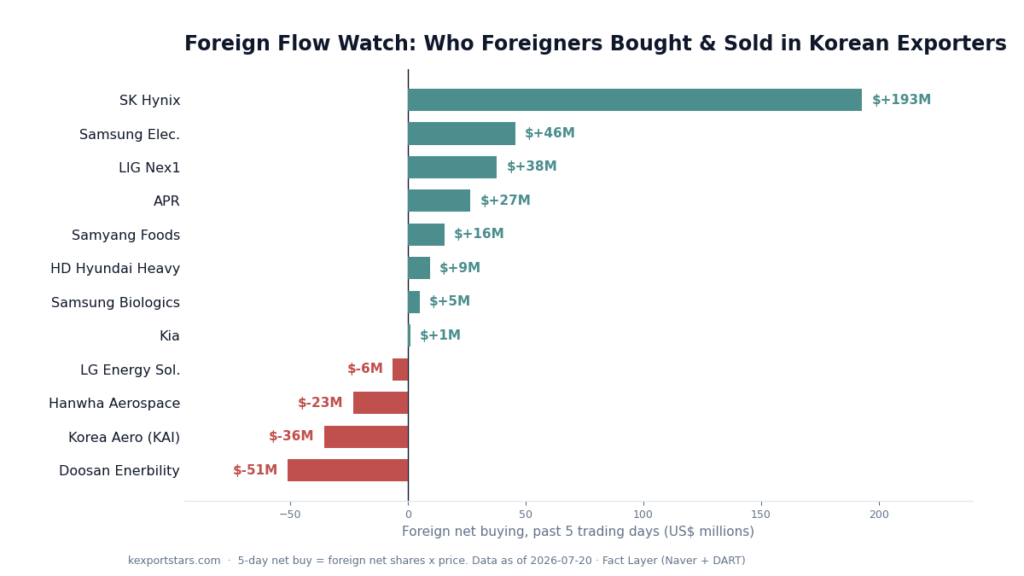
We have been tracking this residual weekly. The issue that first identified it as the buybacks is Foreign Flow Watch, week of 18 September, where the residual’s step-change lined up with the two programmes’ start dates to the day.
Why are the two programmes not the same thing?
One permanently destroys shares. The other parks them and sends them back.
| SK hynix | Samsung Electronics | |
|---|---|---|
| Stated purpose | Cancellation | Employee share compensation |
| Share count effect | 24,070,000 shares retired — 3.31% of 728,002,365 outstanding, permanent | None in the end. Treasury shares return to the market as they vest |
| Per-share value | Rises mechanically: same earnings, fewer shares | Unchanged. It is compensation expense settled in stock |
| Filing | Cancellation decision, rcpNo 20260819800340 | Acquisition decision, rcpNo 20260821000616 |
In English both are reported as “a buyback,” and the distinction disappears. It does not disappear in Korean, because the filings use two different document types with two different legally defined purposes, and the cancellation one names a share count.
This is the same distinction that decides whether a Korean company’s capital return is real. We walked through a clean example in KB Financial’s cancellation, where the bank retired 7% of its shares and the arithmetic is unambiguous. For the memory duo, only one of the two is doing that — and it is not the larger company.
There is a second asymmetry worth naming. SK hynix’s programme is both bigger in won and much bigger relative to the company’s float, which is why its residual runs at roughly twice Samsung’s per session despite a similar market capitalisation ordering. When it stops, the gap it leaves is proportionally larger.
Did we get this right?
On the direction, yes. On the dates, one call is exact and one is a session off.
We publish predictions with dates attached so they can be scored, and scoring them is not optional when the date arrives. Three of our earlier pieces made dated claims about these programmes.
| Where | What we said | What happened | Verdict |
|---|---|---|---|
| 5 Sep 2026 | Both finish in October, not November — about six weeks before the disclosed windows close | Samsung ~6 Oct, SK hynix ~15 Oct, against windows ending 21 and 19 Nov | Held |
| 26 Sep 2026 | Samsung exhausted around 6 October (from 77.82% done) | 96.3% done on 6 October, ~1 session left | Held |
| 26 Sep 2026 | SK hynix exhausted around 14 October (from 68.50% done) | Run-rate now points to ~15 October | Off by one session |
The pace calls are in the 4 September issue and the dated exhaustion estimates in the Chuseok-week issue.
One honest note on why these landed. The September piece flagged its own main weakness: a buyback is a won budget, so if the share price rises the company buys fewer shares with the same money and the programme lasts longer in sessions. That is a real effect and it would have pushed the dates out. It did not dominate, which is luck as much as method — the run-rate stayed inside a narrow band instead. We would not want a reader to take a one-session hit rate as evidence the model is better than it is.
What we cannot tell you yet
Completion is unconfirmed, and the residual is not a clean read on the issuer.
- No acquisition-results report has been filed. We checked both companies’ filing histories on 6 October 2026. Samsung’s most recent acquisition-results report is dated 24 April 2026 and belongs to an earlier programme; SK hynix has filed disposal-results reports in this period but no acquisition-results report for the ₩40.0tn authorisation. Until one appears, “96.3% done” is our estimate and nothing more.
- The residual bucket is not the issuer alone. Other corporates trade these stocks for their own reasons. The 0.16%–0.60% agreement with the authorised spend is strong, but it is agreement between two aggregates, not a per-trade identification.
- Flow data lags, and one session is missing. Every flow figure here ends at 1 October 2026. The 2 October session is excluded because our stored closes disagree with the exchange’s settled closes for 80.1% of common stocks that day — we would rather drop a session than average an unsettled one into a total.
- We do not know what happens to the price. We are describing a bid that is ending, not forecasting a decline. Across the 29 sessions covered here all three published investor groups were net sellers of SK hynix and the stock rose 8.40%; drawing the reverse inference when the residual stops would be the same mistake with the sign flipped.
Prove this wrong
Five things would show this article was wrong, and we would rather name them than be asked later.
- An acquisition-results report lands with a materially different number. If either company’s filed total differs from our estimate by more than 2%, the residual method is weaker than the cross-check above suggests.
- Either programme runs past the end of October. Our pace estimate then failed in the direction the 5 September piece warned about — higher prices stretching a fixed won budget.
- The residual keeps running at $1bn+ a session after the authorisations are exhausted. That would mean we attributed to buybacks something that was mostly other corporates all along.
- Samsung announces that treasury shares from this programme will be cancelled rather than used for compensation. The asymmetry section would then be describing a distinction the company itself erased.
- SK hynix cancels a different share count than 24,070,000. The 3.31% figure is from the cancellation decision filing; a revision changes the one clean per-share claim in this piece.
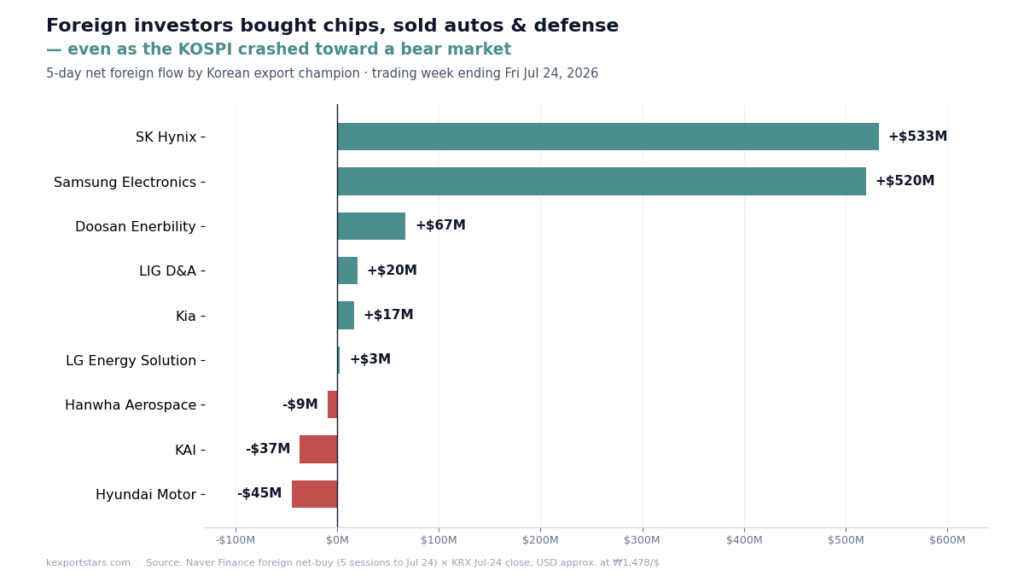
We will score these the way we scored the three predictions above. The next weekly flow issue is the place it happens — the most recent is the week of 28 September, which found almost all of that week’s foreign selling concentrated in these same two names.
Lingo
- Other corporates (기타법인) — the fourth investor category in Korean exchange data, covering listed and unlisted companies trading for their own account. A company buying its own shares appears here, not in a dedicated line.
- Acquisition decision vs cancellation decision — two separate Korean filing types. The first says a company will buy shares and for what purpose; the second says a specific number of shares will be retired. Only the second shrinks the share count.
- Employee share compensation — treasury stock used to settle pay. Economically it is a wage cost settled in equity, and the shares re-enter the float as they are delivered.
- Settled close — the exchange’s confirmed closing price for a session, as distinct from an intraday snapshot. All valuations here use settled closes.
Disclosure
The author holds shares in Samsung Electronics (005930) and SK hynix (000660). This article describes filings and exchange data; it is not a recommendation to buy or sell either stock. Where a figure is our estimate rather than a disclosed number, we have said so in the sentence that contains it.
Sources: company material-event filings via Korea’s electronic disclosure system (20260821000616, 20260819000254, 20260819800340); exchange-published daily investor-group net quantities, valued at settled closes, from our own database. Figures as of 6 October 2026; flow data through 1 October 2026, the last session settled in our data. If any number here is wrong, tell us and we will correct it in place with a dated note.