Last week we wrote that about $1.21bn a session of corporate buying was about to stop in Samsung Electronics and SK hynix. In the three sessions since, it ran at $0.59bn — half. Over the same three sessions the KOSPI fell 5.39% and retail investors bought ₩6.39tn ($4.77bn) of Korean stock.
We are not going to tell you the first fact caused the second. We said last week that we did not know what the price would do when the bid ended, and one week of data has not changed that. What we can do is put the three numbers next to each other, show you the counter-evidence in the same tables, and score the predictions we made before any of it happened.
Key Takeaways
- The residual buyer halved. In Samsung and SK hynix combined it ran at $0.59bn per session against the $1.21bn we measured a week earlier. Samsung’s own fell 82%, SK hynix’s 36%.
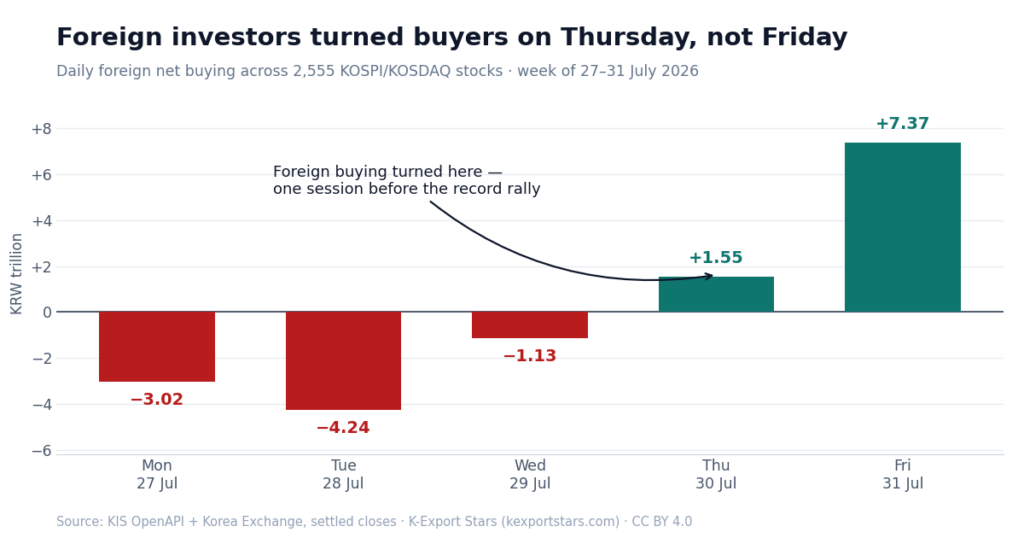
- Retail flipped sign and size. Net buying across 2,543 common stocks went from −$2.26bn in the previous three sessions to +$4.77bn in these three.
- The boards diverged the other way this week. KOSPI −5.39%, KOSDAQ −0.11% — the mirror image of last issue, when the KOSDAQ rose 5.78% and the KOSPI fell 1.09%.
- Foreign selling is less concentrated than last week. The two memory names were 97.6% of foreign net selling a week ago; this week they are 72.3%.
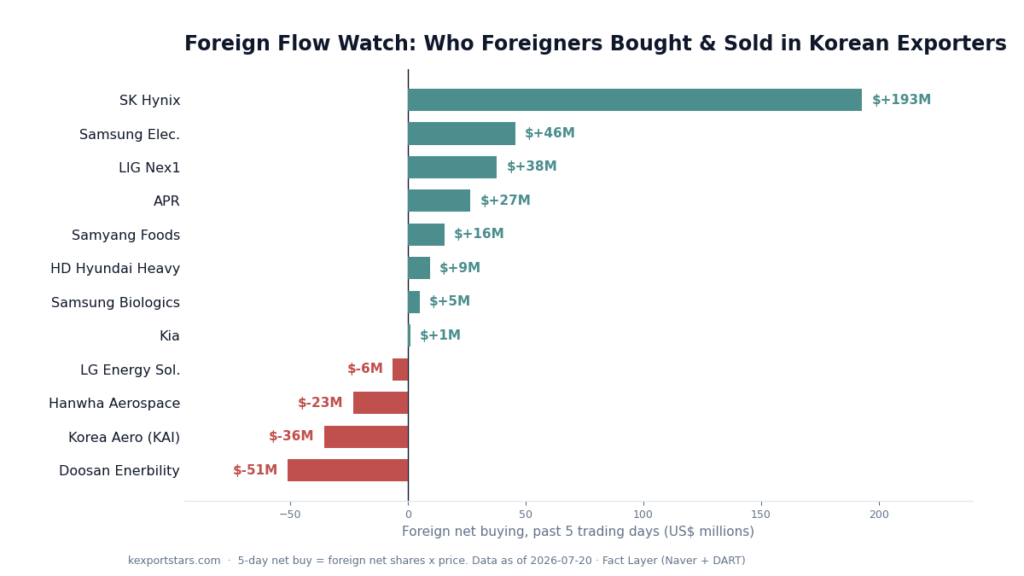
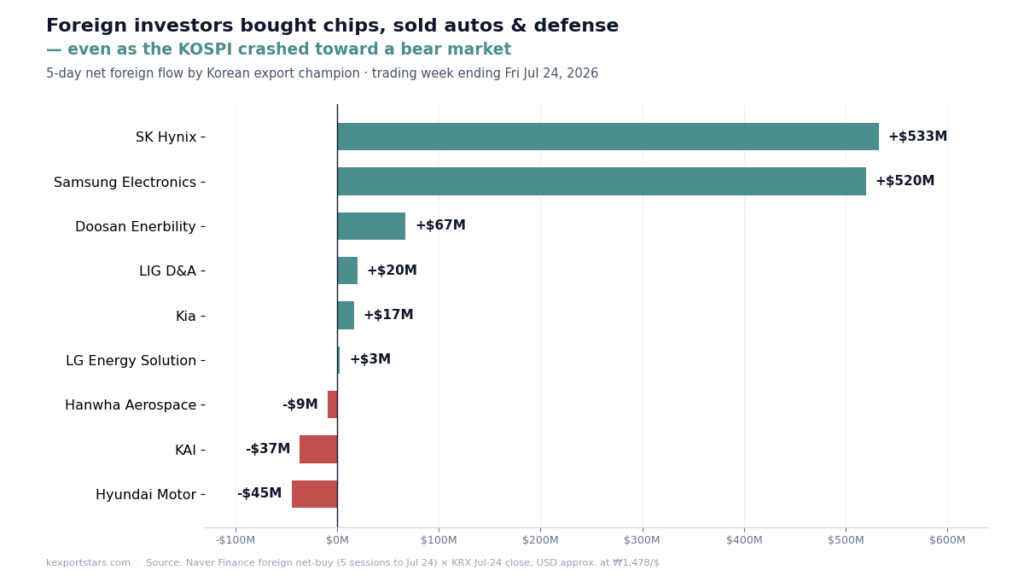
- And foreigners were buying semiconductors. The largest foreign net purchases were chip-equipment and materials names. Whatever this week was, it was not a wholesale exit from the sector.
- We are correcting one of our own numbers from last issue, and one of our two exhaustion dates has moved out by four sessions. Both are below.
What “this week” means — three sessions, and why
Korea traded three days this week, not five. Monday 5 October was a substitute holiday for National Foundation Day and Friday 9 October was Hangul Day. The window below is 6–8 October 2026, three settled sessions, and we compare it against the three sessions before it rather than against a five-day week.
One note on method, because it changed how we built this issue. Our flow table carries its own closing price, and for the most recent session that price is still the intraday one — on 8 October it disagrees with the settled close for 2,035 of 2,543 stocks. That does not make the session unusable: the quantities are complete (the absolute net-buy totals for 8 October sit inside the range of the two settled days, with no missing rows), and we value every flow at the settled close from the price table, not at the flow table’s own price. Last issue we dropped a session for this reason. That was over-cautious, and we are saying so rather than quietly changing practice.
Did the corporate bid actually stop?
It halved. Samsung’s is close to finished; SK hynix’s is not.
| Residual buyer, per session | Measured 6 Oct | This week | Change | Programme done |
|---|---|---|---|---|
| Samsung Electronics (005930) | $0.41bn | $0.07bn | −82% | 98.3% |
| SK hynix (000660) | $0.80bn | $0.51bn | −36% | 86.8% |
| Combined | $1.21bn | $0.59bn | −51% | — |
Residual = minus the sum of exchange-published foreign, institution and retail net quantities, valued at settled closes. Window 6–8 October 2026, three settled sessions. Programme progress is our estimate from cumulative residual against the authorised amounts (Samsung ₩15.0tn, SK hynix ₩40.0tn); neither company has filed an acquisition-results report. USD at ₩1,340.02/$1 (9 October 2026, FinanceDataReader).
The two programmes are behaving differently, and the difference is informative. Samsung is at 98.3% with roughly one session of authorisation left, and it has slowed down: its run-rate over the whole programme is ₩475.5bn a session, but over the last five it is ₩276.8bn. A company that is nearly out of budget and spending less than its own average is not being forced to stop — it is choosing a pace. SK hynix, at 86.8%, still has roughly five sessions of authorisation and is still spending about ₩688.7bn a session.
Who bought what foreigners sold?
Retail, by a margin that reversed the previous week entirely.
| Net buy, 3 sessions | Foreign | Institutions | Retail | Residual |
|---|---|---|---|---|
| 6–8 October 2026 | −$4.70bn | −$1.85bn | +$4.77bn | +$1.78bn |
| 30 September – 2 October 2026 | −$1.46bn | +$0.64bn | −$2.26bn | +$3.08bn |
Both rows: 2,543 KOSPI and KOSDAQ common stocks, same database, same single FX rate. The comparison window is the three sessions immediately before this one, chosen so the session counts match.
Two things changed at once between the two rows above. Foreign net selling more than tripled. And retail reversed outright, from net seller to net buyer — the largest single change in the table, larger than the fall in the residual over the same pair of windows. Retail is the bigger mover here, and it is the one with no disclosure trail at all.
Was this a sector exit?
No — foreigners were net buyers of chip equipment while they sold the two large-cap memory names.
| Foreign net buy, 3 sessions | USD | What it does |
|---|---|---|
| Jusung Engineering (036930) | +$132m | Semiconductor deposition equipment |
| Isu Petasys (007660) | +$74m | High-layer-count PCBs for AI servers |
| Samsung SDI (006400) | +$70m | Batteries |
| DB HiTek (000990) | +$47m | Analogue foundry |
| SK hynix (000660) | −$2,695m | Memory |
| Samsung Electronics (005930) | −$698m | Memory, foundry, devices |
The two memory names are 72.3% of foreign net selling this week, down from 97.6% last week. The concentration is still extreme, but it loosened, and the money that went the other way went into the same industry one layer down. We found no disclosures in the window for the four names above that would explain the buying, and we are saying that rather than implying we looked for a narrative and found one.
And the price?
The KOSPI fell 5.39%. The KOSDAQ did not move.
| 2 Oct close → 8 Oct close | From | To | Change |
|---|---|---|---|
| KOSPI | 7,003.74 | 6,625.93 | −5.39% |
| KOSDAQ | 893.29 | 892.27 | −0.11% |
| SK hynix (000660) | ₩1,841,000 | ₩1,681,000 | −8.69% |
| Samsung Electronics (005930) | ₩276,000 | ₩262,000 | −5.07% |
Here is the honest shape of it. Last week we wrote, in the limitations section of a piece about the buybacks ending: “We do not know what happens to the price. We are describing a bid that is ending, not forecasting a decline.” The bid then halved and the price fell. That is one observation, and the temptation to read it as confirmation is exactly what that sentence was written to resist.
Two pieces of counter-evidence sit in our own tables. The KOSDAQ, where almost none of this corporate buying happens, was flat — if a withdrawn bid were the mechanism, a board with no such bid to withdraw should not have been required to hold still, but it also tells you the move was specific to large caps rather than a market-wide risk event. And in the three sessions covered by our previous issue, every published investor group was a net seller of SK hynix and the stock rose 8.40%. The same data has now produced both directions. One week does not settle it.
Scorecard
Last issue we listed five things that would show it was wrong, and a separate piece on 6 October made three dated predictions. Here is how they stand.
| What we said would prove us wrong | Result |
|---|---|
| If 2 October settles and the four-session picture reverses, stopping the window early cost readers the week’s shape | It held. Re-run with five sessions: foreign −₩7.72tn against −₩7.42tn, concentration 97.8% against 97.6%, and the ex-two rows stayed negative on both sides |
| If the two-stock concentration breaks down on a fifth session, 97.6% was an artefact | It held. 97.8% on five sessions |
| If an execution report lands below our estimate, the exhaustion dates move out | Partly against us. No report has been filed — but our own estimate moved: Samsung’s exhaustion went from ~6 October to ~12 October |
| If the KOSDAQ’s 1 October jump had a disclosed cause in one or two names | Still open. We have not enumerated every constituent and are not claiming we have |
| Our weakest number was the single FX rate | Unchanged. This issue has the same limitation |
| 6 Oct: “$1.21bn a session is about to stop” | Tracking. It ran at $0.59bn — halfway there in three sessions |
| 6 Oct: Samsung exhausted around 6 October | Missed by four sessions. 98.3% done, now estimated ~12 October, because it slowed to ₩276.8bn a session |
| 6 Oct: SK hynix exhausted around 15 October | Holding. 86.8% done, now estimated ~16 October |
And one number of ours was simply wrong
In last week’s falsifier list we wrote “the 90.4% figure” when the concentration figure in that article — in its headline, its summary and its table — is 97.6%. The number 90.4% appeared nowhere else and was supported by nothing. It was a typing error, not a second measurement. We corrected it in place on 10 October with a dated note rather than editing it away silently.
What we cannot tell you
- Neither company has filed an acquisition-results report. Every progress percentage here is our estimate from the residual, not a disclosed figure.
- The residual is not the issuer alone. Other corporates trade these stocks for their own account, and we cannot separate them trade by trade.
- Retail’s $7.03bn swing has no disclosure trail. We can measure it and we cannot explain it.
- Three sessions is a short window. It is what the holiday calendar gave us, and it is why every comparison here is against three sessions rather than five.
- One FX rate across the window. Same limitation as last issue, named again rather than quietly carried.
Prove this issue wrong
- If the 8 October quantities change when the exchange’s figures are refreshed, every three-session total here moves. We used that session on the judgment that its quantities were complete while only its price column was provisional. We will re-check it on 12 October and print the difference.
- If SK hynix’s residual does not fall as its programme runs out, then what we have been calling a buyback proxy is mostly something else.
- If Samsung’s residual rises again after 12 October, the authorisation was not the constraint we assumed it was.
- If retail’s net buying reverses next week while the KOSPI keeps falling, the “retail absorbed it” reading of this week was a one-week artefact.
- If an execution report shows either programme more than 2% away from our estimate, the residual method is weaker than four issues of agreement suggest.
Lingo Check
- Residual buyer (기타법인) — the fourth investor category in Korean exchange data. A company buying its own shares lands here, not in a dedicated line, so it can only be recovered by subtraction.
- Settled close (확정 종가) — the exchange’s confirmed closing price for a session. Our flow table carries a provisional price for the newest session; every figure in this issue is valued at the settled close instead.
- Substitute holiday (대체공휴일) — when a public holiday falls on a weekend, the following Monday closes instead. That is why this week had three sessions.
Disclosure
The author holds shares in Samsung Electronics (005930) and SK hynix (000660). This article reports exchange data and filings about the market as a whole; it is not a recommendation to buy or sell any stock. Where a number is our estimate rather than a disclosed figure, the sentence containing it says so.
Flows: exchange-published daily net quantities by investor group for 2,543 KOSPI and KOSDAQ common stocks, valued at settled closes, from our own database. Index levels are published closes. Won is the primary unit throughout; the dollar conversion rate and its date are stated under the first table. Window 6–8 October 2026. If any number here is wrong, tell us and we will correct it in place with a dated note.