In March 2026 a Korean biotech told its shareholders, in a regulatory filing that has no English counterpart, that it would destroy 9.11 million of its own shares. It did. Then it issued bonus shares — and the one number a foreign investor would check to see any of it went up instead of down.
🔑 Key takeaways
- Celltrion (KRX: 068270) sells its own biosimilars — follow-on versions of blockbuster biologic drugs. That single segment is 93.3% of revenue (DART FY2025 annual report).
- Europe is the business, not the US. Europe is 48.3% of revenue against North America’s 10.1% — though North America grew +149.9% in FY2025 while Korea shrank 18.8%.
- A margin round-trip, not an inflection. Operating margin ran 28.3% → 29.9% → 13.8% → 28.1% across FY2022–25 — FY2025 sits below FY2023. Absorbing its own distributor added 14.1pp of gross margin and an almost equal load of SG&A. Within FY2024→25 alone, 84% of the rebound is cost of goods.
- 42× earnings and 2.5× book on a 5.94% return on equity — on FY2025. The company’s own Value-Up plan targeted 7% only by 2027, and H1 2026 has already passed it: ₩716.3bn of half-year profit attributable to shareholders on ₩18,048.2bn of equity annualises to about 7.9% (H1 2026 half-year report).
- The cancellation was announced, not discovered — and it still vanishes from the share count. The share-count bridge below closes to the share.
Updated, 8 September 2026. This article was written on FY2025 figures and its tables still are. Celltrion’s half-year report, filed 14 August 2026, moves four of our present-tense judgements: the margin round-trip, the US revenue share, the return on equity and the cash-flow bear case. Those four passages now carry the H1 2026 numbers alongside. Nothing in the FY2025 tables changed.
🏢 What Is Celltrion, and What Does It Actually Sell?
Celltrion is the Korean company that built the world’s first antibody biosimilar and now sells eleven of them worldwide.
A biosimilar is a follow-on version of a biologic drug. Biologics are grown in living cells, so a copy is never chemically identical — the regulatory standard is that there are no clinically meaningful differences from the original. That difficulty is the moat: approval takes years and hundreds of millions of dollars.
Celltrion (Wikipedia) was founded on 27 February 1991 and is based in Incheon, west of Seoul. Its first product, Remsima (CT-P13), was the world’s first antibody biosimilar. It has since won global approvals for eleven, and in 2023 the US FDA approved Zymfentra, a subcutaneous version, as a new biologic under a standalone 351(a) Biologics License Application rather than the 351(k) biosimilar pathway.
It manufactures what it sells: 250,000 litres of capacity in Korea plus 66,000 litres in Branchburg, New Jersey, acquired on 31 December 2025 and also used for contract manufacturing.
📊 Where Does Celltrion’s Revenue Actually Come From?
One segment and one continent: biologics are 93.3% of revenue, and Europe is 48.3% of it.
| By segment (FY2025) | Revenue | Share |
|---|---|---|
| Biologics | $2,702M | 93.27% |
| Chemical drugs | $195M | 6.73% |
| By region (FY2025, after intragroup elimination) | Revenue | Share | YoY |
|---|---|---|---|
| Europe | $1,399M | 48.3% | +33.9% |
| Korea | $879M | 30.3% | −18.8% |
| North America | $292M | 10.1% | +149.9% |
| Asia | $215M | 7.4% | +60.6% |
| Latin America | $113M | 3.9% | +14.8% |
Source: DART FY2025 annual report, segment note. Converted at ₩1,436.6/$.
Two things follow. Celltrion is effectively a European revenue base listed in Seoul. That was still true in FY2025, when North America was a tenth of revenue and grew 150% in a year — but it has moved fast since. On the same after-elimination basis, North America was 18.8% of revenue in the first half of 2026 and Europe 45.2%. The tenth is now closer to a fifth.
🗓️ How Did Celltrion Get Here?
Three structural moves, not three products: it took European sales in-house, then US sales, then absorbed the affiliate that had been selling its drugs.
| When | What changed |
|---|---|
| Feb 1991 | Company founded (Incheon) |
| 2005 → Feb 2018 | Lists on KOSDAQ, then transfers to the KOSPI main board |
| 2020 → H2 2022 | Takes European sales in-house, first Remsima then all products |
| 2023 | Does the same in the United States |
| 28 Dec 2023 | Absorbs Celltrion Healthcare, the listed affiliate that marketed its drugs |
| Dec 2024 | Establishes Celltrion Biosolutions, a wholly-owned contract-manufacturing arm |
| 31 Dec 2025 | Acquires the Branchburg, New Jersey plant |
| 24 Mar 2026 | Files a Value-Up plan committing to cancel 9.11m shares — see the bridge below |
The 2023 merger matters most. Before it, Celltrion manufactured and a separate listed company sold — a structure that drew years of questions about transfer pricing and inventory parked between the two. Merging ended the question and retired a ticker that still confuses data providers, as the ticker table below shows.
🌍 Is Celltrion Actually a Global Leader?
Yes in infliximab — Celltrion reports 59% of the European and 30% of the US market for Remsima, attributed to IQVIA.
- Remsima — 59% of the European market; 30% of the US market
- Remsima SC — 30% of the EU5 market
- Truxima — 30% Europe, 31% US
- Herzuma — 27% Europe, about 75% Japan
Shares as of end-Q3 2025, attributed by Celltrion to IQVIA in its DART annual report; we have not seen the underlying IQVIA data. The company also reports Zymfentra prescriptions growing at an average 31% per month since its March 2024 launch — the filing gives no base or window for that rate, so treat it as directional only.
📈 Is the Business Getting Better or Worse?
Revenue has nearly doubled in two years — mostly by absorbing its own distributor — but the operating margin has round-tripped: FY2025’s 28.1% is below FY2023’s 29.9%.
| Consolidated | Revenue | Op. profit | Op. margin | Gross margin | SG&A/rev |
|---|---|---|---|---|---|
| FY2022 (pre-merger) | $1,590M | $451M | 28.3% | 45.2% | 16.9% |
| FY2023 (pre-merger) | $1,515M | $453M | 29.9% | 48.3% | 18.4% |
| FY2024 | $2,476M | $342M | 13.8% | 47.3% | 33.4% |
| FY2025 | $2,897M | $813M | 28.1% | 59.3% | 31.2% |
| Q1 2025 | $586M | $104M | 17.8% | — | — |
| Q1 2026 | $797M | $224M | 28.1% | — | — |
Source: DART consolidated statements — FY2025 annual report, Q1 2026 quarterly report. FY2022–23 are pre-merger and not like-for-like: Celltrion then sold to Celltrion Healthcare at a transfer price and carried none of the distribution cost, so pre-merger revenue and the pre-merger SG&A ratio are both understated relative to today. FY2024 is a trough, not a baseline.
What taking sales in-house actually did. Read only FY2024→FY2025 and this looks like a margin explosion: operating profit +137.5%, gross margin +12.0pp. Read the four-year series and a different, more useful thing happened. Absorbing the distributor did two opposite things at once:
- It captured the distributor’s gross margin. 45.2% (FY2022) → 59.3% (FY2025), a +14.1pp structural gain that survives the wider window.
- It permanently absorbed the distributor’s cost base. SG&A/revenue 16.9% (FY2022) → 31.2% (FY2025), a +14.3pp load that has barely eased in three years.
The two roughly cancel, which is why the operating margin round-tripped: 28.3% → 29.9% → 13.8% → 28.1%. On the full-year series, FY2025 is a recovery to the pre-merger level rather than a new plateau above it. The first half of 2026 is testing that reading: the half-year operating margin is 30.48% and Q2 alone 32.42%, both above FY2023’s 29.9%. A half-year is not a full year — Celltrion’s second halves have historically been stronger, so H1 2025’s 21.73% became FY2025’s 28.1% — so this does not yet settle the question. It does mean the round-trip reading can no longer be stated in the present tense. Within FY2024→FY2025 specifically, about 84% of the operating-margin expansion is cost of goods — but that window starts at a trough, so it measures the rebound rather than the structural change.
Celltrion’s own Value-Up filing is consistent with this reading: it names the profitability levers as “improving the cost-of-sales ratio and SG&A efficiency” — cost first, and SG&A still on the to-do list.
Separately, Celltrion disclosed a $198.0M contract-manufacturing agreement on 17 March 2026 — the filing states the dollar amount itself, at its own rate of ₩1,489.50. It can rise to $252.0M and runs to end-2029, the counterparty is withheld, and supply does not begin until Q1 2027. It is also CMO work: the lower-margin business the bear case has to account for.
🔍 Celltrion Promised a Share Cancellation of 4%. It Delivered. Why Doesn’t the Share Count Show It?
Because a 5% bonus issue and stock-option exercises absorbed it. 9,598,977 shares were destroyed and shares outstanding still rose 0.65%.
On 24 March 2026 Celltrion filed a Value-Up plan — Korea’s voluntary corporate-value disclosure — with hard commitments (rcpNo 20260324800435):
- Cancel 9.11 million treasury shares, about ₩1.7tn ($1.18bn)
- Revenue growth averaging 30%+ a year over 2025–27 (FY2025 delivered 17.0%)
- ROE above 7% by 2027
- A three-year average shareholder-return ratio of 40%, dividends targeted at 30% of EBITDA less capex
It executed. Here is the bridge — every line from a filing, closing to the share:
| Event | Change | Shares |
|---|---|---|
| 31 Dec 2025 (annual report) | 230,960,969 | |
| Stock options exercised, Jan–Mar | +87,292 | 231,048,261 |
| Cancellation, effective 1 Apr (₩1,715.4bn / $1.19bn) | −9,110,000 | |
| Stock options exercised, Apr–early May | +184,080 | 222,122,341 |
| Cancellation, effective 21 May (₩100.1bn / $70M) | −488,977 | 221,633,364 |
| 5% bonus issue, listed 30 Jun | +10,920,342 | 232,553,706 |
Sources: cancellation, 24 Mar · cancellation as amended, 6 May · bonus issue, 21 May. The final line matches the Korea Exchange listed share count at 31 July 2026.
Two mechanics do the hiding.
The bonus issue was calculated on shares excluding treasury. 221,633,364 issued less 3,226,514 held in treasury leaves 218,406,850 eligible; 5% of that is exactly 10,920,342, the number in the filing. A bonus issue is not dilution — every holder receives proportionally more and the price adjusts, like a split — so the cancelled capital is genuinely gone. Only the metric is neutralised.
And the company was issuing shares while cancelling them. 271,372 new shares came from stock-option exercises in the same window, from a pool of 4,190,125. In FY2025, 121,150 options were exercised at an average strike of ₩96,466 against a market price of ₩173,916.
Net effect: 9,598,977 shares — 4.15% of the opening count — retired for ₩1,815.5bn ($1.26bn), and the share count still rose 0.65%. A screen ranking Korean companies by change in shares outstanding would file Celltrion under “issuer”.
💰 What Do You Actually Pay for Celltrion Today?
About 42× earnings and 2.5× book — for a company earning 5.94% on equity.
| Close, 31 Jul 2026 | ₩186,700 (~$130) |
| Market capitalisation | $30.22bn |
| P/E | 42.0× |
| P/B | 2.50× |
| Return on equity | 5.94% |
| Dividend / yield / payout | ₩750 / 0.40% / 15.92% |
P/E uses FY2025 EPS restated for the June bonus issue. The ₩4,668 printed in the annual report was filed in March and adjusted only for FY2025’s own actions, so dividing a post-bonus price by it gives a misleadingly low 40.0×; on ₩4,446 the multiple is 42.0×. ROE and P/B both use total net income over total equity; P/E uses controlling-interest EPS. Payout is dividends declared ($114M) over net profit ($718M). DPS ÷ EPS gives 16.07% instead, because the two use different share counts — period-end 218,613,124 versus weighted-average 220,573,937.
2.5× book on a 5.94% ROE is the sentence to sit with. The Value-Up plan targeting 7% by 2027 is an admission that the current figure is low. Against the other large Korean bio names, the business models differ more than the prices do:
| FY2025 | Market cap | Revenue | Op. margin | Model |
|---|---|---|---|---|
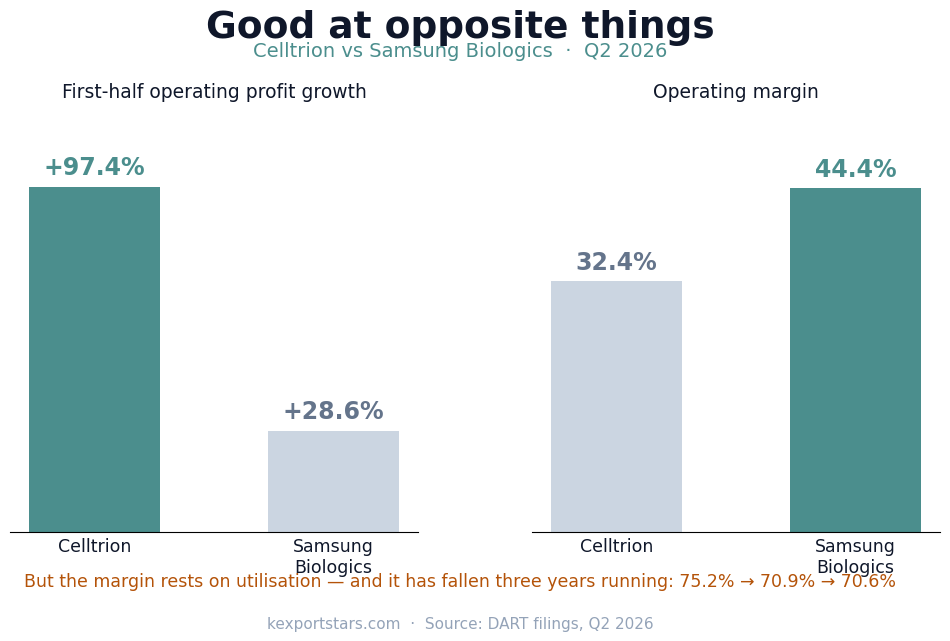
| Samsung Biologics (207940) | $47.85bn | $3.17bn | 45.4% | Makes other firms’ drugs |
| Celltrion (068270) | $30.22bn | $2.90bn | 28.1% | Sells its own drugs |
| Alteogen (196170) | $11.51bn | $150M | 49.5% | Licenses a platform |
| LigaChem Bio (141080) | $2.26bn | $100M | −75.2% | Out-licenses candidates |
Source: KRX closes and market caps at 31 Jul 2026; DART FY2025 consolidated statements. “Korean biotech” is not one asset class. Samsung Biologics’ figures may not be like-for-like following the Samsung Bioepis separation — Bioepis is Celltrion’s direct biosimilar competitor.
🏷️ Which Celltrion Ticker Are You Actually Buying?
Only 068270 is the operating company — and one of the others stopped existing in 2023 but is still quoted live by some data providers.
| Name | Ticker | What it is |
|---|---|---|
| Celltrion, Inc. | 068270 (KOSPI) | The company in this article |
| Celltrion Healthcare | 091990 | Merged away 28 Dec 2023 — does not exist. Some sites still show a live quote page |
| Celltrion Pharm | 068760 (KOSDAQ) | Separate listed affiliate, chemical drugs, $1.24bn |
| Celltrion Holdings | unlisted | Control vehicle — see “Who Controls Celltrion?” below |
We could not find a sponsored US ADR for Celltrion; if an unsponsored OTC line exists it is not one the company maintains, so plan on direct KOSPI access rather than a US listing. See our guides to taxes, FX and access rules for foreign investors and how the KOSPI and KOSDAQ differ.
🌏 Is Foreign Money Buying or Selling Celltrion?
Foreigners sold into a rising week while domestic institutions bought roughly four times as much — and the foreign sign flips depending on the window.
| Celltrion (068270) — window to 31 Jul 2026 | Foreign net | Institutions | Price |
|---|---|---|---|
| 5 sessions | −$46M | +$118M | +4.48% |
| 20 sessions | +$11M | +$227M | +1.69% |
| 47 sessions | +$66M | +$192M | +0.45% |
Net shares valued at each day’s close. Source: K-Export Stars, from Korea Investment & Securities daily data — the dataset behind our Foreign Flow Watch. The foreign figure is negative at 5 sessions, positive at 20 and 47, and negative again at 25: read one window and you will be wrong at another. Institutions are the more consistent buyer here.
🏛️ Who Controls Celltrion?
The control block was 31.21% at 31 December 2025, not the 24.44% carried by most databases — and about a tenth of the company is pledged against loans.
The annual report says it in one sentence: the largest shareholder is Celltrion Holdings with 56,448,667 shares (24.44%), “including related parties, 72,092,977 shares (31.21%).” Sources that carry only the first half understate the control block by a third. In the 4 June 2026 filing the combined figure was 32.89%, of which founder Seo Jung-jin holds 4.18% personally.
| Holder (31 Dec 2025) | Shares | Stake |
|---|---|---|
| Celltrion Holdings (unlisted) | 56,448,667 | 24.44% |
| …including related parties | 72,092,977 | 31.21% |
| National Pension Service | 15,416,445 | 6.67% |
| Employee stock ownership | 658,075 | 0.28% |
Sources: FY2025 annual report; control block from the 4 Jun 2026 major-holding report. The pension fund raised its stake to 7.28% as of 27 Jul 2026 (3 Aug filing). Celltrion had 504,214 retail shareholders at end-2025.
22,567,450 shares — about a tenth of the company — are pledged as collateral for share-backed loans, per the same June filing, whose stated reason includes extending loan maturities and re-establishing pledges. Pledged control blocks are a recurring feature of Korean founder-controlled companies and a recurring source of forced-sale risk. For the policy backdrop, see our piece on Korea’s Value-Up reform.
⚠️ The Bear Case
- Returns are funded by debt, not cash flow. Buybacks $631M plus dividends paid $107M came to $738M against $450M of FY2025 operating cash flow — 1.64× — and financial debt rose $1.54bn → $2.60bn. Operating cash flow actually fell that year ($628M → $450M) while operating profit doubled, as cash tax paid tripled to $309M. That bullet is dated FY2025 and the first half of 2026 has already broken it: half-year operating cash flow of ₩651.4bn is larger on its own than the whole of FY2025, and buybacks plus dividends paid in the half come to about 0.56× of it rather than 1.64× (H1 2026 half-year report).
- Earnings quality: the effective tax rate fell 27.29% → 10.59%, so a third of net-income growth is the tax line rather than the business — and receivables grew 47.3% against 17.0% revenue growth, reaching 43% of annual revenue.
- Intangibles are $9.59bn — 61.7% of assets and 79% of equity, largely from the 2023 merger. An impairment hits the book value the 2.5× P/B is measured against.
- Governance: 10.14% of shares are pledged against loans, and the control vehicle is unlisted — minorities cannot buy into it.
- The margin is a recovery, not a new high — 28.1% in FY2025 against 29.9% pre-merger in FY2023, with SG&A 12.8pp above the FY2023 base — mechanically a consolidation-scope change, since the distributor’s costs moved onto the income statement together with its gross margin, but a load that has not eased. And the Value-Up plan promised 30%+ average revenue growth for 2025–27; year one delivered 17.0%.
- 42× earnings leaves no room for a price war in a business whose purpose is competing on price — and Branchburg adds contract manufacturing against Samsung Biologics on its own ground.
📚 Lingo Check
| Term | Meaning |
|---|---|
| 소각 (sogak) | Cancellation of treasury shares — destroyed, not held. The strongest form of buyback |
| 무상증자 (musang-jeungja) | Bonus issue — free shares to holders. Economically neutral, like a split |
| 특수관계인 (teuksu-gwangyein) | Related parties. Korean filings give the control block with and without them — read both |
| 기업가치제고계획 | Value-Up plan — a voluntary filing of corporate-value targets. Rarely translated |
🎯 Why It Matters
Nothing here was hidden. The cancellation was pre-announced in a Value-Up filing. The control block is stated in one sentence of the annual report. The margin driver is on the face of the income statement. All of it is public, mandatory, and filed on time.
It is also filed in Korean — the company runs an English investor site, but the statutory filings themselves are not translated — and the pieces that travel abroad are the ones that fit a database field. 24.44% instead of 31.21%. Shares outstanding instead of shares cancelled. An unadjusted EPS instead of a restated one. That gap is why this site exists.
Conclusion
Celltrion built the first antibody biosimilar and now earns a 28% operating margin in a business designed to destroy margins — though that is a return to its pre-merger level rather than a new high, because absorbing its own distributor added roughly as much cost as it added gross margin. It trades at 42× earnings and 2.5× book on a 5.94% return on equity, and it is returning capital hard enough to have retired 4.15% of its shares in 2026, out of treasury bought in FY2025 at 1.64× that year’s operating cash flow. The bull case is that Europe compounds and North America keeps growing at three digits. The bear case is written above, entirely out of the company’s own filings. For the other model in Korean bio, see Samsung Biologics, which earns 45% making other companies’ drugs. Weekly flow data for both, free: Foreign Flow Watch · sector tools.
Data & method. Financials, shareholdings and corporate actions from DART, with receipt numbers linked inline. Prices, share counts and market capitalisations from the Korea Exchange, settled session of 31 July 2026. Investor flows from Korea Investment & Securities daily data, net shares valued at each day’s close; closes before 3 June are adjusted for dividends and bonus issues in our series while net-buy is raw shares, so a small number of sessions inside the 47-day window are valued slightly low. Company material also at Celltrion’s investor site. All figures converted at ₩1,436.6/$, the rate published with our 31 July dataset.
Updated 5 August 2026. All prices and market data as of the 31 July 2026 close.
Research and data, not investment advice. See our disclaimer and corrections policy.