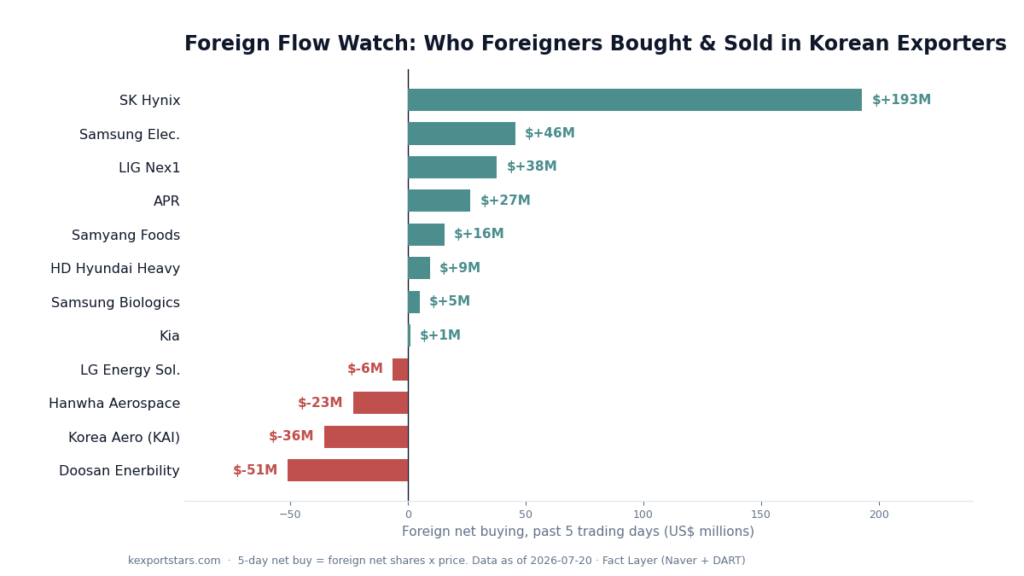
Update — 9 August 2026. Two of the three falsification tests set out in this issue failed within the following week. Issue #4 reports the scorecard and revises the read: foreign investors sold $2.44bn of SK hynix over 3–7 August, the heaviest five sessions of the window.
Key takeaways — week of 27–31 July 2026
- Foreign investors turned buyers on Thursday 30 July, at the week’s lowest closes — one session before the record rally.
- Korean retail investors did the exact opposite — buying SK Hynix through the crash, then selling $2.95bn of it into Friday’s +29.95% limit-up.
- That was profit-taking, not capitulation. Over the last 20 sessions retail is a +$2.43bn net buyer of SK Hynix while foreigners sold $3.59bn. One week does not reverse a month.
- Domestic institutions absorbed the selling: $1.74bn into SK Hynix, $1.48bn into Samsung Electronics.
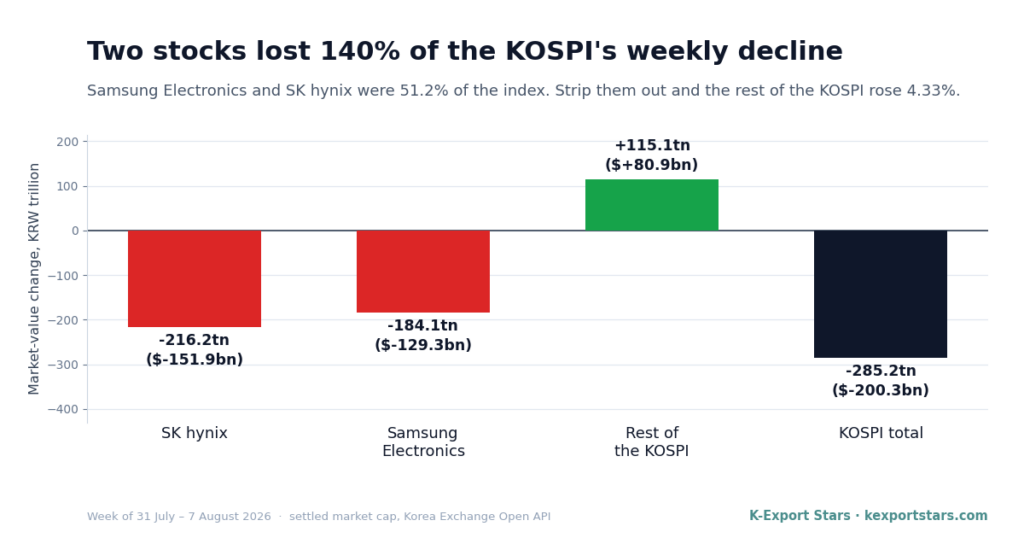
- The KOSPI fell 1.42% on the week — but KOSPI Electronics rose 0.14% while KOSDAQ Electronics fell 5.31%. The bid was size-selective.
The most important number in Korean equities last week was not Friday’s record +17.91% KOSPI session. It was Thursday. That is when foreign investors stopped selling and started buying — at the week’s lowest prices, a full session before the rally that everyone reported.
This is the third Foreign Flow Watch and follows issue #2, which covered the week of 20–24 July. The direction reversed between the two weeks, and we say so plainly below rather than quietly moving on.
Everything here is computed from settled KRX closes and daily investor net-buy data across 2,555 KOSPI and KOSDAQ common stocks. The dataset is free to download and the method is stated at the end so you can reproduce every figure.
📅 What Day Did Foreign Investors Turn Buyers in Korea?
Thursday 30 July — at the week’s lowest closes, one session before the record rally.
| Session | Foreign net | SK Hynix close |
|---|---|---|
| Mon 27 Jul | −$2.10bn | $1,264 (₩1,816,000) |
| Tue 28 Jul | −$2.95bn | $1,079 (₩1,550,000) |
| Wed 29 Jul | −$784M | $975 (₩1,401,000) |
| Thu 30 Jul | +$1.08bn | $920 (₩1,322,000) |
| Fri 31 Jul | +$5.13bn | $1,196 (₩1,718,000) (+29.95%) |
Three sessions of heavy selling, then a flip. SK Hynix closed at $920 (₩1,322,000) on Thursday and Samsung Electronics at $144 (₩207,000) — the lowest closes of the week for both. Friday’s $5.13bn came after prices had already turned.
Read only the weekly net ($377M) and you conclude “foreigners bought Korea.” Read only Friday and you conclude “foreigners chased a rally.” Neither is what the daily data shows, and this is the single clearest argument for looking at sessions rather than weeks.
🧾 Who Actually Sold Korea’s Chip Giants Last Week?
Korean retail investors — not foreigners. Foreign selling was the smaller half of the story, and domestic institutions were on the other side of both. That is the week; the section after this one shows why the week is not the trend.
| Week total | Foreign | Institutions | Retail |
|---|---|---|---|
| SK Hynix | −$601M | +$1.74bn | −$1.19bn |
| Samsung Electronics | −$484M | +$1.48bn | −$922M |
Categories are not exhaustive — other classes (corporates, non-bank financials) make up the remainder, so the three columns do not sum to zero.
Over the week institutions bought roughly 2.9 times what foreigners sold in SK Hynix — a ratio that holds for these five sessions and not beyond them (it is 0.25 over the last 20). But the retail path is the part worth sitting with:
| SK Hynix, by session | Retail net | Close change |
|---|---|---|
| Mon 27 Jul | +$475M | +3.24% |
| Tue 28 Jul | +$1.53bn | −14.65% |
| Wed 29 Jul | +$101M | −9.61% |
| Thu 30 Jul | −$344M | −5.64% |
| Fri 31 Jul | −$2.95bn | +29.95% |
Retail bought $1.53bn on the day SK Hynix fell 14.65%, kept buying as it fell another 9.61%, then sold $2.95bn into a +29.95% limit-up. Foreigners ran the mirror image of that sequence. We are not going to tell you which side was right — one week proves nothing — but the pattern is on the record, and it is not the one retail investors usually believe they are running.
Scope note: our retail series currently covers 27 large-cap tickers, not the full universe. These are name-level facts about SK Hynix and Samsung Electronics only. We do not have, and therefore do not claim, a market-wide retail figure.
🔁 Were Korea Retail Investors Really the Sellers?
Only last week. Widen the window and retail is the buyer — by a lot. We applied this test to the SK Square story below and it changed the answer, so we owe our own headline the same treatment.
| SK Hynix, foreign vs retail | Retail | Foreign |
|---|---|---|
| This week (27–31 Jul) | −$1,188M | −$601M |
| Prior week (20–24 Jul) | +$1,009M | +$645M |
| Last 20 sessions | +$2,431M | −$3,590M |
Over the last twenty sessions Korean retail absorbed $2.43bn of SK Hynix while foreigners distributed $3.59bn of it. Samsung Electronics is the same shape — retail +$862M over the same window. So the honest description of last week is not that retail turned seller. It is that retail took profit into a record rally after a month of accumulation, and foreigners did the reverse.
Whether that profit-taking was well timed is a question our data cannot answer and next week will not settle either. What we can say is that the one-week picture and the one-month picture point opposite ways, and a reader who only saw the first would draw the wrong conclusion about who has been buying Korea’s largest chipmaker.
Retail coverage is complete for the 20-session window (20 of 20 sessions). We hold a longer series but it is only populated for 31 of 47 sessions, so we do not quote a figure from it.
📊 The Scoreboard: Foreign Buys and Sells
| Top foreign buys | Foreign net |
|---|---|
| SK Square (402340) | +$510M |
| Hanmi Semiconductor (042700) | +$99M |
| Daeduck Electronics (353200) | +$70M |
| Jusung Engineering (036930) | +$67M |
| Mirae Asset Securities (006800) | +$66M |
| Hyosung Heavy Industries (298040) | +$65M |
| Kia (000270) | +$55M |
| Hanwha Ocean (042660) | +$54M |
| Top foreign sells | Foreign net |
|---|---|
| SK Hynix (000660) | −$601M |
| Samsung Electronics (005930) | −$484M |
| SK Telecom (017670) | −$108M |
| NAVER (035420) | −$74M |
| KB Financial Group (105560) | −$73M |
| PharmaResearch (214450) | −$59M |
One caveat the tables do not show, and most coverage misses. Foreigners also bought $318M of Samsung Electronics preferred shares (005935) the same week. Same company, same economic exposure, different share class. Count both and net foreign selling of Samsung was −$166M, not −$484M. Our published universe covers common shares only, which is why the preferred line sits outside the table — but leaving it out would overstate the selling by roughly three times.
🎁 SK Square: The Single Biggest Ticket of the Week
Foreigners put $510M into SK Square — the holding company whose largest asset is a 20.07% stake in SK Hynix — while selling SK Hynix itself. It is the most interesting line in the data, and also the one most easily over-read, so here is the full picture rather than the flattering slice.
Per SK Hynix’s FY2025 annual report on Korea’s DART disclosure system (as of 31 December 2025), its largest shareholder is SK Square with 146,100,000 shares — 20.07% then, and 20.00% of the 730,492,365 shares listed at 31 July 2026. Value that holding at Friday’s settled close:
| SK Hynix close, 31 Jul 2026 × 146,100,000 shares | $174.7bn |
| SK Square market cap, same close | $95.4bn |
| Discount to that one asset | −45.4% |
That comparison sets a floor, not a valuation: it ignores SK Square’s other holdings and its net debt, both of which move true NAV. Our SK Square deep dive carries a wider figure, but the gap is mostly date — that report was written in June 2026, and SK Hynix moved 27.2% from its highest to its lowest close inside this single week — not a stricter method. We are re-auditing it.
Now the part that kills the tidy story. “Foreigners rotated out of SK Hynix into the holding company” is a claim that survives exactly one window:
| Window | SK Hynix | SK Square |
|---|---|---|
| Mon–Wed (the sell-off) | −$3.65bn | +$159M |
| Thu–Fri (the turn) | +$3.05bn | +$350M |
| Last 20 sessions | −$3.59bn | +$803M |
| Full history (47 sessions) | −$20.39bn | −$2.87bn |
On the two sessions we identified as the turn, foreigners bought SK Hynix 8.7 times harder than SK Square. Over our full history SK Square is a net foreign sell. What the data supports is narrower and duller than a rotation thesis: SK Square drew the largest single foreign ticket of the week, and foreign flows into it have been positive over the past month after being negative before that. Anything beyond that is a story we would be telling you, not showing you — net flows are aggregates and do not identify counterparties.
Two more numbers for honesty: 46% of the SK Square total was struck at Friday’s +29.91% close, and Friday accounts for 87% of the Thursday–Friday SK Hynix buying. The other 13% — +$409M struck on Thursday at ₩1,322,000, the week’s low close — is the single strongest piece of evidence that foreigners turned before the rally rather than into it. Valuing net shares at each day’s close is the right method, but on a limit-up week it flatters whatever was bought last.
📉 Did the Index Show Any of This?
No — and the sector data explains why. The KOSPI fell 1.42% on the week. Underneath it:
- KOSPI Electronics & Semiconductors: +0.14% — second-best of the 23 KOSPI sectors
- KOSPI Textiles & Apparel: +1.91% (best)
- KOSPI Food, Beverage & Tobacco: −0.21% · Pharmaceuticals: −0.67%
- KOSPI Construction: −13.54% · Media & Entertainment: −11.56% · Telecom: −10.88% (worst three)
- KOSDAQ index: −3.80% · KOSDAQ Electronics: −5.31%
The same sector name finished +0.14% on the KOSPI and −5.31% on the KOSDAQ — a 5.45-point gap. That is the flow story showing up in prices: domestic institutions absorbed the large-cap chip selling, and their smaller KOSDAQ counterparts got no such bid. A single index level shows none of it.
All 44 KRX sector indices, with charts, are free at kexportstars.com/tools. As far as we can tell no other free English-language source carries them.
🔄 Why This Issue Contradicts the Last One
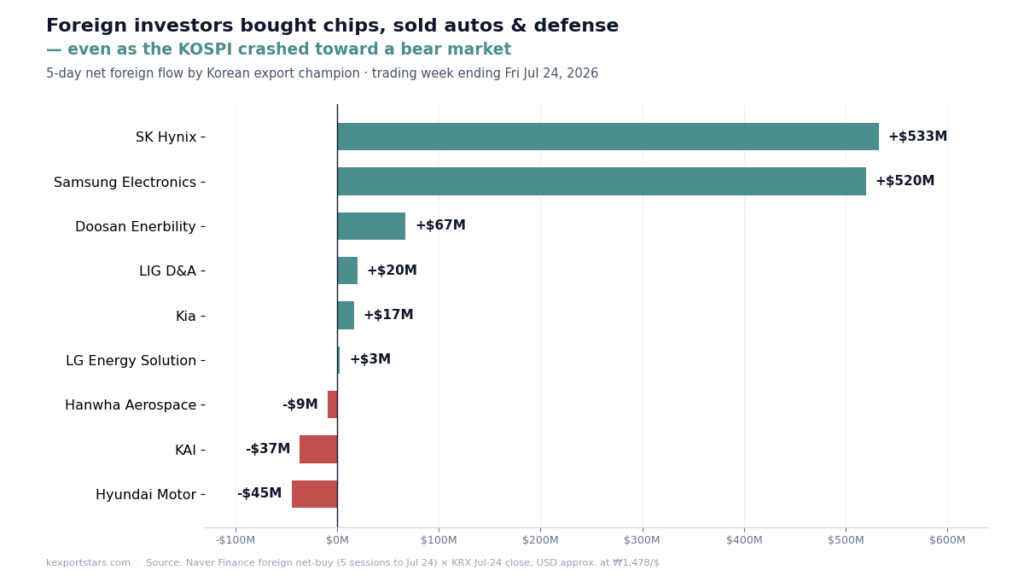
Issue #2 reported that foreigners were net buyers of the chip giants in the week of 20–24 July, printing ≈$533M for SK Hynix and ≈$520M for Samsung. Two corrections to our own prior issue. First, the direction flipped this week. Second — and this is our error, not a market change — those two figures were struck at a single price rather than at each day’s close. On the day-by-day method we use throughout, the same share counts (447,516 and 3,080,409) are worth ≈+$627M and ≈+$562M at issue #2’s own exchange rate of ₩1,478/$. That correction is now appended to issue #2.
One presentational note, so the two issues reconcile: the wider-window table above converts every window at this issue’s rate (₩1,436.6/$) so the windows stay comparable with each other, which is why the prior week reads +$645M there rather than the +$627M we have just published in issue #2. That is a 2.9% currency difference, not a different measurement.
That is the honest lesson of a weekly flow series, and we would rather state it than let two issues sit on the site implying a direction that the data does not support. Where a claim depends on the window, we will now show you the other windows in the same table.
⚠️ What Would Prove This Read Wrong
- If foreign buying stops now that prices have recovered, Thursday was a squeeze rather than accumulation, and the “they turned at the lows” framing is too generous.
- If retail keeps selling at these higher prices, last week was the start of distribution rather than profit-taking — which would be the genuine change, since the last twenty sessions say the opposite.
- If SK Square’s foreign inflow reverses within two weeks, the past month was a trade around the crash and not a positioning change.
🔭 Next Week’s Watch Points
- Does the Thursday turn hold? Persistent foreign buying at recovered prices means conviction; a stall means it was mechanical.
- Retail re-entry. After selling $2.95bn into the limit-up, whether retail chases back in is the single most informative flow next week.
- The KOSPI/KOSDAQ electronics gap. +0.14% versus −5.31% in one week. If it persists, the bid is size-selective and small-cap chip names stay unloved.
- SK Square’s discount. −45.4% against the SK Hynix stake alone at Friday’s close. We have not benchmarked that against every Korean holding company and do not claim it is the widest — only that it is worth watching from here.
📚 Lingo Check
개인 (gaein) — “retail,” literally “individuals.” Korean market data reports flows in three headline buckets: 외국인 (foreign), 기관 (institutions) and 개인 (retail). Korean retail is unusually large as a share of turnover, which is why a retail bucket appears in daily wire copy in Korea and almost never in English coverage.
지주회사 할인 (jijuhoesa halin) — “holding company discount.” Korean holding companies routinely trade below the market value of their listed stakes: dividends are taxed as they pass up the chain, holders have no direct claim on the operating asset, and governance risk sits at the parent. Korea’s Value-Up programme has turned this from an accepted fact of life into a live policy question.
🔬 Data & Method
Universe: 2,555 KOSPI and KOSDAQ common stocks (SPACs, ETFs and preferred shares excluded — hence the separate note on Samsung preferred). Flow period: the five settled sessions 27–31 July 2026. Index period: the same five sessions, measured from the previous Friday’s close (24 July) — the identical basis as the return_1w_pct field in our published sector file, so the numbers above and the numbers you download will agree. Flows: daily investor net-buy in shares from Korea Investment & Securities OpenAPI, valued at each day’s close and summed, never at a single week-end price. Retail: 27 large-cap tickers only. Prices, share counts, market caps and indices: Korea Exchange Open API, settled closes only. Shareholding: SK Hynix FY2025 annual report via DART, as of 31 Dec 2025. FX: ₩1,436.6/$.
Won values approximate traded value; we do not have execution prices. Reproduce everything from our published files: foreign-flows-latest.json, foreign-flows-aggregates.csv, korea-sectors-latest.json. CC BY 4.0 — reuse them, just cite K-Export Stars.
🎯 Why It Matters
English-language coverage of Korea reports the index and the foreign number. It rarely reports the retail bucket at all, and almost never reports the day the direction changed. Last week those two omissions were the entire story: the turn was Thursday, and the biggest seller of SK Hynix and Samsung Electronics was domestic retail, selling into the largest one-day rally in the market’s history.
Conclusion
Foreign investors stopped selling Korean stocks on Thursday 30 July, at the week’s lowest closes, one session before a record rally. Korean retail investors bought that decline and then sold $2.95bn of SK Hynix into the rebound — profit-taking at the end of a month in which they had accumulated $2.43bn of it. Domestic institutions took the other side of both — in this week. The prior week they were sellers of SK Hynix while retail and foreigners both bought, which is the whole reason we publish the wider windows alongside. Whether Thursday marked a bottom or a bounce, we will report in this series — including if it goes against what this issue implies.
Research and data, not investment advice. See our disclaimer and corrections policy.