Every few months a new Korean beauty label goes viral on TikTok, sells out at Olive Young, and mints a hot IPO. Betting on which one wins next is a coin flip. But there is one company that gets paid whether the winner is d’Alba, a Perfect Diary, or a brand that doesn’t exist yet — because it physically makes the product for all of them. Meet the arms dealer of K-beauty.
🔑 Key Takeaways
- Cosmax is the picks-and-shovels play on K-beauty. It is an ODM — it formulates and manufactures cosmetics for roughly 4,000 corporate clients worldwide (Source: DART FY2025 annual report) — so its revenue tracks the whole category, not one fragile label.
- FY2025 was a record — but read the tax line. Revenue ₩2,398.8bn (+10.7% YoY) and consolidated net income ₩131.1bn (+48.3%), yet operating income rose only +11.6% and pre-tax profit +13.7%. Most of the headline jump came from a lower tax charge (Source: DART consolidated FY2025 filing). H1 2026 has since refuted our reading of that as a one-off high base: controlling-interest net income was ₩90.3bn in six months — 73% of the entire FY2025 figure — on a 21.9% effective tax rate (Source: DART H1 2026 semi-annual report).
- It trades like an industrial, not a beauty stock. ~17.0× earnings on DART’s own EPS of ₩10,847 and a 1.8% dividend yield (₩184,600 close, as of Jul 28, 2026) — a discount to premium brand owners like Amorepacific.
- Mind the ticker, and mind the family. The business is Cosmax Inc (192820) — not holding company Cosmax BTI (044820) or supplements affiliate Cosmax NBT (222040). And inside BTI, two brothers now hold exactly 24.34% each, with their mother’s 13.83% the deciding block.
Correction, 8 September 2026. This piece was written from Cosmax’s FY2025 annual report and mid-2026 filings, and two of its judgements have since been overtaken. We argued that FY2025 net income was a tax-flattered high base rather than a run-rate, and that normalising the tax rate would move the multiple well above 17×. Cosmax’s H1 2026 semi-annual report (filed Aug 13, 2026) refutes that: controlling-interest net income of ₩90.3bn in six months, up 210.6%, at a 21.9% effective tax rate — and an annualised multiple nearer 11.6× than 17×. The guarantee book has also grown, to ₩457.3bn from the ₩393.6bn we reported, and the ratio to equity depends on which equity you use (74.7% on the FY2025 denominator the filings print; 64.4% on the Jun 30, 2026 balance sheet). We have also updated GIC’s stake, which is now below 5%, and corrected our description of Cosmax’s Value-Up participation. Figures explicitly labelled FY2025 or dated Jul 28, 2026 are unchanged and remain correct as stated. See our Corrections Policy.
💡 The “Arms Dealer” Thesis in One Line
Cosmax doesn’t own a single beauty brand — it makes products for thousands of them, which means it profits from the whole K-beauty boom instead of betting on one label winning. In a gold rush, the reliable money is in selling shovels, not panning for gold. Cosmax sells the shovels.
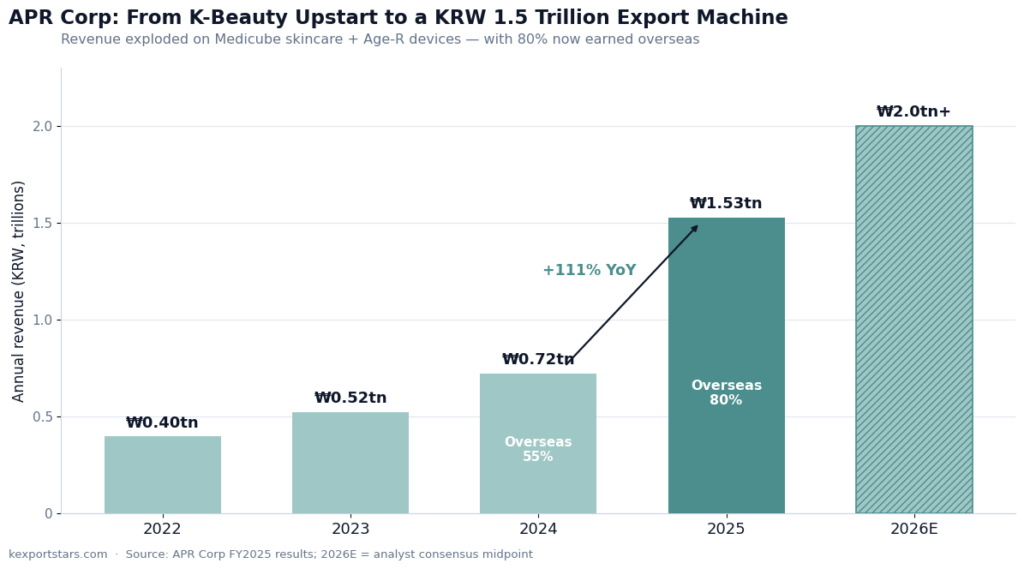
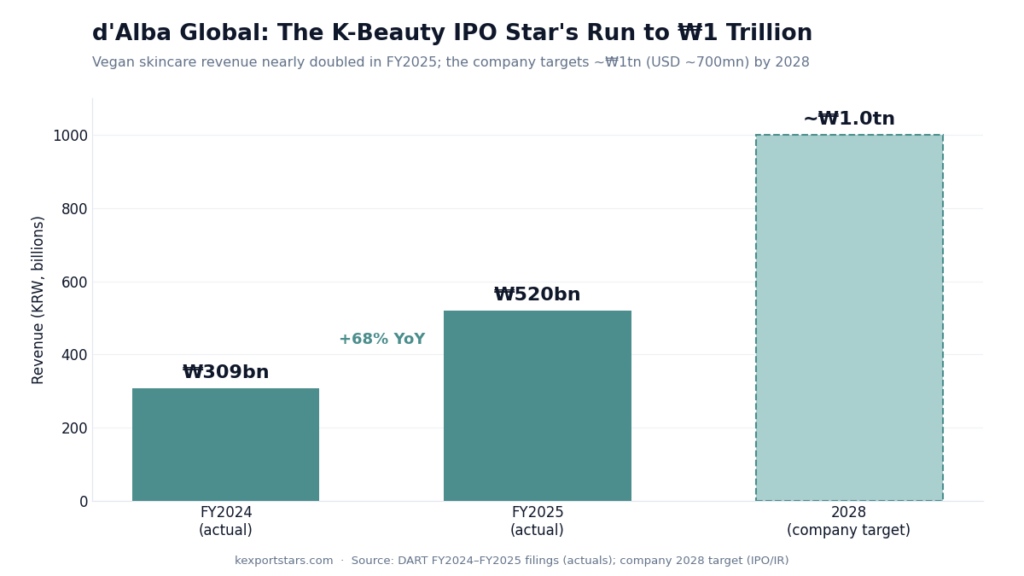
This is the opposite of a single-brand bet like d’Alba Global or APR, where the whole thesis rests on one brand staying hot. If a rival label steals d’Alba’s shelf space, d’Alba’s shareholders feel it. Cosmax likely makes products for both — so it barely notices which one is winning this quarter. Cosmax’s own FY2025 filing puts hard numbers on that diversification: no single external customer accounted for 10% or more of consolidated revenue in either FY2025 or FY2024 (Source: DART FY2025 consolidated notes, “major customers”). That is exactly what news aggregators and quote pages miss when they file Cosmax under “Korean cosmetics stock.”
🏭 What Is an ODM, and Why Does It Matter Here?
An ODM (original design manufacturer) both develops the formula and manufactures the product for a brand that puts its own name on the box — a step beyond an OEM, which only builds to someone else’s spec. When an indie label wants a new serum, it doesn’t build a lab and a factory. It goes to Cosmax, which already has the formulation, the regulatory know-how, and the production line. The brand handles marketing; Cosmax handles chemistry and scale.
Korea happens to own this layer of the global beauty supply chain. Cosmax, Kolmar Korea and Italy’s Intercos are the three cosmetics ODMs operating at genuine global scale, and two of the three are Korean. Cosmax says it supplies roughly 4,000 corporate clients across basic skincare, colour cosmetics and mask sheets, and its filing describes supplying a premium brand of “French group L”, a major Japanese brand house, and global consumer-goods majors — the names themselves are shielded by non-disclosure agreements (Source: DART FY2025 annual report, business overview). Treat any specific “Cosmax makes brand X” claim with caution unless the brand says so itself.
Cosmax added a European base in 2026, agreeing to buy 51% of Keminova, an ODM in Brescia’s “Beauty Valley” about 100km from Milan, with roughly ₩18bn of revenue and 20 million units of annual capacity — a small, customer-first entry rather than a greenfield build (announced Feb 2026; Korean press). It is a bridgehead, not yet a needle-mover.
For the bigger map of who sits where in this supply chain — brands, ODMs and retailers — see our complete guide to K-beauty stocks for global investors.
📊 Was FY2025 Really a Record Year?
Yes on revenue and reported profit — Cosmax posted its best-ever year with revenue ₩2,398.8bn and consolidated net income ₩131.1bn — but the quality of that profit is lower than the +48% headline suggests, because operating income grew only +11.6% and the rest came from below the operating line.
| Metric (Cosmax Inc, consolidated) | FY2025 | FY2024 | YoY |
|---|---|---|---|
| Revenue | ₩2,398.8bn | ₩2,166.1bn | +10.7% |
| Operating income | ₩195.8bn | ₩175.4bn | +11.6% |
| Pre-tax income | ₩156.5bn | ₩137.6bn | +13.7% |
| Income tax charge | ₩25.4bn | ₩49.2bn | −48.3% |
| Net income (consolidated) | ₩131.1bn | ₩88.4bn | +48.3% |
| Net income attributable to Cosmax owners | ₩123.1bn | ₩85.8bn | +43.4% |
| Operating margin | 8.2% | 8.1% | +0.1pt |
| Effective tax rate | 16.3% | 35.8% | −19.5pt |
| EPS (DART, controlling basis) | ₩10,847 | ₩7,562 | +43.4% |
Source: DART, Cosmax Inc FY2025 annual report (filed Mar 18, 2026), consolidated statements. Effective tax rate = income tax charge ÷ pre-tax income (our calculation from the filing).
💰 What Do You Actually Pay for Cosmax Today?
At ₩184,600 (Jul 28, 2026 close), Cosmax carries a market capitalisation of ₩2.10tn (about $1.4B) and trades at roughly 17.0× DART’s reported EPS of ₩10,847 — an industrial multiple for a company sitting at the centre of a consumer boom.
Note added 8 September 2026: that 17.0× uses FY2025 earnings. On H1 2026 results — basic EPS of ₩7,956 for the six months, annualised — the same Jul 28, 2026 close works out nearer 11.6× (Source: DART H1 2026 semi-annual report; annualisation is ours, not a company forecast). The table below is point-in-time as of Jul 28, 2026 and has not been restated.
| Valuation snapshot | Value (as of Jul 28, 2026 close) |
|---|---|
| Share price | ₩184,600 (~$124.9) |
| Shares outstanding | 11,349,509 |
| Market cap | ₩2.10tn (~$1.4B) |
| P/E on controlling-interest EPS | ~17.0× |
| P/E on consolidated net income | ~16.0× (flattering — see below) |
| Dividend / yield / payout | ₩3,300 / 1.8% / 28.6% |
| 52-week range | ₩144,900 – ₩266,000 |
| Position in range / off 52w high | 33% / −30.6% |
| Year-to-date return | +13.3% |
| Foreign ownership (of shares outstanding) | 37.4% |
Sources: KRX closing price and shares outstanding as of Jul 28, 2026; DART FY2025 for EPS (₩10,847), dividend per share (₩3,300) and the company-reported 28.60% cash payout ratio; Naver Finance for the foreign-ownership series. Market cap = 11,349,509 shares × ₩184,600. All price-derived figures are point-in-time — check a live quote before acting.
Two things stand out. First, the multiple you quote depends on which profit line you divide by. Cosmax consolidates majority-owned subsidiaries, so ₩8.0bn of FY2025 profit belonged to their minority holders, not to owners of 192820. Using consolidated net income makes the stock look like 16.0× when a 192820 shareholder is really paying 17.0×. That is the same accounting trap we unpack at much larger scale in the Kolmar Korea write-up, where the gap is ₩43bn rather than ₩8bn. Second, the stock sits about 31% below its 52-week high and near the low end of its range, up 13.3% year-to-date — well behind the profit growth, so the record year has not been re-rated. That is the value-versus-growth tension at the heart of this name.
🏷️ Which Cosmax Ticker Should You Actually Buy?
Only Cosmax Inc (192820) is the global cosmetics ODM; Cosmax BTI (044820) is the family holding company and Cosmax NBT (222040) is a health-supplements company that sits under BTI, not under Cosmax Inc. Foreign brokerages sometimes surface all three under “Cosmax,” and they are not interchangeable.
| Entity | Ticker | What it is |
|---|---|---|
| Cosmax Inc | 192820 (KOSPI) | The operating business — the cosmetics ODM. 99.98% of FY2025 revenue came from the cosmetics segment. This is the “arms dealer.” |
| Cosmax BTI | 044820 (KOSPI) | The family-controlled holding company that owns 27.23% of Cosmax Inc and is also the top shareholder of Cosmax NBT. |
| Cosmax NBT | 222040 (KOSDAQ) | The health-functional-food / supplements affiliate — a sister company held 43.95% by BTI, not a subsidiary of 192820. |
Source: DART FY2025 annual reports and large-holding reports (Cosmax Inc, Cosmax BTI, Cosmax NBT); BTI’s stake in NBT per its large-holding report filed Jul 6, 2026. Segment split per DART FY2025 consolidated note 37.
If your thesis is “K-beauty manufacturing,” the ticker you want is 192820. Buying BTI gives you the holding company — with its own discount, its own cross-holdings, and the succession question discussed below. Buying NBT gives you supplements, and it does not sit inside Cosmax Inc’s results at all.
🏛️ Who Actually Controls Cosmax — and What Do Minority Holders Get?
Cosmax Inc is controlled through the family holding company Cosmax BTI, which owns 27.23% directly (27.51% with related parties) — and inside BTI, the founder’s two sons now hold exactly 24.34% each, leaving their mother’s 13.83% as the block that decides the succession. This unresolved standoff is the single governance fact a foreign buyer of 192820 should know, and it appears in no English-language coverage we can find.
The control chain. Cosmax was founded in 1992 by Lee Kyung-soo. He is no longer among the holding company’s reported shareholders: he sold down his BTI stake in 2023 — at which point his wife, chairwoman Suh Sung-suk, became the lead reporting shareholder — and he does not appear in BTI’s June 2026 shareholder schedule at all. As of BTI’s most recent large-holding report (filed Jun 26, 2026), the family bloc holds 63.01% of Cosmax BTI, split as follows:
| Holder of Cosmax BTI (044820) | Shares | Stake |
|---|---|---|
| Lee Byung-man (elder son) — direct | 1,915,841 | 19.95% |
| SSY Co., Ltd. (100% owned by Lee Byung-man) | 421,670 | 4.39% |
| Elder-son bloc total | 2,337,511 | 24.34% |
| Lee Byung-joo (younger son) — direct | 1,010,361 | 10.52% |
| Cos M&M Co., Ltd. (100% owned by Lee Byung-joo) | 905,480 | 9.43% |
| BJH Co., Ltd. (100% owned by Lee Byung-joo) | 421,670 | 4.39% |
| Younger-son bloc total | 2,337,511 | 24.34% |
| Suh Sung-suk (chairwoman, mother) | 1,328,079 | 13.83% |
| Other related parties (foundation, executives) | 48,625 | 0.50% |
| Family bloc, total | 6,051,726 | 63.01% |
Source: DART large-holding report on Cosmax BTI, filed Jun 26, 2026 (9,603,921 voting shares outstanding). SSY and BJH were both newly incorporated in 2026 with ₩100m of capital each. Percentages as reported in the filing.
Read the table again: the two brothers’ blocs are identical to the share. That is not a rounding coincidence — SSY and BJH were incorporated in 2026 and each received precisely 421,670 shares. The mother’s residual 13.83% is therefore the swing block in any contest over the group. Lee Byung-man is an executive of Cosmax Inc; Lee Byung-joo is a registered director of the holding company, Cosmax BTI. Whichever way that 13.83% eventually moves will settle who controls the parent of the company whose shares you own. Nothing has been announced, and none of this is misconduct — but “succession unresolved at the holdco” is a live risk that a screener will never show you.
Outside shareholders. Korea’s National Pension Service is the largest outside holder at 12.85%, having added 230,966 shares over the quarter (Source: DART large-holding report filed Jul 1, 2026, position as of Jun 22, 2026). Norway’s Norges Bank is a 5%-plus holder; Singapore’s GIC has dropped below the 5% threshold. They have been moving in opposite directions, which we take up in the flow section below.
Shareholder returns. Cosmax raised its dividend to ₩3,300 per share for FY2025 from ₩2,300 for FY2024 — a 43% increase, a 1.8% yield at the Jul 28, 2026 close, and a cash payout ratio of 28.6% as reported by the company (Source: DART FY2025 dividend disclosure). That is not a token payout; it is roughly double what Kolmar Korea distributes. Cosmax is also a Value-Up participant, which we understated in the original version of this piece: it filed a corporate value-enhancement plan on Dec 3, 2025 committing to a 30% shareholder-return ratio on separate-basis net income by 2028, alongside ₩3.7tn of consolidated revenue and an 8% operating margin by the same year, plus governance items — an off-peak AGM date, a female outside director, a dividend amount fixed before the record date, and a written CEO-succession policy (Source: DART, Cosmax corporate value-enhancement plan, Dec 3, 2025; re-filed Mar 26, 2026 to flag high-dividend-company status under Article 104-27 of the Restriction of Special Taxation Act). What is genuinely missing is the other half of the reform agenda: there is no large buyback-and-cancellation programme, and cash is going into capacity — Korean nameplate capacity alone rose 31% in FY2025.
Governance risk to watch: the guarantee book. Cosmax guarantees the borrowings of its overseas subsidiaries, and the book keeps growing. On Sep 1, 2026 the board approved two more: CNY 110m for Cosmax China against a KB Kookmin Bank Shanghai loan, and US$50m for Cosmax West against a Citibank New York facility. The line that matters is not either deal but the one beneath them: the filings put Cosmax’s total outstanding guarantee balance at ₩457,299,966,651 (Source: DART, “decision to guarantee the debt of another party” (Cosmax China) and the same-day filing for Cosmax West, both Sep 1, 2026).
Be careful which equity you divide by. The guarantee filings themselves print equity of ₩612,343,808,452, and state explicitly that this is the FY2025 year-end consolidated figure — so on the filing’s own denominator the guarantee book is 74.7% of book value. Cosmax’s equity has since grown: total equity at Jun 30, 2026 was ₩710,417,732,403 (Source: DART H1 2026 semi-annual report, consolidated balance sheet), against which the same guarantees are 64.4%. Both numbers are defensible; quoting one without naming its denominator is not. Guaranteeing overseas subsidiaries is normal for a manufacturer with plants on four continents, and none of it is on-balance-sheet debt. But it is contingent liability at scale — and the concentration is worth naming: Cosmax China alone accounts for ₩138.8bn of the balance, Cosmax West ₩96.2bn and Cosmax Indonesia ₩79.8bn (same filings, debtor-by-debtor schedule). Read it before you size a position.
🌏 Is Foreign Money Buying or Selling Cosmax?
Selling, on a short view: foreigners own 37.4% of Cosmax but have been net sellers for the past 20 trading sessions, offloading 109,553 shares (including 44,272 in the last five), while Singapore’s state investors cut their stakes below the 5% disclosure threshold in July. The headline ownership number and the recent flow point in opposite directions, and most coverage quotes only the first.
The detail: GIC Private Limited reported 603,144 shares (5.314%) as of Jun 29, 2026, down 115,453 shares from its previous filing (Source: DART large-holding report, filed Jul 9, 2026). It then kept selling: a later filing puts GIC at 487,434 shares (4.295%) as of Jul 9, 2026 (Source: DART large-holding report, filed Aug 5, 2026), and the separately-reporting Government of Singapore at 490,616 shares (4.323%) as of Jul 2, 2026, down from 612,490 (5.397%) (Source: DART large-holding report, filed Aug 5, 2026). Both Singaporean entities are now below the 5% line that forces continued disclosure — which makes the selling larger than we originally reported, and harder to track from here. Pulling the other way, Norges Bank raised its holding to 6.08% on Jun 25, 2026, and the National Pension Service added over the same quarter. So this is not a stampede — it is a genuine two-sided debate among large institutions about whether a flat-margin ODM deserves a re-rating. Foreign-ownership and net-buy figures are as of Jul 28, 2026 (Source: Naver Finance foreign-flow series). For how these weekly flows read across the whole market, see our Foreign Flow Watch series.
🇨🇳 How Much Does China Still Matter?
A lot — China is both Cosmax’s biggest opportunity and its biggest swing factor, with Shanghai, Guangzhou and a Guangzhou joint venture together accounting for roughly 1.34 billion units of the group’s 2.67 billion units of annual capacity. That is half the production base pointed at one market.
Cosmax runs manufacturing corporations in Shanghai and Guangzhou serving the domestic Chinese beauty market — home to local brands and fierce price competition — plus a 342.8-million-unit joint venture with Yatsen Biotechnology in Guangzhou (Source: DART FY2025 annual report, capacity table). When China booms, Cosmax’s volumes and margins lift with it; when Chinese beauty demand softens or a plant runs at low utilisation, it drags group profit and adds foreign-exchange noise. Cosmax’s own filing flags USD, EUR and CNY as its principal currency exposures. This is why an ODM’s earnings can be lumpier than “4,000 clients” makes it sound: the client list is diversified, the factory base is not.
⚠️ The Bear Case (the ODM cohort risks)
- Structurally thin margins, and gross margin is going the wrong way. Operating margin is ~8% because the brand — not the manufacturer — captures the pricing power and the customer. Gross margin actually fell to 17.1% in FY2025 from 19.3% in FY2024; reported operating profit held up because SG&A came down. Cosmax will never carry a luxury brand’s margin.
- Profit quality, not profit level, is the question. FY2025’s 16.3% effective tax rate versus 35.8% a year earlier did more for net income than the business did — but H1 2026 shows the tax rate settling at 21.9%, not reverting to 36%, and controlling-interest EPS of ₩7,956 for the half. Annualised, that is roughly 11.6× the Jul 28, 2026 close, not 17× (Source: DART H1 2026 semi-annual report; our annualisation, not a company forecast). The live concern is different: H1 operating margin fell to 8.6% from 9.3%, so the earnings jump rests on a ₩40bn swing in financial costs rather than on operations.
- Plant concentration, not customer concentration. DART confirms no customer is 10%+ of revenue — but roughly half of capacity sits in China, so utilisation and the yuan swing group profit year to year.
- Contingent liabilities. ₩457.3bn of outstanding guarantees as of Sep 1, 2026, largely for overseas subsidiaries — 74.7% of the FY2025 equity the filing itself uses as the denominator, or 64.4% against the ₩710.4bn of equity reported at Jun 30, 2026.
- Unresolved succession at the holdco. Two sibling blocs at exactly 24.34% each of Cosmax BTI, with the mother’s 13.83% undeclared. Group-level decisions may not always put the 192820 minority shareholder first.
- Capex-led, not return-led. A 28.6% payout is respectable and the Value-Up plan targets 30% by 2028, but cash is going into new capacity and there is still no buyback-and-cancellation programme.
🗺️ Where Cosmax Sits in the ODM Landscape
Cosmax, Kolmar Korea and Italy’s Intercos are the three cosmetics ODMs at genuine global scale — and owning one of the Korean pair is the cleanest way to bet on K-beauty’s growth without picking a winning brand. Cosmax and Kolmar compete head-to-head for the same indie-brand and multinational accounts, with different geographic mixes, different business mixes, and very different governance.
We break the pair down in detail in the companion piece on Kolmar Korea stock — which is the post to read if you want the head-to-head, including why Kolmar’s consolidated earnings flatter its multiple far more than Cosmax’s do. For the contrast with the brand side of the trade — the premium houses that own the customer and the margin — see our look at Amorepacific’s valuation and China comeback. Together, the ODMs and the brands are two ways to express the same K-beauty thesis, with very different risk and margin profiles.
📚 Lingo Check
| Term | What it means | 한국어 |
|---|---|---|
| ODM | Original design manufacturer — designs/formulates and makes the product for a brand. | 제조자개발생산 |
| OEM | Original equipment manufacturer — builds strictly to the customer’s spec, no formulation. | 주문자상표부착생산 |
| Picks-and-shovels | Investing in the supplier of a boom rather than the volatile end-players — sell shovels in a gold rush. | 곡괭이·삽 투자 |
| Controlling-interest net income | The share of consolidated profit belonging to the parent’s own shareholders, after stripping out minority stakes. The right numerator for the parent’s P/E. | 지배주주순이익 |
| Effective tax rate | Income tax charge divided by pre-tax profit. A sharp fall can inflate reported net income without any operating improvement. | 유효세율 |
| Debt guarantee (contingent liability) | A promise to repay another entity’s borrowing if it defaults. Not on-balance-sheet debt, but real exposure — Korean listcos must disclose each decision. | 타인에 대한 채무보증 |
| Holding-company structure | A parent holdco controls the listed operating company, entrenching founder control — a Korea Discount driver. | 지주회사 구조 |
| Korea Discount | Korean stocks trading below global peers, blamed on governance and shareholder-return gaps. | 코리아 디스카운트 |
🎯 Why It Matters for K-Export Stars
Cosmax is a near-perfect fit for this site’s thesis: a Korean export champion selling into a global boom, sitting one layer below the brands the world already knows. It is a pure export-manufacturing play — the kind of company an owner-operator would call a real business, not a story. And it is the clearest single-stock way to own K-beauty’s structural growth without gambling on which label trends next quarter. It is also a case study in why we read the Korean filings rather than the English press release: the wires reported a record year, while the filings show a flat-to-falling operating margin, an earnings jump that came from financial items rather than the factory, ₩457.3bn of guarantees, and two brothers deadlocked at 24.34% apiece. None of that makes Cosmax uninvestable. It makes it a stock you should size with your eyes open.
Conclusion
Cosmax (192820) lets you own the entire K-beauty supply chain instead of one fragile brand — record FY2025 revenue of ₩2,398.8bn at roughly 17.0× earnings, with the stock still 31% off its 52-week high (as of Jul 28, 2026). The bull case is structural: as long as indie brands keep launching, someone has to make the product, and only three companies do it at global scale. The bear case is equally structural: flat-to-falling ~8% operating margins, a profit line driven by financial items rather than operations, half the capacity pointed at China, ₩457.3bn of guarantees (as of Sep 1, 2026), and a holding-company succession that has not been settled. Just make sure you buy the right ticker — the ODM is 192820, not BTI (044820) or NBT (222040). For the full landscape, start with our K-beauty stocks guide, and if you are new to the mechanics, how to buy Korean stocks as a foreign investor.
Disclaimer: This article is for informational and educational purposes only and is not investment advice, a recommendation, or a solicitation to buy or sell any security. Figures are drawn from official DART filings, KRX market data and company disclosures as of the dates noted, and may since have changed; prices and valuations are point-in-time and go stale quickly. Always verify current data and consult a licensed financial professional before making any investment decision. The author holds no position in the securities mentioned at the time of writing.
Written by James Ju — a Seoul-based engineer who reads Korean-language DART and KRX filings, the primary sources most English-language coverage skips. About the author.