📌 As of 3 July 2026 — a point-in-time view. Financials corrected 30 Aug 2026.
✏️ Corrected 30 Aug 2026 — this article described a company that no longer existed in the form it described. Samsung Biologics spun off its biosimilar arm on 1 November 2025, which changed the share count, the revenue base and the peer comparison all at once.
- Samsung Bioepis is not a subsidiary. It was separated on 1 Nov 2025 into a new listed entity, Samsung Epis Holdings, in a horizontal spin-off. Samsung Biologics’ shares outstanding fell from 71,174,000 to 46,290,951 — a 35% reduction that invalidates any per-share figure calculated on the old count.
- The revenue table matched neither the old basis nor the new one. We printed ₩4.3tn for 2024 and ₩4.7tn for 2025. As originally reported, FY2024 revenue was ₩4.547tn; restated for the spin-off it is ₩3.497tn, and FY2025 continuing-operations revenue is ₩4.557tn.
- The operating margins were roughly half the filed figures. We printed 20.1% / 22.2% / 25.0%. The filed continuing-operations margins are 41.0% (FY2023), 37.8% (FY2024) and 45.4% (FY2025).
- The capacity figures and their tense were wrong. “784,000 litres in 2025 and 964,000 upon Plant 5’s integration” should be 785,000 litres at Songdo — and Plant 5 was already running, not under construction. The 845,000-litre global figure depends on an acquisition that had not closed.
- The Biosecure section named the wrong company. The article said the Act targets WuXi AppTec and then benchmarked Samsung against WuXi Biologics. These are two separate listed companies, and the distinction decides whether the thesis works at all.
- The peer multiples are removed. They carried no source, and one of the four peers — Catalent — had ceased to trade as a listed company after Novo Holdings completed its acquisition in December 2024, so a mid-2026 forward P/E for NYSE: CTLT could not exist.
Second pass, 30 Aug 2026 — an independent re-check found that the corrected version committed the very error it had just warned about, and the valuation section has been rebuilt.
- The headline multiple was stated as “53.4× its filed FY2025 earnings” with no label. That divides today’s price by an EPS struck on a weighted-average count of 67,010,390 shares — 45% more than the 46,290,951 used for the market capitalisation in the same table. The article had warned three paragraphs earlier that per-share figures on the old count are invalid.
- The valuation table and the risk and conclusion sections now show the full range, 36.9× to 59.0×, name 40.7× (market capitalisation ÷ continuing-operations profit) as the like-for-like figure, and explain what separates them. No underlying financial figure changed.
Sources for the replacement figures: DART, Samsung Biologics FY2025 business report, filed 12 Mar 2026, rcpNo 20260312001119 (amended 15 May 2026 as rcpNo 20260515001658), and the OpenDART financial-statement API for that filing and for the FY2024 report. That is the same filing this article already linked to in its table header. Our corrections policy.
- 🔀 The FY2024 revenue line was restated down 23% and almost nobody adjusted for it. Compare FY2025’s $2.95bn to the FY2024 figure as originally published and growth looks like +0.2%. Compare it to the restated continuing-operations base and it is +30.3%. Same company, same year, two answers. (Source: DART rcpNo 20260312001119 vs the FY2024 report)
- 📉 Utilisation went down, not up. The filing’s own batch table: 71.4% (2023), 75.2% (2024), 70.9% (2025) — because capacity grew faster than output. Any “locked-in high utilisation” claim has to survive that table.
- 🇺🇸 Revenue from US-based customers did double, from $0.53bn to $1.12bn, taking the Americas from 23.5% to 38.0% of revenue. That is the real number behind the Biosecure story.
- ⚖️ But the Act is not operating yet. WuXi Biologics — Samsung’s actual competitor, and the one its own filing names as a peer — is not on the Pentagon list the law keys off. WuXi AppTec, a different company, is.
💵 Price at writing — KRX settled close, 3 July 2026: $921 (₩1,421,000)
🎯 Target discussed in the original report (3 July 2026): $1,264 (₩1,950,000)
📈 Implied gap to that target at the time: 37.2%
Preserved as the point-in-time record of what this report said. Neither figure is a current view, and we do not publish target prices. The ₩1,421,000 figure is the KRX settled close for 3 July 2026, verified against exchange data; the original box printed it twice with two different values (₩1,421,000 and ₩1,420,000), and the original text dated it only as “June 2026”, which was wrong — the price is the last settled close before publication. FX ₩1,542/$ throughout this correction (USD/KRW, 2 Jul 2026).
*Market report as of 3 July 2026 · financials corrected 30 August 2026*
Samsung Biologics Valuation: CDMO Super-capacity and Biosecure Act Tailwind
Samsung Biologics (KRX: 207940) was incorporated on 22 April 2011 and is the world’s largest contract development and manufacturing organisation by bioreactor volume (Wikipedia; incorporation date per its FY2025 business report). It runs a single enormous manufacturing complex in Songdo, Incheon, making commercial-scale biologics — principally monoclonal antibodies — for global pharmaceutical companies.
As of November 2025 it is also a different company from the one most English-language coverage describes. It separated its biosimilar business and is now a pure-play CDMO. This report works through what that separation did to the accounts, what the capacity actually is, what the US Biosecure Act has and has not delivered, and what an investor was paying in mid-2026.
🔀 What Happened to Samsung Bioepis?
It left. On 1 November 2025 Samsung Biologics completed a horizontal spin-off, placing Samsung Bioepis and the group’s other investments into a newly created listed company, Samsung Epis Holdings — so Bioepis is no longer a Samsung Biologics subsidiary, and has not been since that date.
The original version of this article described Bioepis as a “wholly-owned subsidiary” and treated its biosimilar growth as part of the investment case. That was already out of date when the article was published. The filing sets out the timetable precisely:
| Step | Date |
|---|---|
| Board resolution to create Samsung Epis Holdings by spin-off | 22 May 2025 (material-event report) |
| Shareholder meeting approving the split plan | 17 October 2025 |
| Split date | 1 November 2025 |
| Re-listing of the changed and new entities | 24 November 2025 |
Source: DART rcpNo 20260312001119, “회사의 법적·상업적 명칭” and the corporate-history schedule.
The share-count effect is the part that breaks models silently. Samsung Biologics’ issued shares went from 71,174,000 to 46,290,951 — the filing states the reduction as 24,883,049 shares — with treasury of 51,433 leaving 46,239,518 in circulation. Paid-in capital fell from ₩177,935,000,000 to ₩115,727,377,500. A per-share figure computed on the old share count understates the correct one by 35%. It also cuts the other way in a valuation: an EPS struck on a weighted-average count that still contains ten months of the old share base inflates any P/E computed against today’s price. We work through that below.
📈 What Do the Financials Look Like After the Split?
Revenue of $2.95bn and a 45.4% operating margin in FY2025 — on a continuing-operations basis that restates the two prior years downward, because the biosimilar business has been stripped out of them too.
| Consolidated, continuing operations, as filed in the FY2025 report | FY2023 | FY2024 | FY2025 |
|---|---|---|---|
| Revenue (매출액) | $1.91bn | $2.27bn | $2.95bn |
| Operating profit (영업이익) | $0.78bn | $0.86bn | $1.34bn |
| Operating margin | 41.0% | 37.8% | 45.4% |
| Profit from continuing operations (계속영업이익) | $0.62bn | $0.67bn | $1.05bn |
| Profit for the year, incl. discontinued (당기순이익) | $0.56bn | $0.70bn | $1.16bn |
| Basic EPS — continuing / discontinued | $8.65 / −$0.83 | $9.48 / $0.39 | $15.62 / $1.65 |
| Total equity, year-end (자본총계) | $6.37bn | $7.07bn | $4.83bn |
Source: DART, Samsung Biologics FY2025 business report (rcpNo 20260312001119), consolidated statements, via the OpenDART financial-statement API. There are no non-controlling interests, so all profit is attributable to owners. Won amounts as filed: revenue ₩2,938,756m / ₩3,497,146m / ₩4,556,972m; operating profit ₩1,205,546m / ₩1,321,366m / ₩2,069,221m; continuing-operations profit ₩949,062m / ₩1,040,302m / ₩1,614,330m; profit for the year ₩857,691m / ₩1,083,316m / ₩1,784,352m; basic EPS continuing ₩13,334 / ₩14,616 / ₩24,091 and discontinued −₩1,284 / ₩605 / ₩2,537; equity ₩9,830,492m / ₩10,904,676m / ₩7,451,111m. Margins are our arithmetic. FX ₩1,542/$; dollar figures rounded independently. Note that the equity fall in FY2025 is the spin-off distribution, not a loss.
The restatement trap
This is the part worth slowing down for, because it produces two defensible-looking growth rates that differ by a factor of 150.
Samsung Biologics’ originally reported FY2024 consolidated revenue, in the business report filed in March 2025, was ₩4,547,322m. The FY2025 report restates that same year to ₩3,497,146m, because Bioepis is reclassified as a discontinued operation and pulled out of the comparative. The difference — ₩1.05tn, a 23.1% reduction — is the biosimilar business.
| How you compute FY2025 revenue growth | Answer |
|---|---|
| FY2025 ₩4.557tn against FY2024 as originally reported (₩4.547tn) | +0.2% |
| FY2025 ₩4.557tn against FY2024 restated for continuing operations (₩3.497tn) | +30.3% |
The second is the correct like-for-like comparison. The first is what a database returns if it stored the FY2024 figure before the restatement and never refreshed it, and it is a plausible way to conclude that a 30%-growth business has stopped growing. Neither number is fabricated; they answer different questions, and only one of them compares the same set of factories in both years.
Note: the chart that originally sat here plotted the incorrect revenue and margin series and has been removed. The filed data is in the tables above.
🏭 How Much Capacity Does Samsung Biologics Actually Have?
785,000 litres at Songdo as of the FY2025 report, across five plants that are all built and running — and 845,000 litres only once a US acquisition that had not yet closed completes.
| Site | Capacity | Status at the report date |
|---|---|---|
| Songdo Plant 1 | 30,000 L | Operating |
| Songdo Plant 2 | 155,000 L | Operating; a 1,000 L bioreactor was added in 2025 |
| Songdo Plant 3 | 180,000 L | Operating |
| Songdo Plant 4 | 240,000 L | Operating |
| Songdo Plant 5 | 180,000 L | Brought into full operation during 2025 — not under construction |
| Songdo total | 785,000 L | Owned and operating |
| Rockville, Maryland | 60,000 L | Acquisition of Human Genome Sciences Inc. (a GSK subsidiary) agreed December 2025; “인수 절차를 진행 중” — in progress at the report date |
| Stated global total | 845,000 L | The filing’s own wording is “증가될 전망” — expected to increase to. It is a forward figure, not a current one. |
Source: DART rcpNo 20260312001119, “영업개황” and “사업의 개요”. The original version of this article gave 784,000 L for 2025 and 964,000 L “upon Plant 5’s integration”; neither figure appears in the filing, and Plant 5 was already integrated.
And is the capacity being used?
Less of it, proportionally, than a year earlier. The filing publishes utilisation on a batch basis, and it fell in 2025:
| Drug-substance production (batches) | 2023 | 2024 | 2025 |
|---|---|---|---|
| Capacity | 733 | 833 | 1,034 |
| Output | 523 | 626 | 733 |
| Utilisation | 71.4% | 75.2% | 70.9% |
Source: DART rcpNo 20260312001119, “생산능력, 생산실적, 가동률”. The filing explains that capacity is computed from available production hours after planned slowdowns and product changeovers.
Output rose 17% in 2025. Capacity rose 24%. That is what bringing an 180,000-litre plant online looks like in the year you bring it online, and it is not, by itself, a problem — a CDMO builds ahead of demand or it has nothing to sell. But it is the opposite of the picture the original version of this article painted, in which fixed-cost dilution from rising utilisation was driving margins up. Margins did rise sharply in 2025. Utilisation did not.
💡 Lingo Check: CDMO, Spin-off and the Biosecure Act
| Term | What it means |
|---|---|
| CDMO 위탁개발생산 |
A contractor that develops and manufactures drugs for other pharmaceutical companies, from cell-line development through commercial batches. It sells factory time and know-how, not drugs of its own. |
| Horizontal spin-off 인적분할 |
A Korean corporate split in which existing shareholders receive shares in the new company pro rata, so both entities end up with the same shareholder register. Contrast the vertical form (물적분할), where the parent keeps 100% of the new subsidiary. The difference matters enormously to minority holders, and the horizontal form is the shareholder-friendly one. |
| Discontinued operations 중단영업 |
A business being disposed of or spun off, reported on a separate line — and stripped out of the prior-year comparatives too. This is why a company’s own reported revenue for the same past year can change between two filings. |
| 1260H list 중국 군사기업 목록 |
The US Department of Defense’s list of “Chinese military companies”. The enacted Biosecure Act does not name companies; it works by reference to this list, which is why which WuXi entity is on it decides everything. |
🧪 Has the Biosecure Act Actually Delivered a Windfall?
Not yet, and not in the way this article originally described. The Act is law, but the company Samsung Biologics competes with is not designated under it, and the restrictions it does impose apply to US federal procurement rather than to private pharmaceutical companies’ commercial sourcing.
Here is the corrected chain of facts, in order:
- The Act became law on 18 December 2025, folded into the FY2026 National Defense Authorization Act. Coverage that still treats it as pending is out of date.
- The enacted text names no company. Earlier drafts listed WuXi AppTec, WuXi Biologics, BGI and others by name. The law as passed works by reference to the Department of Defense’s Section 1260H list.
- On 8 June 2026 the Pentagon added WuXi AppTec to the 1260H list. WuXi Biologics was not added.
- These are two different companies. Both were carved out of the former WuXi PharmaTech and both are separately listed. WuXi Biologics is the biologics CDMO — the one Samsung competes with, and the one Samsung’s own filing names as a peer. WuXi AppTec is the other one. The original version of this article named AppTec as the target and then benchmarked Samsung against Biologics in the same piece.
- The clock is slow. Even for a designated entity, the Office of Management and Budget must publish the operative list by December 2026, issue guidance within 180 days after that, and the FAR Council then has a year to write it into procurement rules.
⚠️ What this means for a model. Any forecast that has already booked displaced Chinese volume into Samsung Biologics’ revenue is modelling something that has not happened. The Act may yet matter — designations can change and commercial buyers do read political signals — but as of mid-2026 there is no mechanism in force that redirects a single commercial batch.
What is in the numbers
The US shift is visible in the revenue split, whatever is causing it. Revenue from customers in the Americas more than doubled:
| Revenue by region of customer (continuing operations) | FY2024 | FY2025 | Change |
|---|---|---|---|
| Americas | $0.53bn (23.5%) | $1.12bn (38.0%) | +110.8% |
| Europe | 58.2% | 52.0% | — |
| Korea | 16.0% | 8.2% | — |
| Other | 2.3% | 1.8% | — |
Source: DART rcpNo 20260312001119, segment note “지역에 대한 공시” and the narrative regional split in “영업개황”. Won as filed: Americas ₩822,632m (FY2024) → ₩1,733,922m (FY2025); totals ₩3,497,146m → ₩4,556,972m. The percentage rows are the filing’s own; the Europe and Korea shares are stated in the narrative rather than broken out in won for both years. This is revenue by the region of the contracting customer, not by where the drug is sold.
And the contract announcements behind it are large and specific. The filing’s corporate-events schedule records four CMO contracts signed in 2025: ₩2,074.7bn ($1.35bn) with a US pharmaceutical company on 14 January, ₩737.3bn ($478M) with a US company on 28 April, ₩102.5bn ($66M) with a European company on 10 June, and ₩1,800.1bn ($1.17bn) with a US company on 9 September. That is $2.99bn of announced US contract value in a single year.
We are not going to attribute those wins to the Biosecure Act, because nothing in the filing does. The honest statement is narrower and still useful: US demand for Samsung’s capacity rose sharply in 2025, and it did so before the Act had any operative effect.
🔬 ADC and Next-generation Modalities
The original version of this article said the dedicated antibody-drug-conjugate facility was “scheduled to begin commercial operations by late 2026”. The filing says it was completed and GMP-ready by the end of the first quarter of 2025, alongside the mRNA production facility that started up in 2022.
What is still ahead: an ADC drug-product line and a prefilled-syringe mother line, both planned by 2027. Samsung signed a fixed-price construction contract with a Korean builder on 14 November 2025 for the ADC drug-product plant extension, total value ₩52.4bn excluding VAT ($34M). Separately, the company has secured land for a third bio-campus in Songdo and confirmed an investment plan of roughly ₩7tn ($4.5bn) through 2034. (Source: DART rcpNo 20260312001119)
Samsung is the factory side of the ADC market; for the platform side — the Korean company that designs ADCs, licensed two of them to J&J and Ono, and has since been buying rights rather than selling them — see our LigaChem Bio deep dive.
⚖️ What Did You Actually Pay for Samsung Biologics in mid-2026?
At ₩1,421,000 the honest answer is a range, not a number: 36.9× to 53.4× FY2025 earnings, depending on which share count you put in the denominator, and 8.8× the book value of equity. The like-for-like figure — today’s market capitalisation against the profit of the business that remains — is 40.7×. On any of them it is a growth premium that has to be earned by the order book rather than by a regulatory tailwind that is not yet operating.
| Samsung Biologics (207940), at ₩1,421,000 | Value |
|---|---|
| Market capitalisation (46,290,951 shares) | $42.65bn |
| P/E — market cap ÷ FY2025 profit for the year (₩1,784,352m) | 36.9× |
| P/E — market cap ÷ continuing-operations profit (₩1,614,330m) ← like-for-like | 40.7× |
| P/E on the filed total basic EPS (₩26,628, struck on 67,010,390 weighted-average shares) | 53.4× |
| P/E on the filed continuing-operations EPS (₩24,091, same weighted average) | 59.0× |
| Book value per share (equity ₩7,451,111m) | $104 (₩160,963) |
| P/B | 8.83× |
| Operating margin, FY2025 | 45.4% |
| Net margin, FY2025 | 39.2% |
| Return on equity, FY2025 | 16.4% on opening equity / 23.9% on closing |
Our arithmetic on filed inputs. Read the ROE row carefully: year-end equity fell by ₩3.45tn during FY2025 — the spin-off distribution, partly offset by the ₩1.78tn earned in the year — so an average-equity ROE is not meaningful for this year and we have given both endpoints instead of picking one. Price: settled close from the Korea Exchange (KRX), 3 Jul 2026. Share count 46,290,951 per the FY2025 share-total schedule; weighted-average count 67,010,390 per note 29 of the consolidated statements (주당이익, “earnings per share”).
Why This Stock Has Two P/Es, and Which One to Use
Use 40.7× if you want the multiple on the company you can actually buy; a data-vendor screen will show you 53×, and the 45% gap between them is entirely the spin-off.
The filing’s basic EPS of ₩26,628 is struck on a weighted-average share count of 67,010,390 — because the demerger took effect on 1 November 2025, the year ran on 71,174,000 shares for ten months and on 46.29 million for two. The filing reconciles it explicitly: 71,174,000 opening, minus 5,073 for treasury movement, minus 4,158,537 for the spin-off, equals 67,010,390. But the market capitalisation you pay is struck on the 46,290,951 shares that exist today. Dividing a current price by an EPS built on 45% more shares inflates the multiple — which is exactly the trap this article warned about two sections earlier, and then walked into in its own headline. (Source: DART rcpNo 20260312001119, consolidated note 29.)
Keeping both sides on one basis fixes it. Market capitalisation of ₩65.78tn divided by FY2025 profit for the year (₩1.784tn) is 36.9×; divided by continuing-operations profit only (₩1.614tn) it is 40.7×. We prefer the second: the ₩170bn gap between them is discontinued-operations profit earned by the biosimilar arm that Samsung Biologics shareholders no longer own. Counting that profit as earnings while the price in front of you reflects only the remaining company overstates what you are buying. All four rows are printed above because a reader checking our number against a screen will usually see 53×, and should know why it differs.
On the peer comparison
The original version of this section listed forward P/E, EV/EBITDA and ROE figures for Lonza, WuXi Biologics and Catalent. Those figures carried no source, and Catalent had ceased trading as a listed company after Novo Holdings completed its acquisition in December 2024 — so one row of that table described a security that did not exist on the stated date. We have removed the whole set rather than replace unsourced numbers with different unsourced numbers.
What we can source is the peer group itself, because Samsung names it. The filing states that the CDMOs with global capacity above 300,000 litres in 2025 are Samsung Biologics, Lonza (Switzerland), WuXi Biologics (China) and FUJIFILM Biotechnologies (a FUJIFILM Holdings subsidiary, Japan), and it notes that FUJIFILM Biotechnologies is expanding aggressively outside Japan. Two caveats belong with that: litres are not market share, and “largest by capacity” is only the right metric while the medicines the world wants are made in bioreactors. (Source: DART rcpNo 20260312001119)
⚠️ Potential Risk Factors
⚠️ The premium rests on utilisation, and utilisation fell in 2025 — and it fell again in the first half of 2026, to 69.9%, while the company raised $2.18bn with 90% of it earmarked for an acquisition rather than capacity (the rights offering, decoded). At 40.7× the earnings of the continuing business — 53× on the filed per-share figure, see the table above — and nearly 9× book, the market is paying for the next several years of order intake. This is a business with heavy fixed costs in depreciation and skilled labour: a shortfall in bookings hits the margin line quickly, and the 70.9% utilisation figure is the number to watch, not the litre count.
- The Biosecure tailwind is not in force. Restrictions apply to federal procurement, the operative list is not due until December 2026, and the direct competitor is not designated.
- Manufacturing location risk. The filing states the exposure plainly: with production concentrated in Korea, a US pharmaceutical tariff would erode Samsung’s price competitiveness against rivals manufacturing inside the United States — and it names them, including Lonza’s Texas plant and California acquisition and WuXi Biologics’ Massachusetts build-out.
- Client concentration. A large share of revenue sits with a handful of global pharmaceutical majors; losing or downsizing one contract moves utilisation directly.
- Execution. The Rockville acquisition had not closed, and the ADC drug-product and prefilled-syringe lines are 2027 projects.
🎯 Why It Matters for K-Export Stars
Samsung Biologics is the case that shows why a Korean filing has to be read rather than summarised. A spin-off completed in November 2025 changed the share count by 35%, restated the prior year’s revenue down by 23%, and turned a diversified biotech into a pure contract manufacturer — and none of that is visible in an English-language database row. Neither is the utilisation table, which contradicts the growth story most coverage tells. Neither is the distinction between two Chinese companies with the same first word in their names, on which an entire investment thesis turns.
🛡️ Conclusion
Conclusion
Samsung Biologics in mid-2026 was a pure-play CDMO with 785,000 litres of operating capacity, 45.4% operating margins, revenue growing 30% on a like-for-like basis, and a doubling of business from US customers — priced at 40.7× the earnings of the continuing business (53× on the filed per-share figure) and nearly 9× book. The growth is real and the margins are exceptional. The regulatory tailwind that the original version of this article treated as the central catalyst was not, on the record, operating.
The number that decides the next few years is utilisation, which fell to 70.9% in 2025 as Plant 5 came online. Filling it is the whole job. We publish no rating and no target price.
Disclaimer: This report is for informational and educational purposes only and does not constitute investment advice. Figures are point-in-time and were correct as of the dates stated. Investors should conduct their own research before making financial decisions.
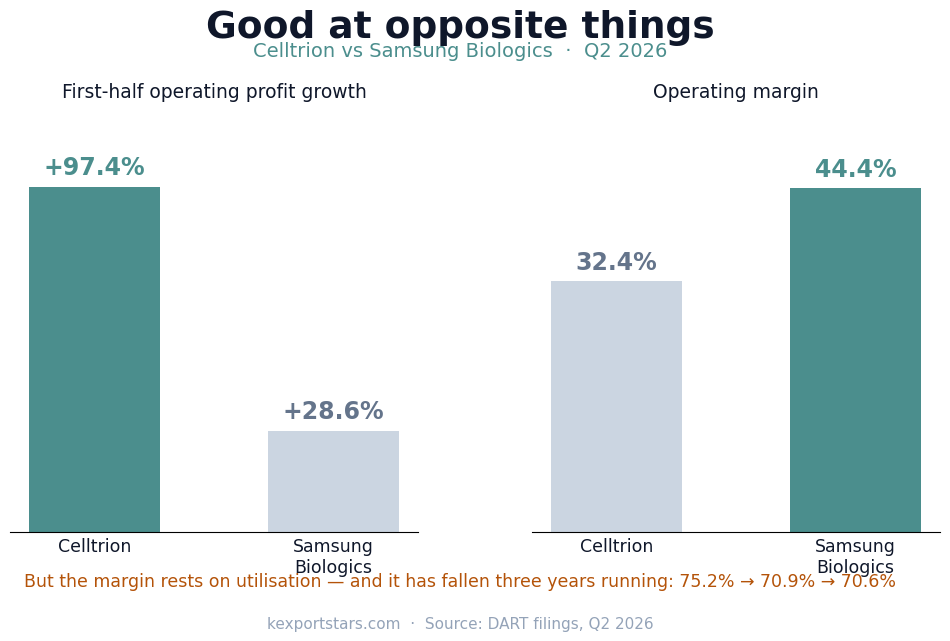
The other model in Korean bio. Samsung Biologics makes other companies’ drugs; Celltrion develops and sells its own biosimilars — 28.1% operating margin against Samsung Biologics’ 45.4%, and a very different balance sheet. Our Celltrion deep dive covers the share cancellation that its own share count hides.
Written by James Ju — a Seoul-based engineer who reads Korean-language DART and KRX filings, the primary sources most English-language coverage skips. About the author.